I have just finished a commentary on the Luxembourg Court’s judgment in Quotal (judgment of the Court of Justice of 4 June 2026, C-198/25), which I hope will be published in the coming months.
Here I am posting an advance English version of that commentary (translated by Claude Opus 5).
The subject is fairly technical. It looks at how the principle of procedural autonomy and the requirement of effectiveness of EU law «compete» in a very specific problem: judicial remedies against administrative decisions on asylum applications (international protection). From there, it examines the role of the reviewing court and the requirements flowing both from EU legislation and from the case-law of the Luxembourg Court. It analyses, in particular, the procedural rules of the Netherlands and of Spain and the way in which they meet the requirements of EU law. It also deals with the replacement of Directive 2013/32/EU by Regulation (EU) 2024/1348.
Despite how specific the topic is, as I was writing the commentary — while examining the relationship between the principle of procedural autonomy, on the one hand, and the effectiveness of EU law, on the other — a scene from El viaje a ninguna parte, Fernando Fernán Gómez’s film, kept coming to mind.
Acabo de terminar un comentario a la sentencia Quotal del Tribunal de Luxemburgo (STJ de 4 de junio de 2026, C-198/25) que espero que se publique en los próximos meses.
Aquí adelanto una versión en inglés de dicho comentario (traducción hecha por Claude Opus 5).
El tema es bastante técnico. Se trata de ver en qué forma «compiten» el principio de autonomía procesal y la exigencia de efecto útil en un problema muy específico: los recursos judiciales contra las decisiones de la administración en relación a las peticiones de asilo (protección internacional). A partir de ahí se examina el papel del órgano jurisdiccional revisor y las exigencias tanto de la normativa de la UE como de la doctrina del Tribunal de Luxemburgo. Se analiza, en concreto, la regulación procesal de los Países Bajos y de España y la forma en que se adecuan a las exigencias del Derecho de la UE. También se trata el desplazamiento de la Directiva 2013/32/UE por el Reglamento (UE) 2024/1348.
Pese a lo específico del tema, a medida que escribía el comentario, al examinar la relación entre, por una parte, el principio de autonomía procesal y, por otra parte, el efecto útil del Derecho de la UE, me venía a la cabeza una escena de «El viaje a ninguna parte», la película de Fernando Fernán Gómez.
La propuesta de régimen 28 en materia de sociedades está atrayendo la atención tanto de académicos como de prácticos. Aquí comparto una breve nota sobre dicha propuesta. El comentario se centra en la forma en que ese régimen 28 propuesto enlaza la evolución legislativa sobre formas societarias europeas con la jurisprudencia del Tribunal de Luxemburgo en materia de libertad de establecimiento. La tesis que sostengo es que la propuesta de régimen 28 es un paso para el cambio de paradigma: del conflicto como problema al conflicto como solución. O, si se prefiere, de la pluralidad como dificultad a la pluralidad como ventaja. Este es el PDF de la contribución.
I. La imposición del catalán como lengua vehicular y de aprendizaje (y la correlativa exclusión del español)
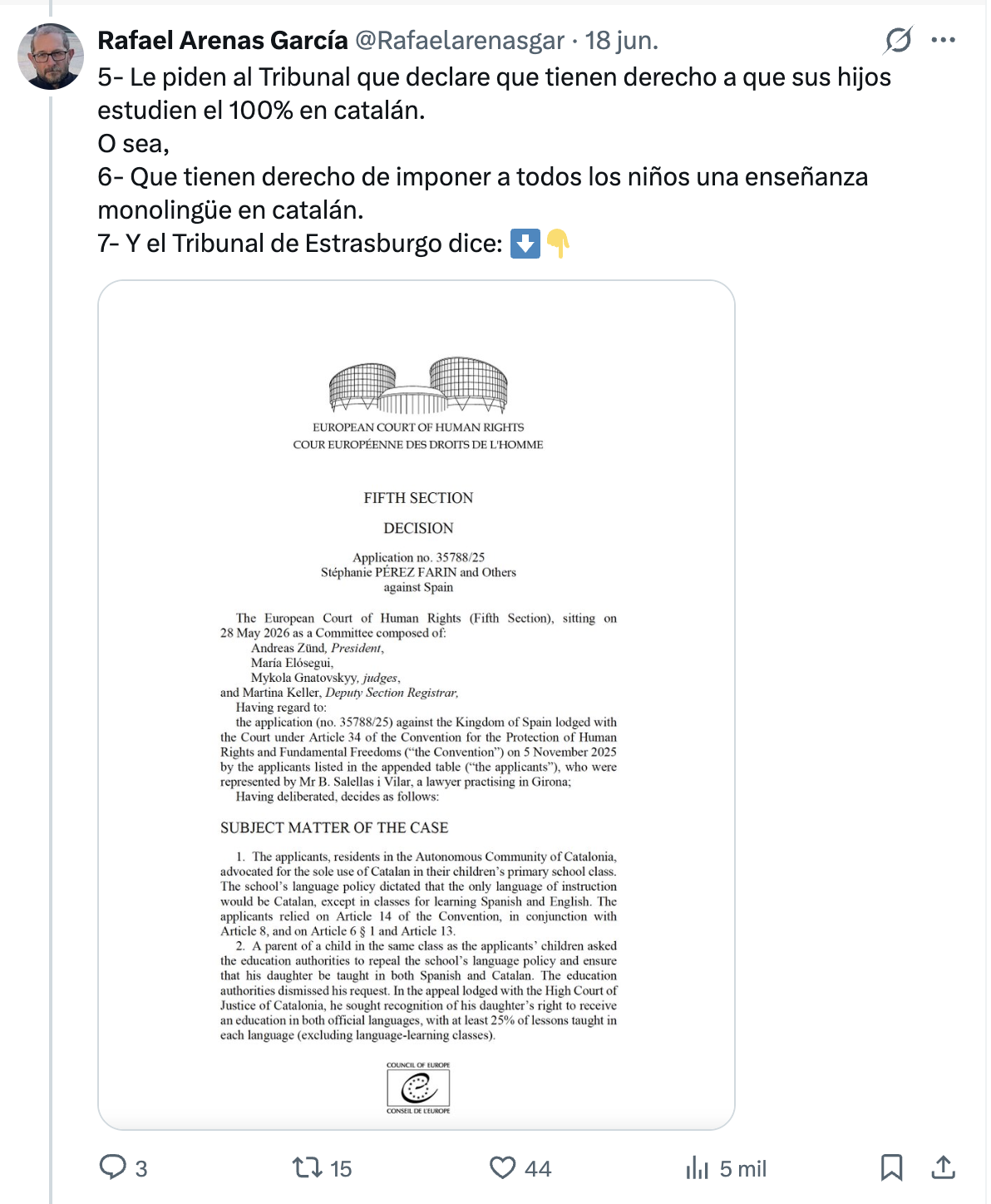
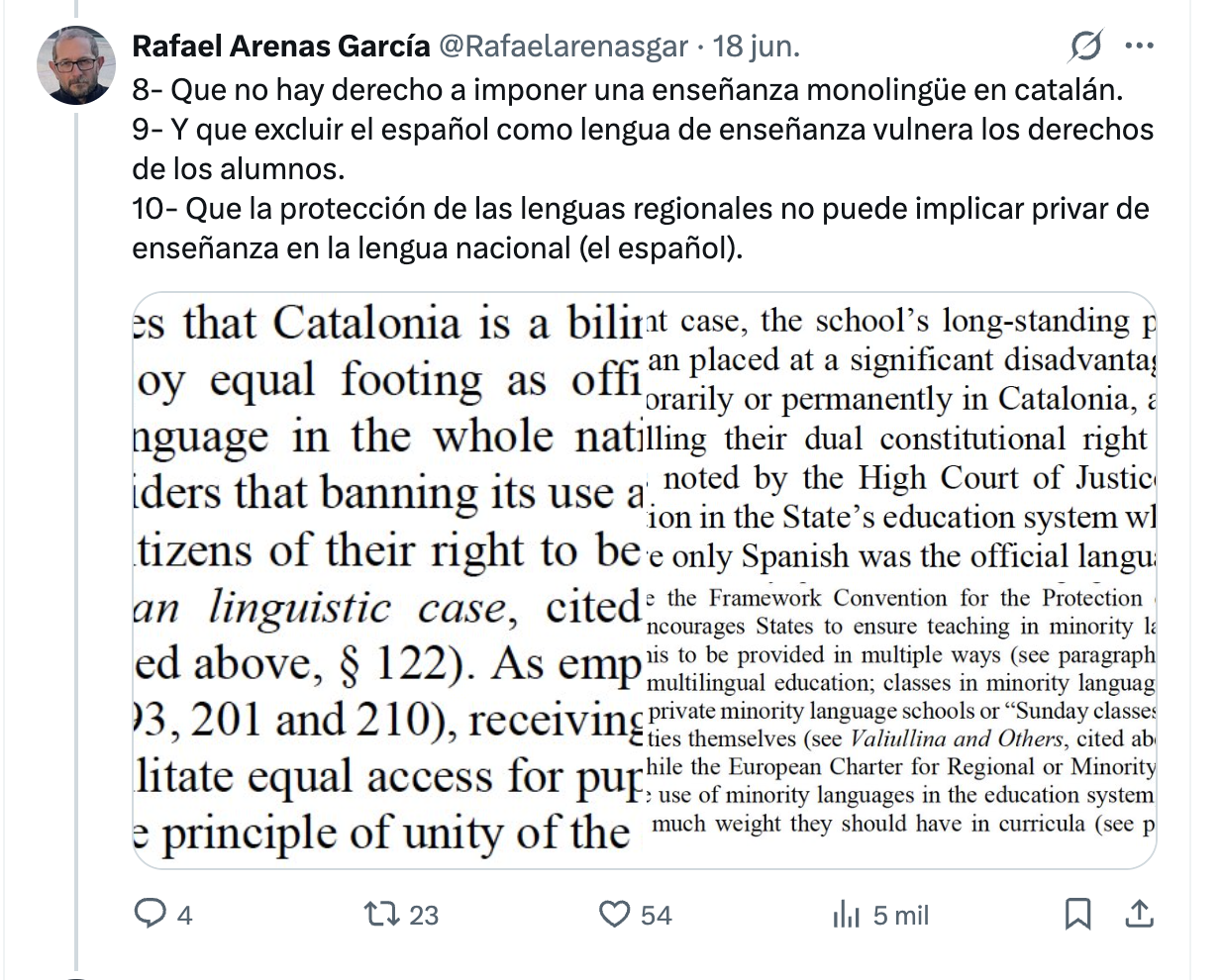
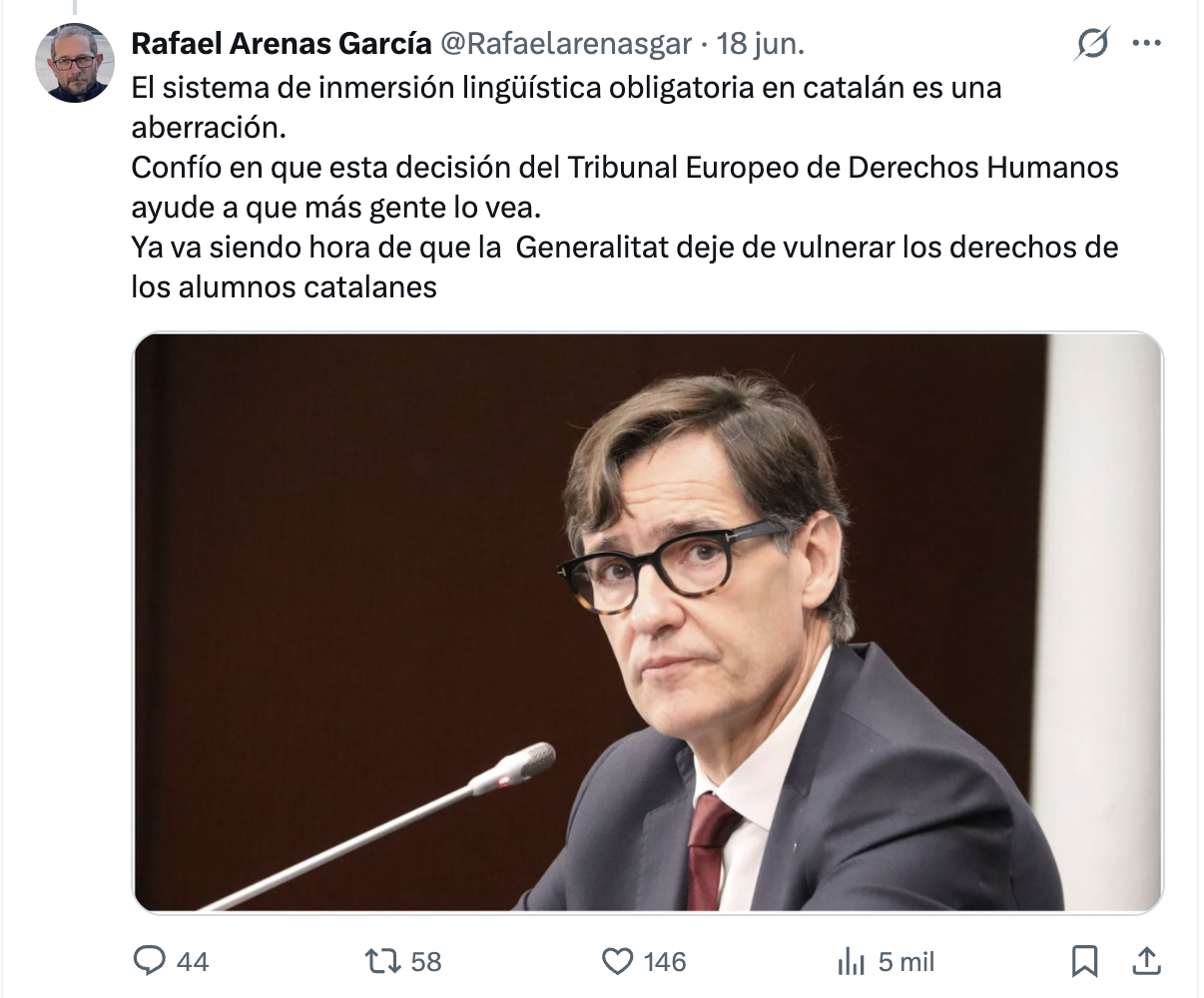
Hace unos días conocimos una decisión del Tribunal Europeo de Derechos Humanos en relación al sistema de inmersión lingüística obligatoria en catalán que se practica en Cataluña.
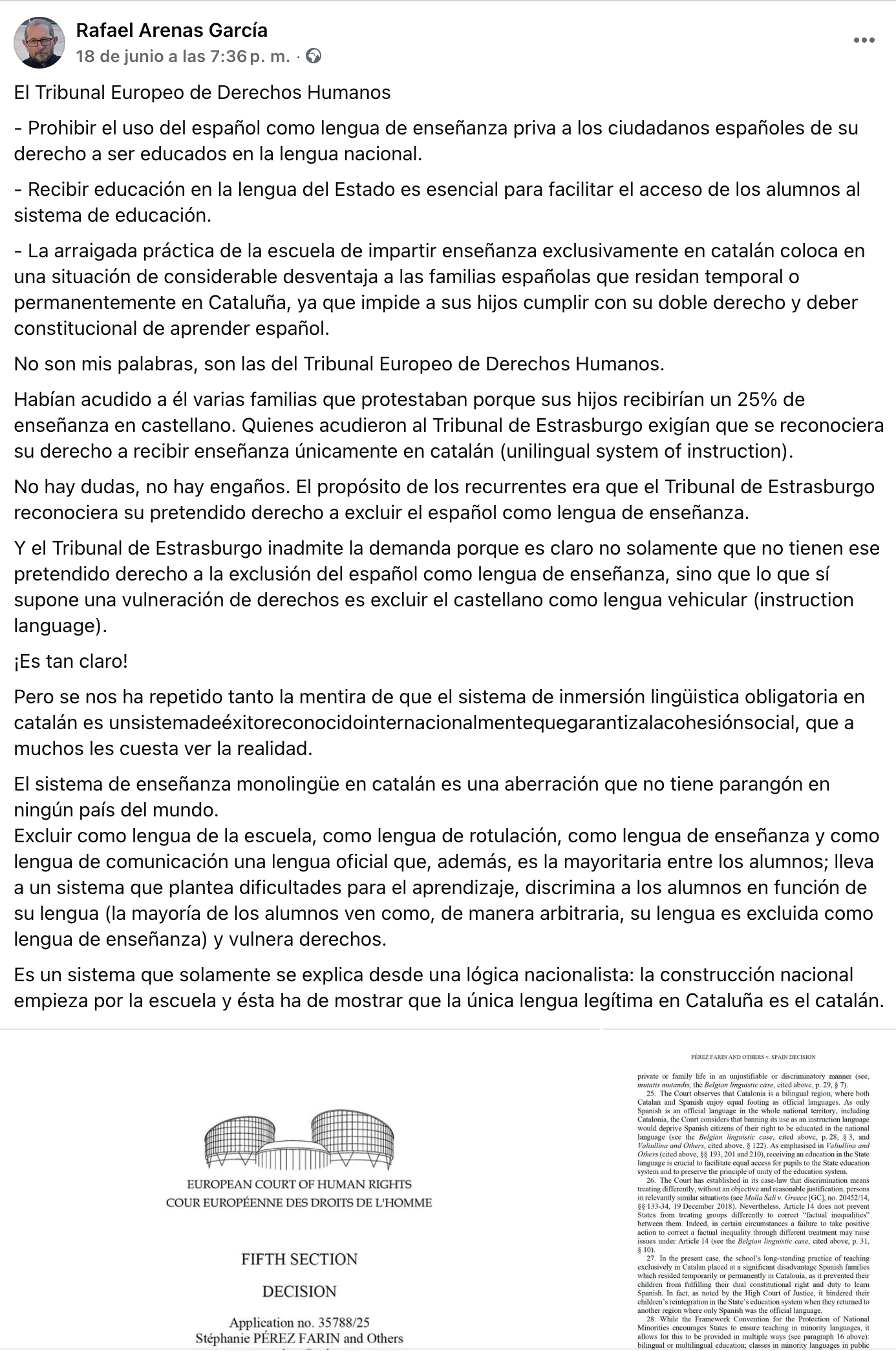
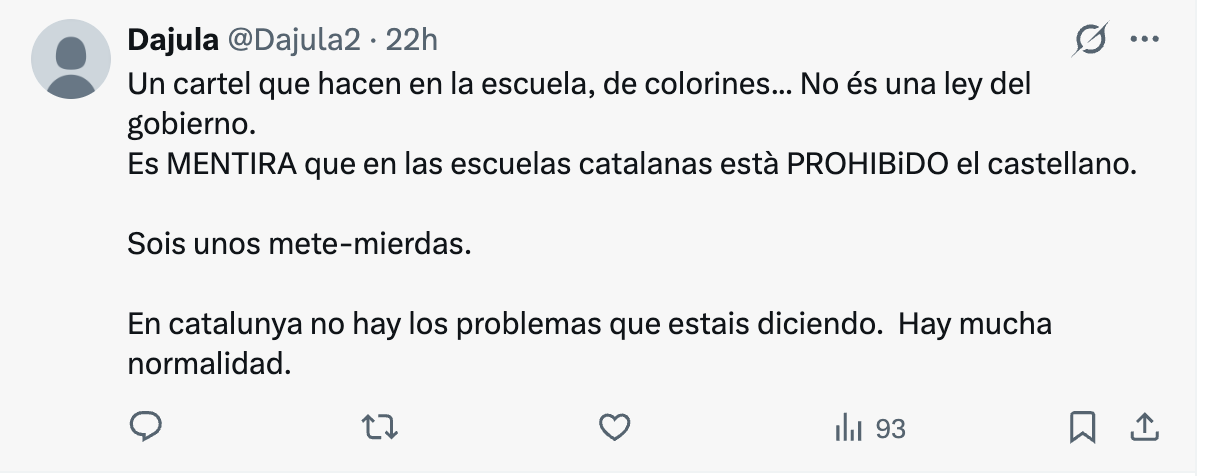
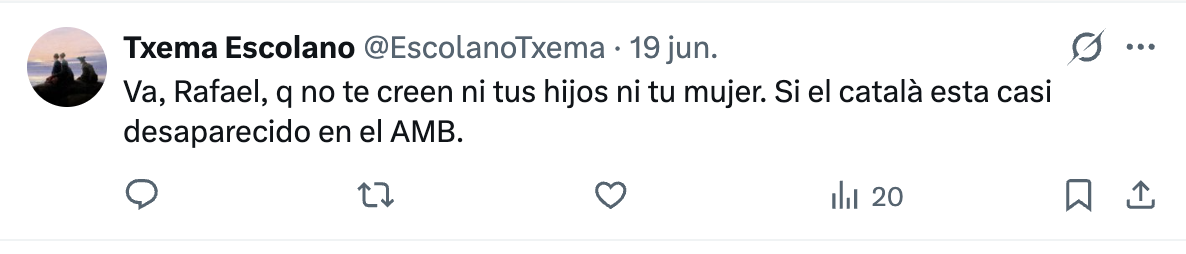
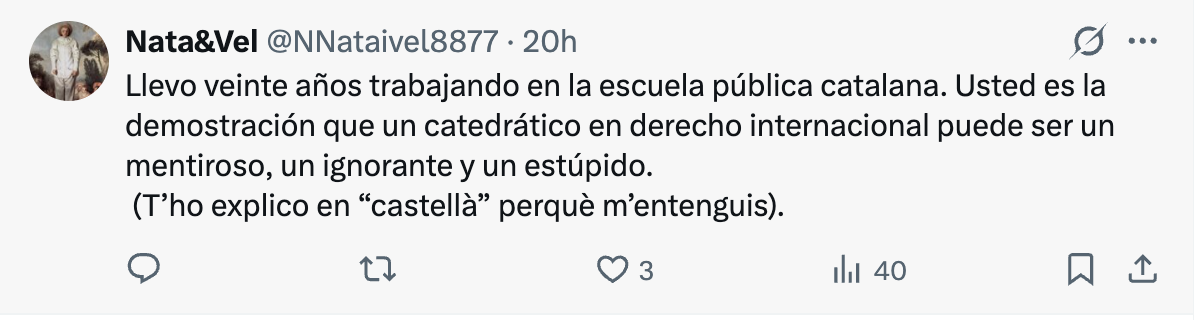
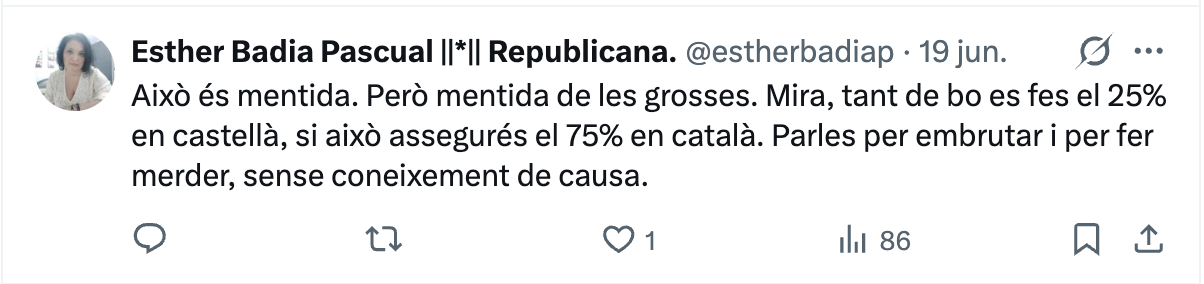
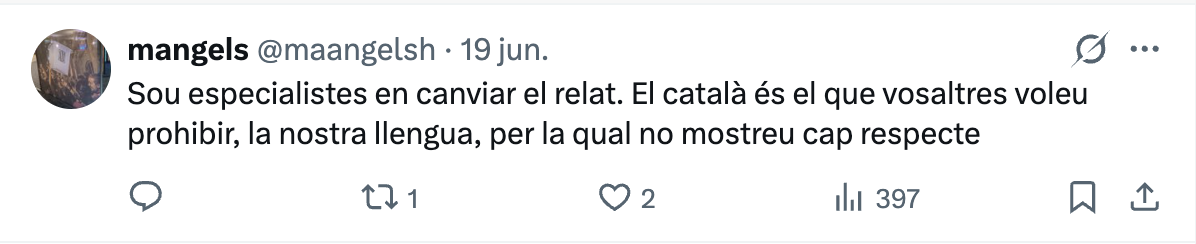
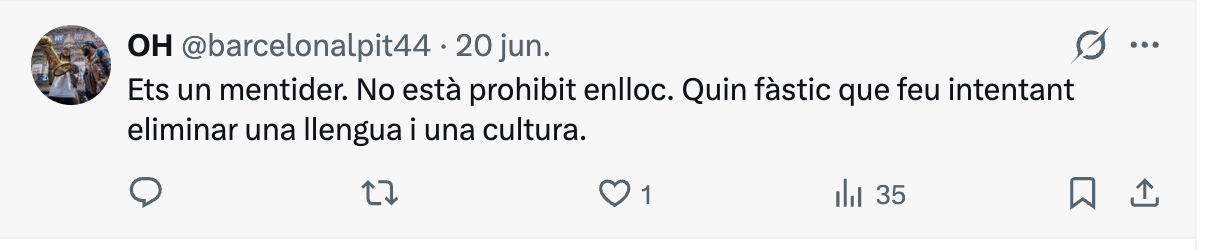
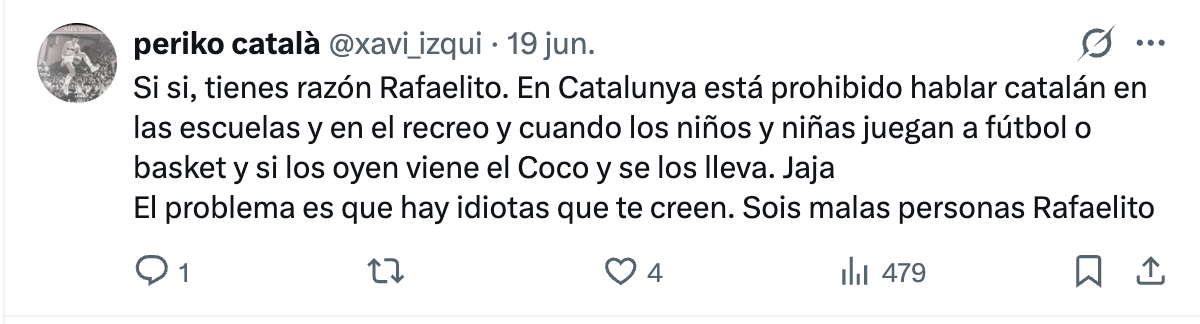
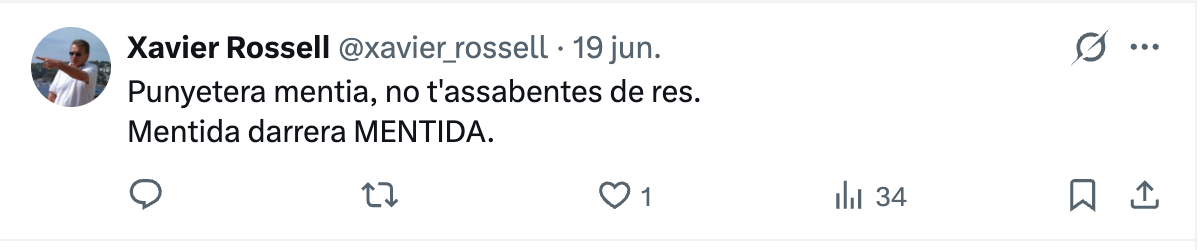
Comenté la decisión en facebook y en un hilo de X.
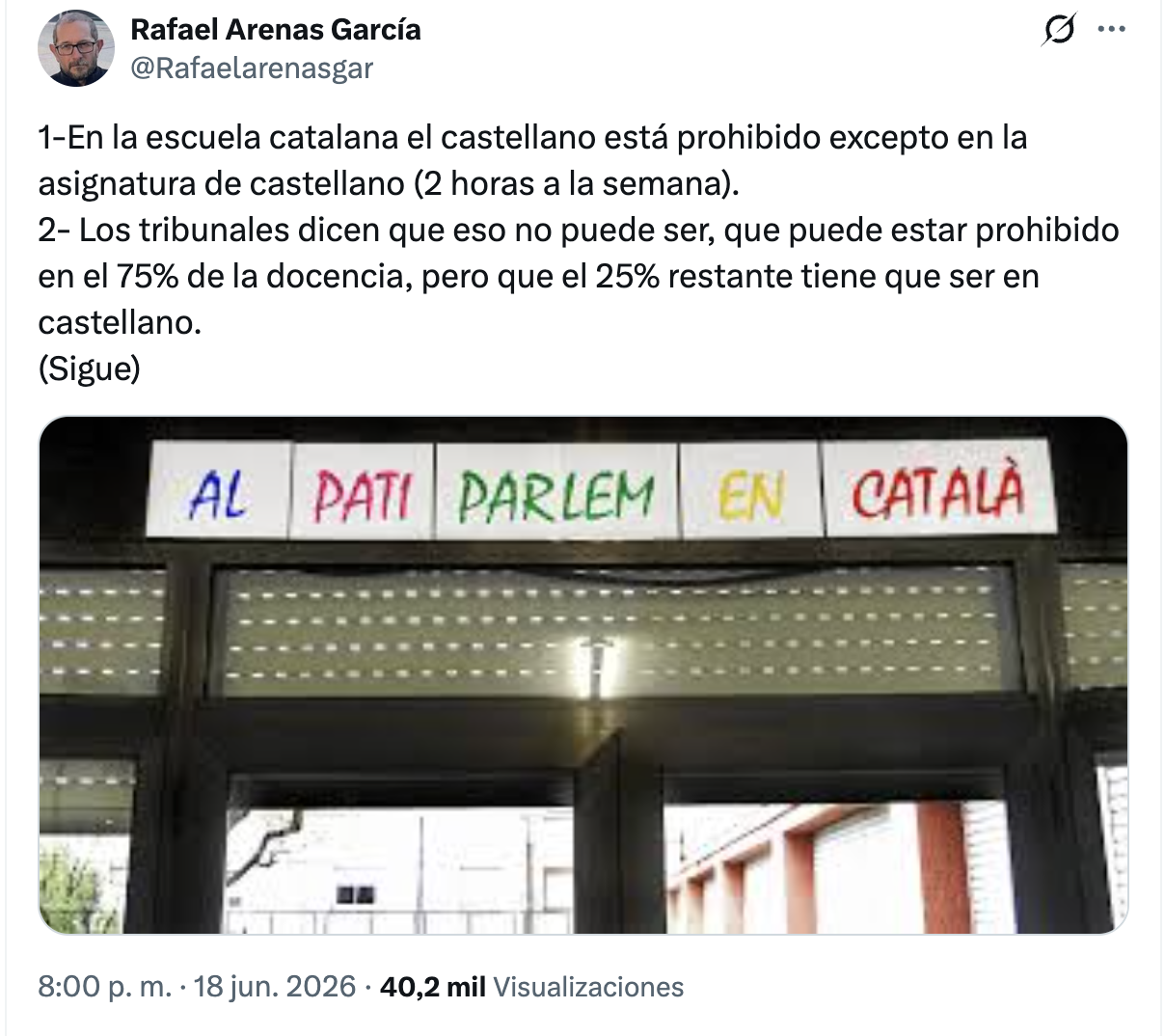
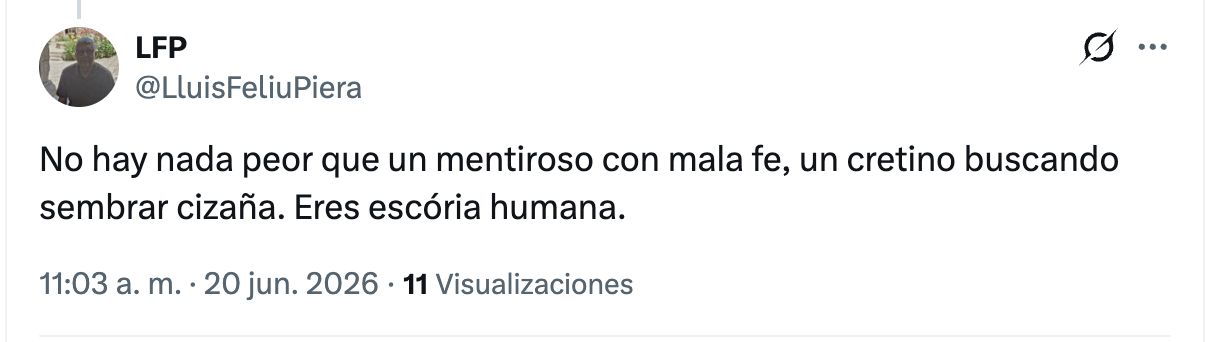
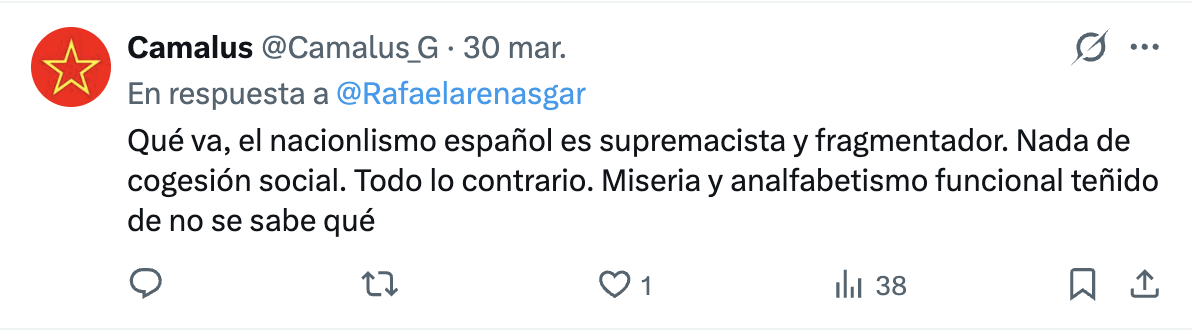
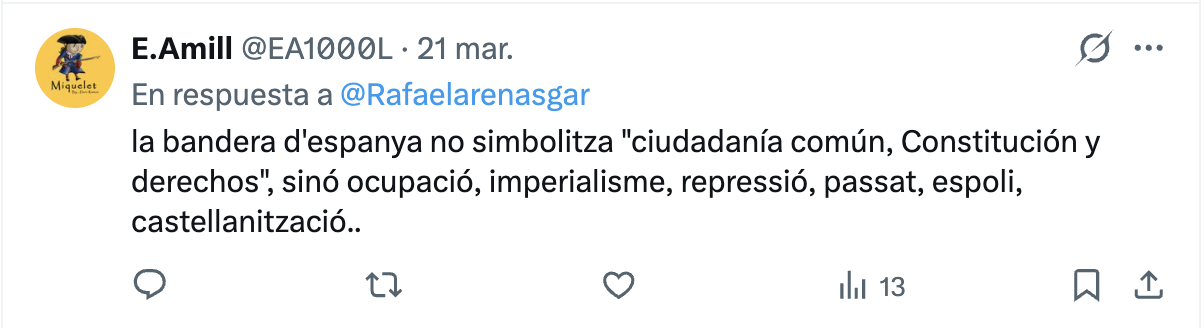
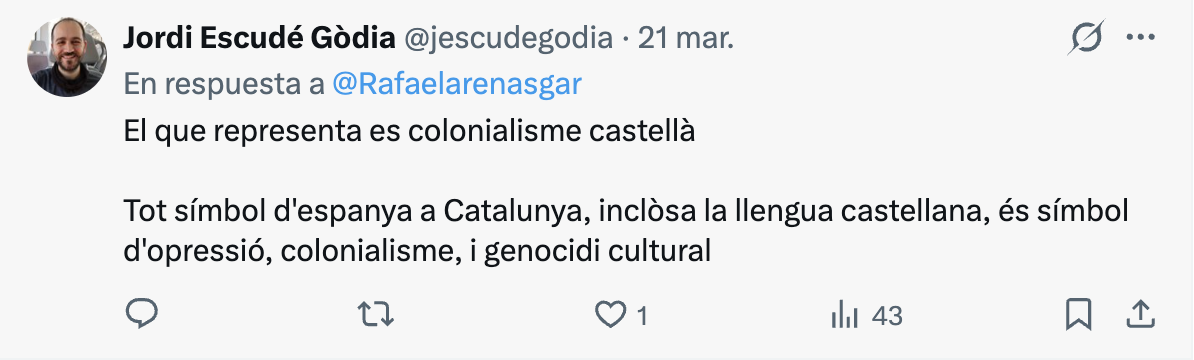
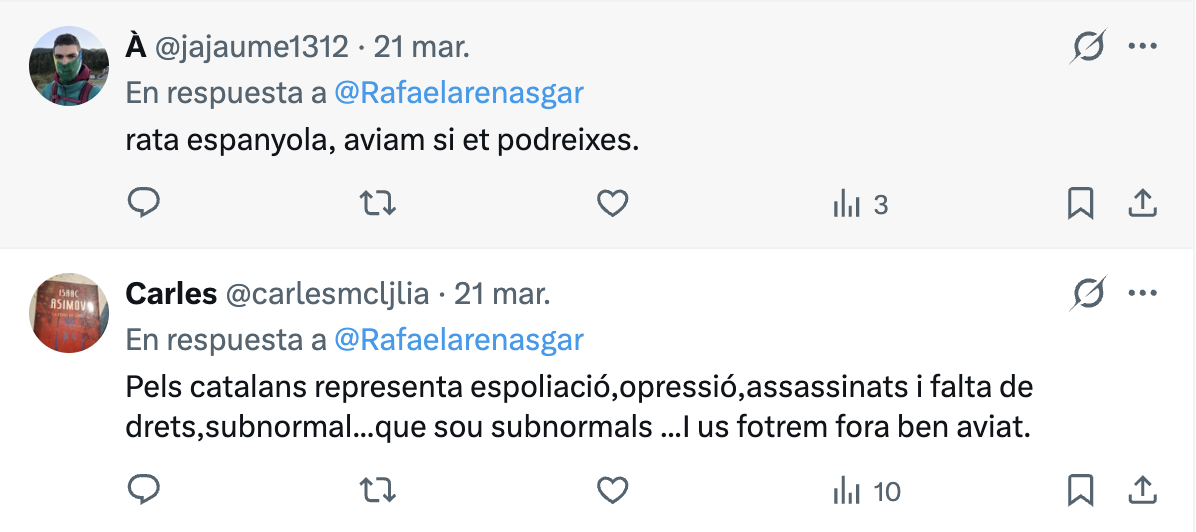
La «respuesta» por parte de los nacionalistas se movió entre el insulto y la negación. En concreto, la negación de esa exclusión del castellano que denunciaba en el primer tweet. También se mantuvo que era lógico que el catalán fuera la única lengua en la escuela pues es la lengua de Cataluña, mientras que el español es una lengua «impuesta». No me ocuparé, sin embargo, de este último argumento, que desconoce que el español es usado en Cataluña desde hace siglos y que es la lengua materna de más de la mitad de los catalanes, además de la lengua que sirve como lengua común no solamente entre los catalanes, sino entre estos y el resto de los españoles. Prefiero centrarme en la negación de la prohibición del castellano en el sistema educativo catalán.
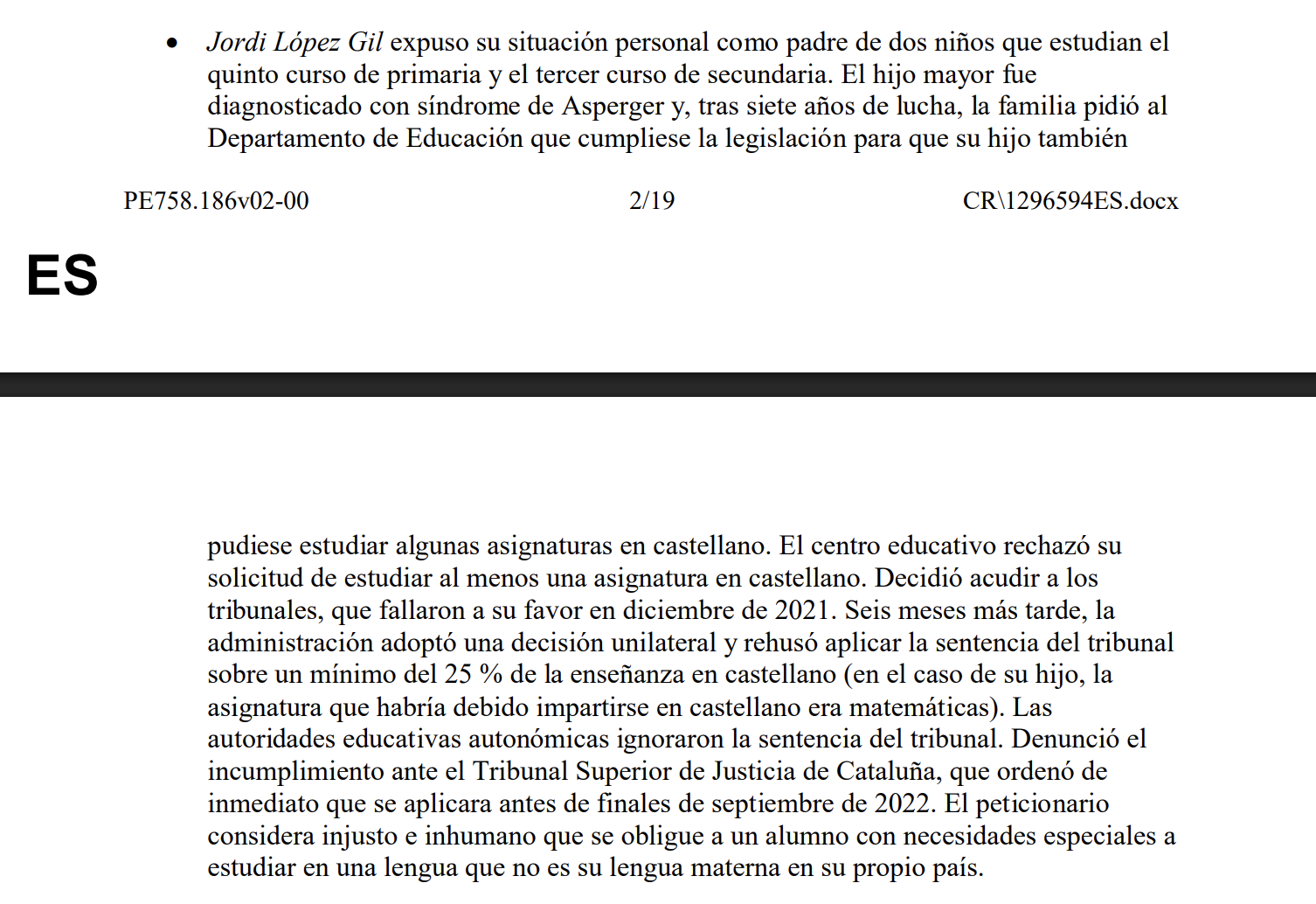
Es significativa esta negación ya no de la realidad, sino de los argumentos propios. Recordemos que la decisión del Tribunal de Estrasburgo lo que hace es inadmitir el recurso planteado por varias familias de Canet de Mar que rechazaban que sus hijos, tras una orden judicial del Tribunal Superior de Justicia de Cataluña (TSJC), recibieran un 25% de la docencia en español. Esto es, el problema era, de acuerdo con la perspectiva de los recurrentes, que antes de la medida judicial sus hijos recibían un 100% de la docencia en catalán y un 0% en castellano; tras la decisión del TSJC esas proporciones variaron a 75% en catalán y 25% en castellano y lo que solicitaban las familias es que se delcarara que ese 25% de castellano vulneraba sus derechos fundamentales y que, por tanto, era obligado volver a la situción en la que la proporción de castellano en la docencia era 0%.
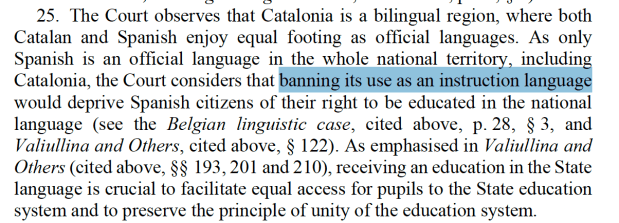
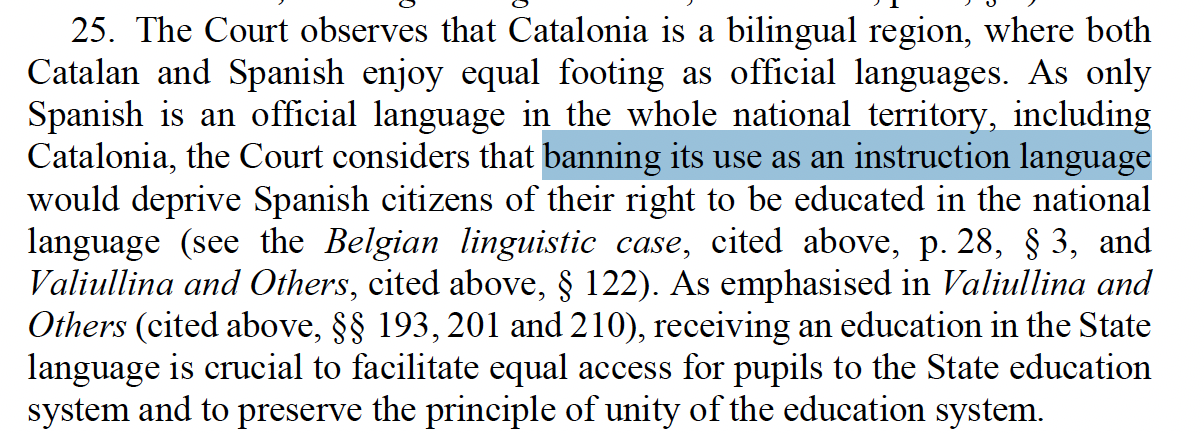
Dicho de otra forma: lo que pretendían estas familias era que se reconociera su derecho a excluir el castellano como lengua de enseñanza para sus hijos. De hecho, la palabra «prohibición» es la que utiliza el propio Tribunal de Estrasburgo en el apartado núm. 25 de su decisión.
Prohibir su uso como lengua de enseñanza, que es lo que le estaban pidiendo y lo que rechaza. Una prohibición, además que es meridiana en las instrucciones que cada año publica el Departamento de Educación de la Generalitat y que tienen como fin orientar el funcionamiento de los centros educativos catalanes. La Asamblea por una Escuela Bilingüe de Cataluña (AEB) ha impugnado las de los cursos 2022-2023 y 2025-2026 sobre la base, precisamente, de la exclusión del castellano que estas instrucciones imponen. A continuación mostraré algunos ejemplos de la forma en que se limita el uso del español en el sistema educativo catalán mediante la vía de imponer la utilización del catalán en todas las actividades que se realizan en el centro con exclusión de las que se desarrollen en clase de castellano u orientadas a la enseñanza de esa lengua.
Comenzaré con las instrucciones para el curso 2022-2023.
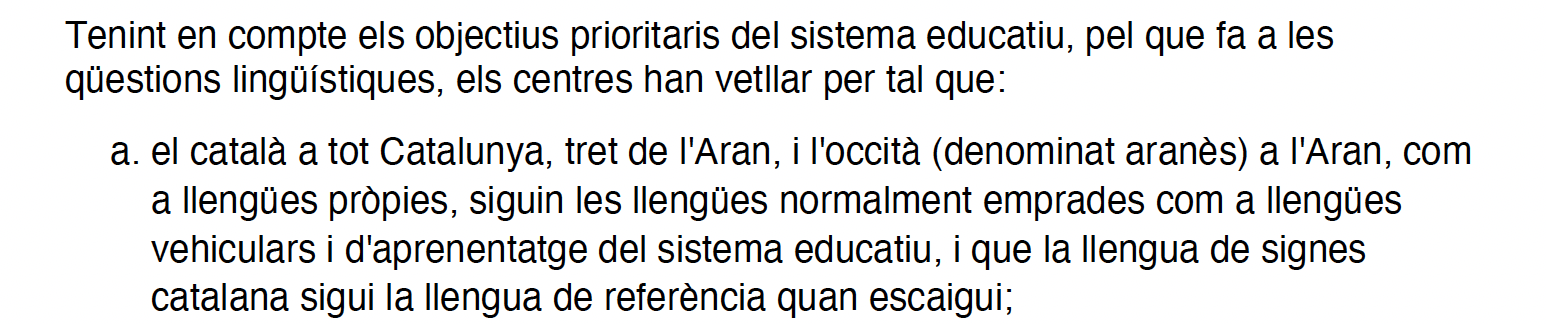
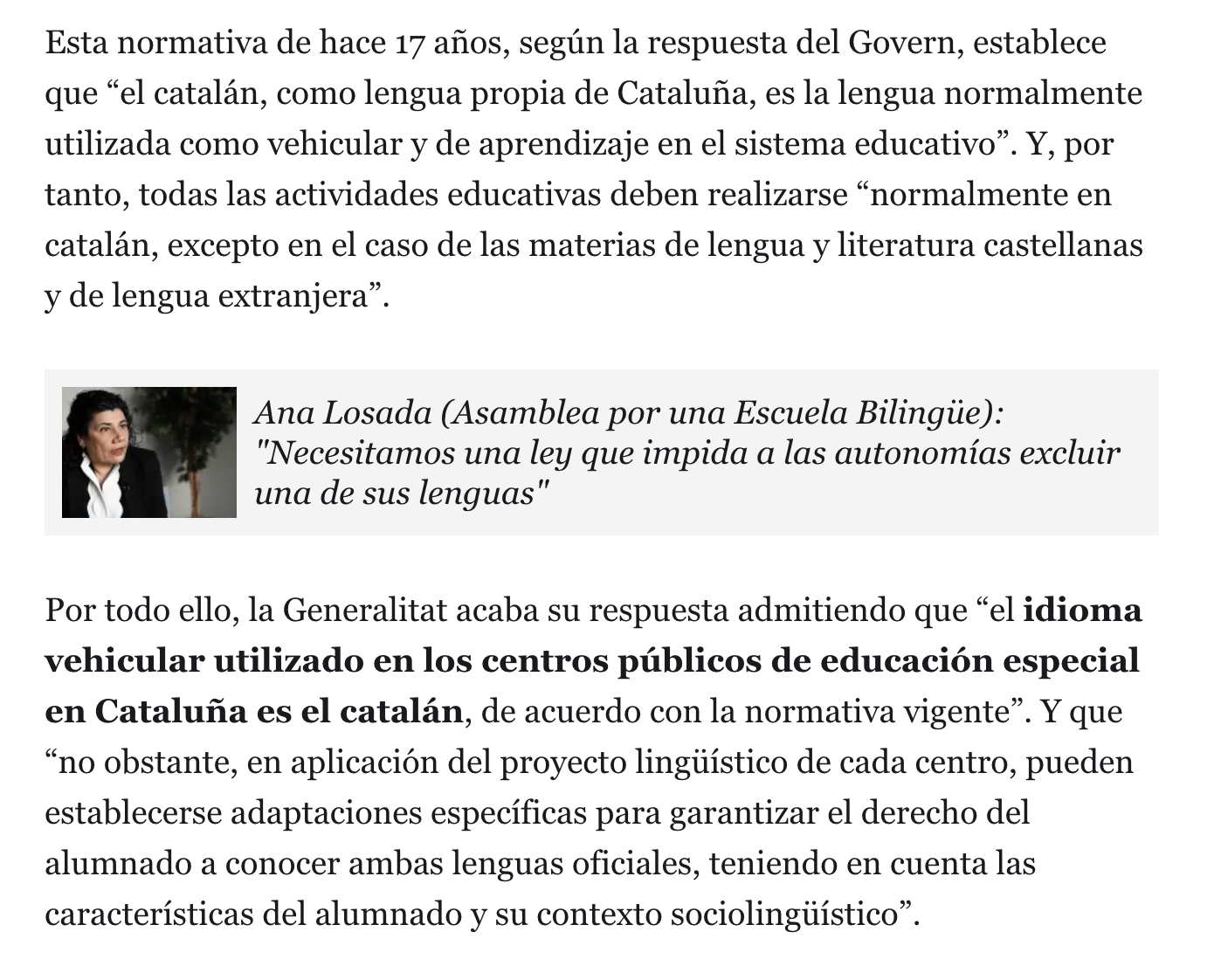
En estas instrucciones se indica que el catalán ha de ser la lengua normalmente utilizada como vehicular y de aprendizaje en el sistema educativo. Se indica que el aranés tendrá esta función en el Valle de Arán, pero no se menciona el castellano; esto es, el castellano no será una lengua utilizada como lengua vehicular y de aprendizaje en el sistema educativo. Esto es consecuencia de que la única lengua que se considera como lengua de la escuela es el catalán.
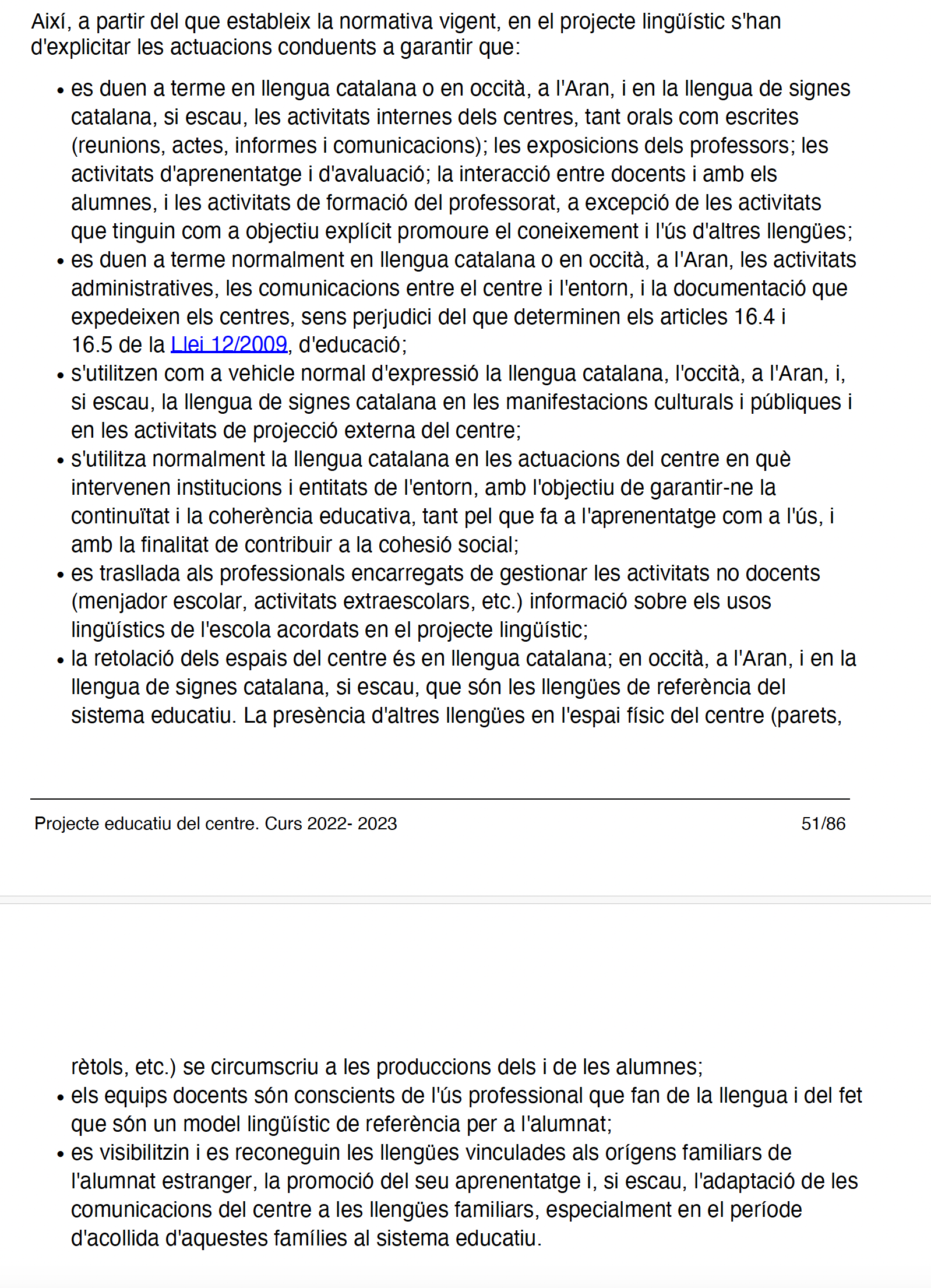
Lo anterior implica que la lengua que ha de utilizarse en:
Las actividades internas de los centros, tanto orales como escritas.
Exposiciones de los profesores.
Actividades de aprendizaje y de evaluación.
Interacción entre docentes y con los alumnos.
Actividades de formación del profesorado.
Actividades administrativas.
Comunicaciones entre el centro y el entorno.
Documentación que expiden los centros educativos.
Manifestaciones culturales y públicas.
Actividades de projección externa del centro.
Actuaciones del centro en que intervengan instituciones y entidades del entorno.
Rotulación de espacios del centro.
Lógicamente, si todas estas actividades han de realizarse en catalán no podrán realizarse en castellano, esto es, establecer el catalán como única lengua de la institución tiene como consecuencia que la presencia del castellano se limitará, como indican las instrucciones, a la que sea necesaria para su aprendizaje. Es decir, la lengua de la institución es el catalán y es la lengua que deberá utilizarse siempre (con la excepción del aranés en el Valle de Arán) salvo cuando sea preciso utilizar otra lengua en el marco del aprendizaje de ésta (castellano, cuyo aprendizaje ha de garantizarse; o, inglés, por ejemplo).
El carácter excluyente de la imposición del catalán es claro en materia de rotulación, ya que aquí se indica expresamente que la presencia de una lengua diferente del catalán en los espacios físicos del centro queda reducida a los trabajos de los alumnos.
Las instrucciones para el curso 2025-2026 repiten el mismo esquema; pero añaden más referencias a la presencia del castellano. Esto tiene una explicación. Tal como indicaba, la AEB impugnó las Instrucciones para el curso 2022-2023 y tras varias peripecias procesales, el TSJC acabó dictando sentencia en la que declaraba nulos varios apartados de esas instrucciones (lo comentaba aquí).
La razón de la nulidad es clara. Por mal que les pese a los nacionalistas, el español (castellano) en tanto que lengua oficial en toda España, incluida Cataluña, no puede ser excluida como lengua del sistema educativo. Esto no quiere decir que la presencia del castellano tenga que ser la misma que la del catalán. Si se justifica adecuadamente, el catalán puede tener una proyección cuantitativamente mayor que el castellano en el sistema educativo. De igual forma que debería poder justificarse lo contrario, una presencia cuantitativamente mayor del castellano que del catalán; pero lo que no puede ser es que ambas lenguas tengan posiciones cualitativamente distintas. Ambas son lenguas oficiales y el argumento de que el catalán es lengua propia de Cataluña no puede suponer una preferencia sobre el castellano que, podríamos decir, es también lengua propia en el conjunto de España. Dotar de una posición de preferencia al catalán choca con la Constitución; en concreto, con su artículos 3 (oficialidad del castellano), 14 (no discriminación) y 27 (derecho a la educación).
Con el fin de eludir las tachas de inconstitucionalidad que habían conducido a la nulidad de determinados incisos de las instrucciones del curso 2022-2023, la Generalitat «sembró» de referencias al castellano las instrucciones para el curso 2025-2026; pero, a la vez, dejó también claro que esas referencias al castellano no podían implicar que éste se colocara en la misma posición que el catalán.
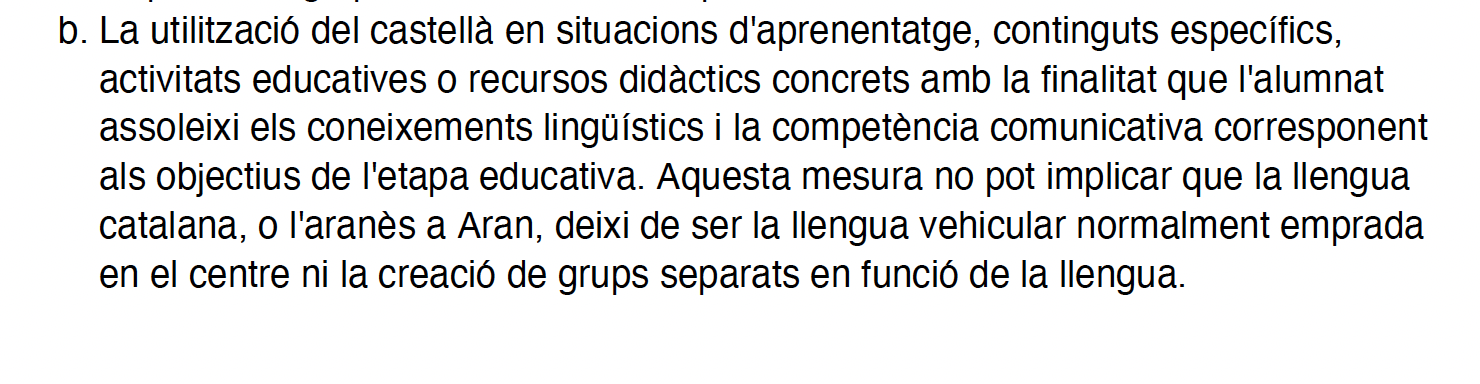
Es decir, se podrá utilizar el castellano en situaciones que tengan como objetivo aprender esta lengua; pero esta presencia del castellano no puede implicar que el catalán deje de ser la lengua normalmente utilizada en el centro. Es decir, la lengua de la institución seguirá siendo el catalán y el castellano será una lengua que se aprende, no una lengua EN la que se aprende. La prohibición de la utilización del castellano para el aprendizaje de otras materias, como vehículo de comunicación con las familias o entidades ajenas al centro se mantiene; así el catalán es la lengua que deberá utilizarse como vehicular y de aprendizaje, en la acogida del alumnado de reciente incorporación y en todas las actividades educativas, incluidas las complementarias y las extraescolares.
Y por eso el proyecto lingüístico tiene como una de sus funciones
Esto es, asegurar que el catalán (y el aranés en el Valle de Arán) son las lenguas normalmente utilizadas como vehiculares y de aprendizaje en todas las etapas educativas; así como la lengua de signos catalana. El castellano está vetado como lengua vehicular y de aprendizaje y su presencia ha de limitarse a la asignatura de lengua castellana y a lo que sea necesario para aprender la lengua. De hecho, se niega que los alumnos castellanohablantes con necesidades educativas especiales puedan tener una educación en la que se emplee el español para el aprendizaje de materias diferentes del castellano.
La negativa de la Generalitat a permitir la utilización del castellano en este caso se basa en que la lengua vehicular del sistema educativo es el catalán.
No hay por tanto muchas dudas sobre la prohibición del español como lengua vehicular en el sistema educativo catalán. Las instrucciones de la Generalitat son muy claras al respecto y lo saben bien quienes han solicitado a la administración una educación en la que el castellano esté presente y que siempre han recibido un «no» por respuesta. Esta exclusión, como digo, se traduce en las comunicaciones con los alumnos, en el idioma de las «interacciones» entre los profesores, en la lengua en la que han de realizarse las actividades extraescolares y en la que han de desarrollarse los encuentros con personas y entidades ajenas a la comunidad educativa. Ahora bien, para entender el sentido de esta prohibición y también las reacciones cuando se denuncia tenemos que ir un poco más allá, tenemos que ver cuál es objetivo de esta prohibición del castellano como lengua de aprendizaje en el sistema educativo catalán.
II. La Cataluña ideal (según los nacionalistas)
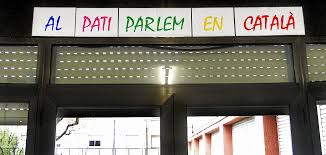
El credo nacionalista postula que la escuela ha de prefigurar una Cataluña ideal en la que la lengua de cohesión sea el catalán. Idealmente, debería llegarse a una situación en la que se pudiera vivir plenamente en catalán y ahí la escuela es un buen campo de experimentación. Primero hacemos que la docencia sea en catalán y que toda la vida de la escuela se desarrolle en catalán, que los materiales que se utilicen sean en catalán, que las reuniones con las familias se desarrollen en catalán, que la rotulación y todas las indicaciones estén en catalán y luego daremos el siguiente paso, que es el de intentar que el catalán sea también la lengua de los juegos y del patio. A esto responde el cartel que compartía en el tweet y donde se recuerda a los niños que también han de utilizar el catalán en el patio.
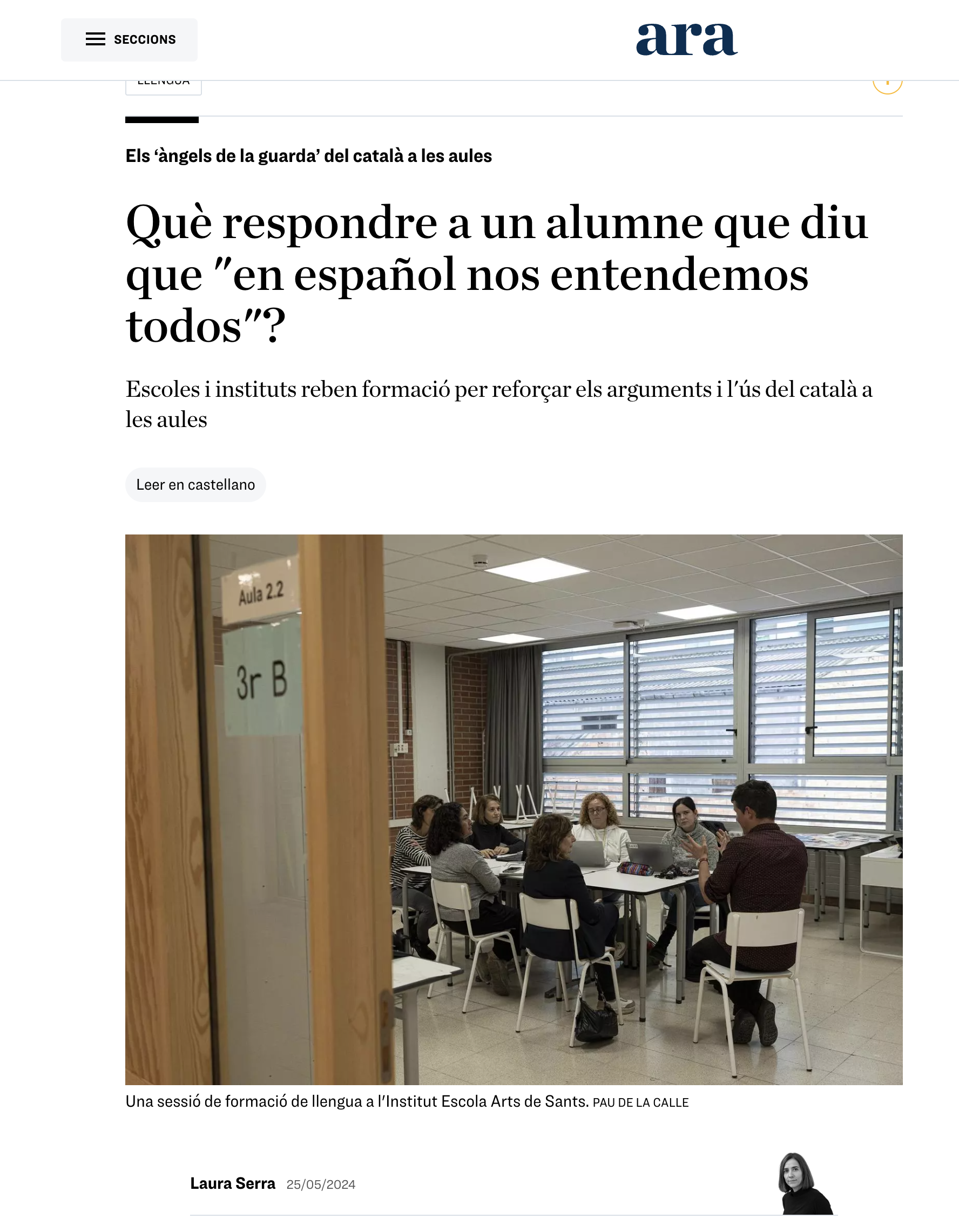
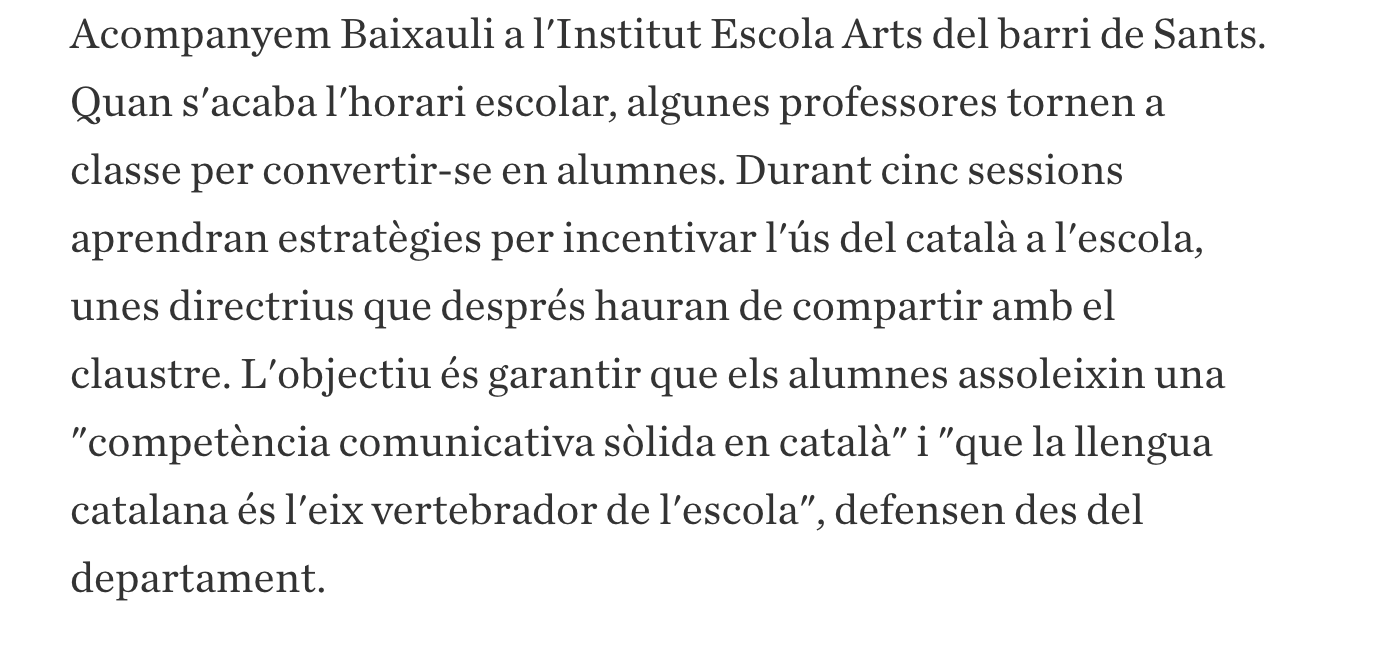
Aparte de esto también se realizan actividades que tienen como objetivo que los niños utilicen el catalán en su tiempo libre. Asi informaba de ello el diario Ara, por ejemplo.
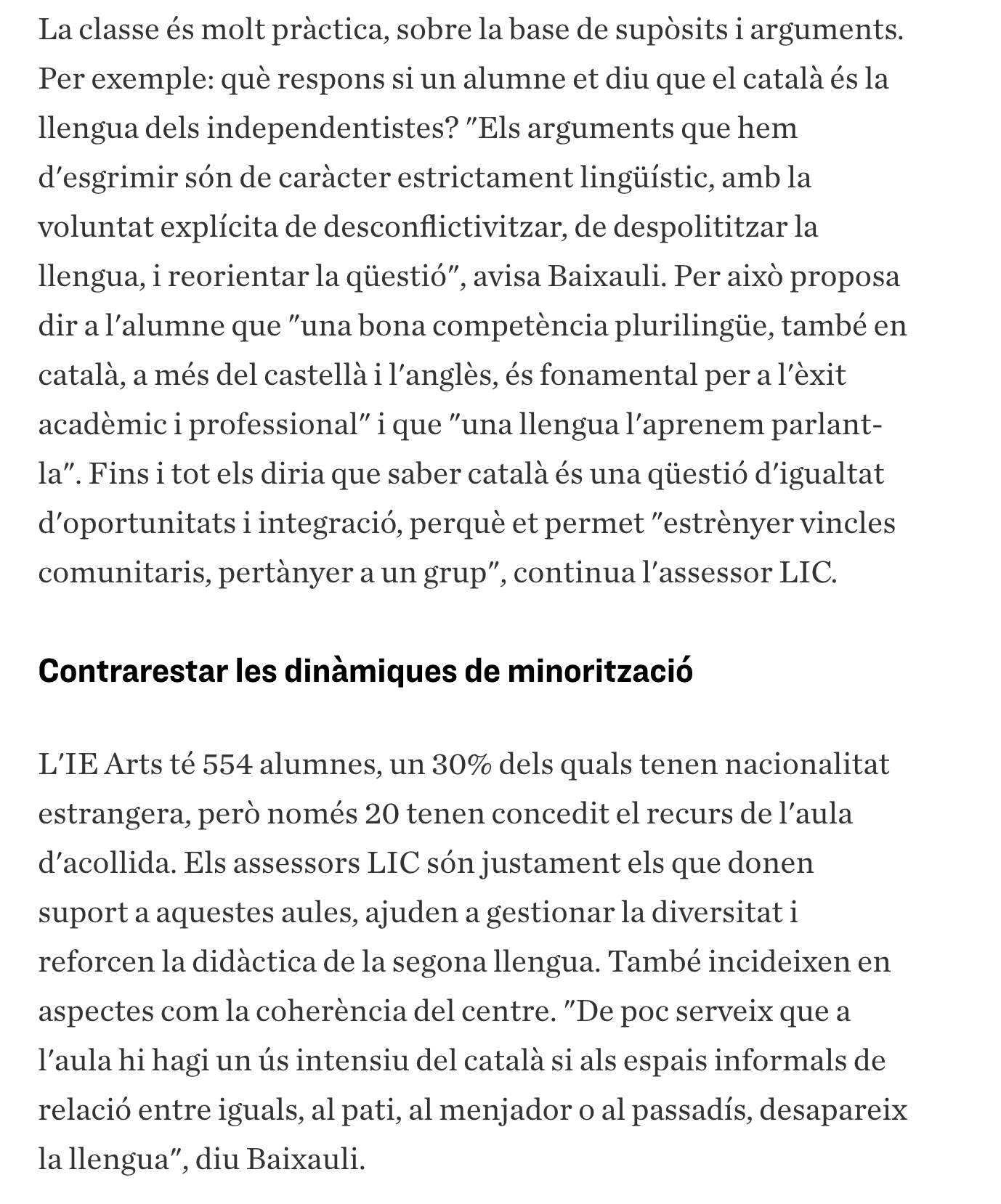
Es significativo lo que dice este profesor: «De poco sirve que en el aula se haga un uso intensivo del catalán si en los espacios informales de relación entre iguales, en le patio, el comedor o los pasillos desaparece la lengua«. ¿Qué nos está diciendo?
Lo primero es que nos describe dos hechos: en primer lugar que en el aula se hace un uso intensivo del catalán; esto es, el catalán es la lengua de relación dentro del aula. En segundo término que fuera del aula los alumnos hablan otra lengua (muy mayoritariamente, el español). El profesor no lo formula así, sino que lo dice de una manera mucho más sutil: «desaparece la lengua». ¿Qué es eso de que «desaparece la lengua»? ¿Acaso los alumnos están mudos en los pasillos? No creo, más bien hablarán, reirán, se gastarán bromas y hasta chillarán para desesperación de los adultos (como ha sucedido siempre); pero no lo harán en catalán, sino en español. Esto es, no es que la lengua desaparezca, sino que los alumnos, fuera del aula, utilizan la que mejor les parezca que, en este caso, no coincide con la que se usa en el aula.
Pero lo segundo también es importante. Quien habla (Baixauli, una asesor LIC, de Lengua, Interculturalidad y Cohesión social), dice que «de poco sirve» el uso del catalán en el aula si no se habla fuera del aula. Esto es, la exclusión del castellano como lengua vehicular y de aprendizaje (otra forma de decir que la única lengua vehicular y de aprendizaje ha de ser el catalán) tiene un objetivo que va más allá del aula y que, por lo que explica Baixauli, se concreta en la extensión del uso social del catalán o, lo que es lo mismo, en la disminución del uso social de otras lenguas y, más concretamente, del castellano.
Siempre que tengo ocasión insisto en esto, porque con demasiada tranquilidad se dan por buenas las políticas de promoción del uso de las lengua que -si somos claros- implican decirle a las personas que están utilizando la lengua equivocada. Aquí, a los alumnos, a quienes se les traslada que la lengua que han de usar en el patio o en los pasillos ha de ser el catalán y no la que ellos emplean habitualmente. Lo de la «desparición de la lengua» para expresar que los alumnos emplean una diferente a la deseada es muy claro.
Es decir, la prohibición del castellano como lengua vehicular es instrumental al objetivo de fondo, que es la extensión del uso social del catalán en detrimiento del español. A mí este tipo de políticas me repugnan, porque considero que ningún poder público ha de indicar a las personas qué lengua han de usar en sus relaciones particulares. Que haya programas públicos orientados a que los niños cambien la lengua que emplean cuando hablan con sus amigos me parece inadmisible.
Pero es lo que hay, y así se entiende la insistencia de los nacionalistas en los datos sobre utilización social del catalán. No incidiré aquí en ello, porque ya me he ocupado de esto en otros sitios (aquí, por ejemplo); pero recordaré que el uso social del catalán está por encima de lo que se correspondería en función del número de catalanes que lo tienen como lengua materna. Esto es, si el número de personas que en Cataluña tienen como lengua materna una distinta del catalán aumenta la única forma de conseguir una mayor presencia del catalán es mediante técnicas que fuercen a las personas a emplear una lengua distinta de la que les es natural. Esas técnicas existen y, como digo, están llevando a un «sobreuso» del catalán en relación al número de hablantes nativos; pero es ilusorio pensar que consigan que acabe siendo mayoritaria entre la población una lengua que es materna de poco más de un tercio de los catalanes.
Tener en cuenta lo anterior explica algunas de las afirmaciones que he podido leer en X estos últimos días. Son frecuentes los que indican -profesores incluidos- que el uso del catalán en las escuelas es mayor de ese 25% que se discute. Confunden dos cosas que hay que separar; pero que, por lo que he explicado, es natural que no distingan.
Cuando se habla de lengua vehicular y de aprendizaje se habla de lengua reglada; esto es, aquella a la que han de ajustarse las programaciones, evaluaciones y materiales. Aquí la presencia del catalán es muy superior al 90%; entre otras cosas porque, como hemos visto, así lo exigen las instrucciones del Departamento de Educación. Sí que hay algunos casos en centros de enseñanza media en que algún profesor imparte clase en castellano; pero diría que están disminuyendo y que en la escuela primaria la utilización casi exclusiva del catalán apenas tiene excepciones. Recurro aquí a mi experiencia personal (tres hijos escolarizados en Cataluña y una esposa que ha sido maestra en Cataluña por más de 30 años), más los casos a los que tengo acceso a través de mi colaboración con la AEB; pero es que quienes cuestionan la exclusión del castellano lo hacen también a partir de su experiencia en los centros educativos. Recurren a su vivencia para cuestionar una afirmación general.
Cuestión distinta es que en los patios, pasillos o que en la interacción con los profesores los alumnos utilicen el castellano. Por supuesto que pasa y si se contaran esas interacciones habría que ver cuál es el porcentaje de «uso social» en la escuela del catalán y del castellano; pero es que yo no estoy hablando de eso. Yo no hablo de la lengua que eligen Carlos y Miquel para quedar después del instituto, o la que emplean Carolina y Maria para contarse un chisme o la que utilizan dos adolescentes para declararse su amor en una esquina del patio. Yo hablo de la lengua en la que han de impartirse las clases, en la que han de realizarse los exámenes y en las que los profesores han de desarrollar las reuniones, la lengua de los avisos oficiales y de las reuniones con los padres. Esa es la lengua que rigen las instrucciones del Departamento de Educación, la que vigilan los tribunales de justicia y a la que se refiere el Tribunal de Estrasburgo en su reciente decisión.
Lo que pasa es que, como he intentado explicar, para los nacionalistas esa lengua es solo una herramienta, un instrumento para llegar a una Cataluña en la que todos renunciemos a nuestras lenguas para abrazar el catalán, y como eso no sucede no dejan de repetir: «¡Qué prohibición ni prohibición! ¡Pero si la gente sigue hablando en español, incluso en la escuela!»
Pues sí, y cuando más se den cuenta de lo que aquí explico, que intentar cambiar desde el poder o la escuela los usos lingüísticos de las personas es repugnante a mi me tocará (ya lo estoy haciendo) recordar que de todo esto no tienen culpa ni los catalanohablantes ni la lengua catalana y que nadie debería permitir que las perversas políticas de unos afecten a su elección de lengua, ni en el sentido de abrazar la lengua que se pretende imponer ni en el de rechazar esta lengua por la utilización que algunos hacen de ella para sus propósitos políticos.
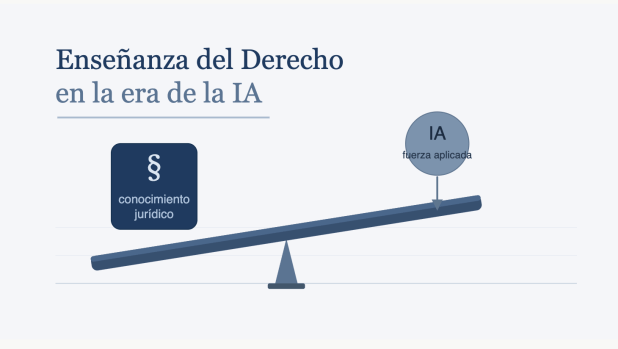
Over the past year, conversations about how AI was affecting the teaching of Law have been constant at the Faculty —not only in formal meetings, but also in corridor and coffee-break exchanges.
In the work I share here I set out my view on how legal studies must be modified in order to adapt to the reality of AI. I begin by examining what AI can do within our field of work, and move from there to its projection onto legal studies. I start with the question of assessment, go on to methodology, and conclude with the structure of the curriculum.
This is merely a contribution to the debate —a debate I believe to be unavoidable and one that cannot be postponed.
Durante el último año, las conversaciones sobre cómo estaba afectando la IA a la docencia del Derecho han sido constantes en la Facultad. No solo en reuniones formales, sino también en conversaciones de pasillo o de café.
En el trabajo que aquí comparto, expongo mi visión sobre cómo hemos de modificar los estudios de Derecho para adaptarnos a la realidad de la IA. Comienzo por analizar qué cosas puede hacer la IA en nuestro ámbito de trabajo para, de ahí, pasar a la proyección en los estudios jurídicos. Empiezo por la evaluación, sigo con la metodología y concluyo con la estructura del plan de estudios.
Se trata tan solo de una contribución al debate, porque creo que este debate es ineludible que no puede posponerse.
ABSTRACT: I. The Construction of Identity and Its Enemies. II. The Construction of Catalan Identity. III. From Spain to Spaniards. IV. Hate Speech and Hispanophobia: 1. Hate Speech and the Limitation of Rights. 2. Limitation of Rights and Nationalism in Catalonia. V. Hate Speech and Public Institutions. VI. Conclusion.
I. The Construction of Identity and Its Enemies
The construction of a group’s identity often involves opposition to one or more other groups. It is a commonplace phenomenon that most of us have experienced. From football clubs (what unites more than the rivalry of a Barça–Madrid, Espanyol–Barça, Oviedo–Sporting, Athletic–Real Sociedad, Betis–Sevilla…?) to local rivalries between neighbouring towns or even between urban tribes. Nations are no different. National identity, in part, arises from opposition to other countries. One’s own virtues are highlighted and, almost inevitably, conflicts with other nations come to be portrayed as a struggle between “good” (one’s own nation) and “bad” (the others). This can be clearly seen in these 30 seconds of Lady Hamilton, the film by Alexander Korda, where in less than a minute it is explained why the British Empire is so good and, consequently, why those who attack it are so bad.
The British Empire is a community in which each territory has its own purpose and function; yet there are those who, driven by ambition, seek to destroy what others have built. In this way, England’s actions elsewhere are explained and justified, while at the same time those who oppose it are discredited. Crystal clear.
II. The Construction of Catalan Identity
The construction of the Catalan nation follows the same pattern: elements must be identified that give it a distinct identity, one that also serves to differentiate Catalans within the broader community in which they were historically integrated without major controversy—the Spanish people as a whole. This requires, on the one hand, a particular interpretation of history in which Catalans are endowed with special virtues. In this regard, for example, the fanciful speech by Pau Casals at the United Nations, which I share below, fits well.
The template is always the same: a people defined by positive traits (industriousness, a peaceful and enterprising character…) whose origins can be traced back to prehistory, and which must confront those who, lacking such qualities, seek to hinder its progress. This can already be clearly seen in the works of Catalan nationalists from the early twentieth century—the period in which Pau Casals spent his youth—which likely helps to better understand his speech at the United Nations in 1971. Thus, in the book by Antoni Rovira i Virgili, History of Nationalist Movements, originally published between 1912 and 1914, we read:
This linguistic territory closely corresponds to the original area of the Iberian race, from which the Catalans descend. Prat de la Riba states: “When the Phoenician traveller whose account was recorded by Avienus, one hundred and fifty years before Christ, travelled along the Sardinian Sea coast, he encountered there the Iberian ethnos, the Iberian nationality, extending from Murcia to the Rhône, that is, from the Libyco-Phoenician peoples of eastern Andalusia to the Ligurians of Provence. Those peoples are our ancestors; that Iberian ethnos is the first link that history allows us to see in the chain of generations that have forged the Catalan soul.”
Soon, the territory of the Iberian race, open to incursions, was invaded by other races (…). But when the Roman Empire collapsed under the pressure of the barbarians, and the medieval nuclei that would give rise to the historical nationalities emerged, the old Iberian race resurfaced, marked by the powerful imprint of Rome, yet preserving a vivid ethnic individuality.
(…) Yet this historical event [the discovery of America] would not have had such a disastrous influence on our homeland had Castile not committed a great injustice. By the famous codicil to the will of Isabella the Catholic, the citizens of the Catalan-Aragonese Crown were excluded, under penalty of death, from trade with the Indies (…). Without this unjust prohibition, Catalonia would have carried its genius for work and creation overseas; it would have become, like England, a great maritime and commercial power. The Catalan language would have spread throughout the Americas; today there would be, in the New World, alongside nations of Spanish and Portuguese language, nations of Catalan language, and Catalan would be one of the great world languages. The antipathy of Castile, manifested in Isabella’s codicil, destroyed at that historical moment the magnificent future that awaited Catalonia.”
The narrative continues; but what has been quoted is sufficient: a distinct identity set against external enemies who strive to prevent the nation from flourishing. The same pattern we saw in the explanation of the British Empire given to Emma Hamilton in the film by Alexander Korda.
In principle, this line of thinking should belong to a bygone stage; and to a large extent, I believe that is indeed the case in most places. It is hard to imagine that anyone in the United Kingdom today would find persuasive what we saw in the 1941 film. National constructions based on hypothetical ethnic distinctions stretching back to prehistory tend, at best, to provoke a smile; if not to raise serious concerns. Yet in Catalonia this remains the official doctrine. It is not insignificant to recall that a Catalan public university—the University of Tarragona—bears the name of the author of the passages quoted above, and that the speech by Pau Casals—outlandish in its content—was taken from the official YouTube channel of the Parliament of Catalonia.
In other words, in Catalonia a distorted view of history continues to be embraced, one in which “Castile” is held responsible for the fact that Catalonia is not a sovereign and prosperous nation—a nation which, in Antoni Rovira i Virgili’s account, would have been comparable to nineteenth- and early twentieth-century England.
III. From Spain to Spaniards
This is already a problematic approach in itself; yet it can become even more troubling when the shift is made from “Castile” to “Castilians,” a term some use to refer to all Spaniards who are not of Catalan origin (with “Catalan” understood as extending to Valencia and the Balearic Islands). In this framing, “Castilians” are portrayed as colonizers, dominators, and extractors of Catalonia’s wealth. Moreover, they are burdened with the stereotypes typical of any identity-building process based on opposition to other groups. Just as Catalans are depicted as modern, hardworking, cultured, and peace-loving, “Castilians” are cast as lazy, violent, uncultured, and primitive.
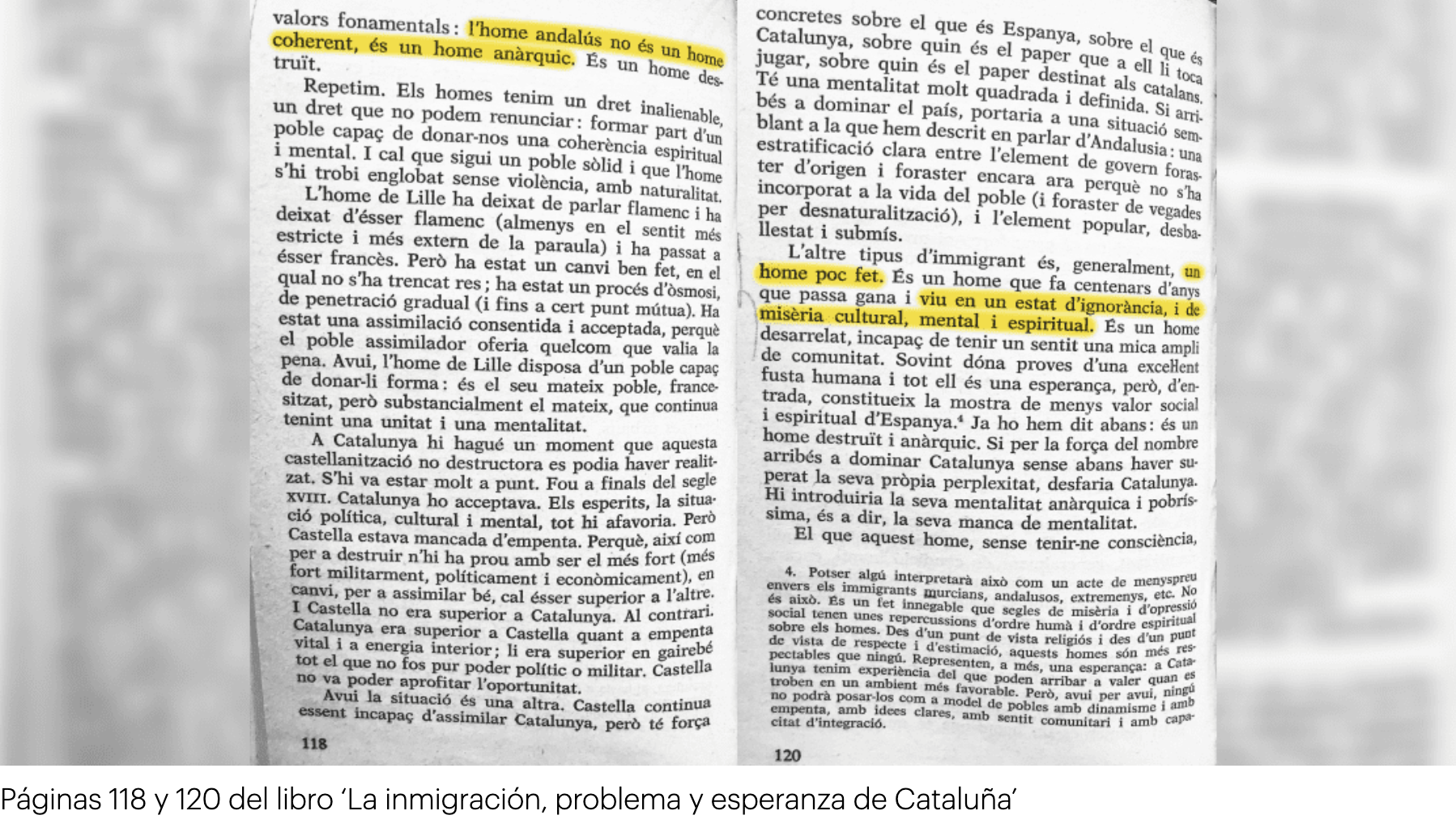
Am I exaggerating? Let us recall what Jordi Pujol, President of the Generalitat between 1980 and 2003 and the most influential political figure in Catalonia over the past half century, wrote:
“The Andalusian man is not a coherent man; he is an anarchic man. He is a destroyed man. (…) The other type of immigrant is, generally, an unformed man. He is a man who for hundreds of years has gone hungry and has lived in a state of ignorance and of cultural, mental, and spiritual poverty.”
What Jordi Pujol wrote is particularly relevant, as he did so at a time (the 1970s) when Catalonia was home both to those whose families had lived in the region for generations and to more than two million people who had come from other parts of Spain. These were the people then referred to as charnegos, a term that included not only recent arrivals but also their children, many of whom had already been born and raised in Catalonia. Pujol’s reflection was therefore not abstract, nor a historical reconstruction in the manner of Antoni Rovira i Virgili; rather, it was directly relevant to a society in which groups of people could be distinguished on the basis of their family origins. The disparaging words of the man who would later serve for more than twenty years as President of the Generalitat stigmatized a collective that had a significant presence in the region he would go on to govern.
In other words, Catalan nationalism is, to some extent, built upon a caricature of history that portrays “Castilians” as harmful to Catalonia and its development and, at the same time, upon stereotypes in which the supposedly “elevated” character of the Catalan spirit and its capacity for work and innovation are contrasted with the economic, moral, and intellectual poverty attributed to other peoples of Spain—or to Spaniards more generally. This is not a subterranean phenomenon; rather, it finds expression in official institutions (the Rovira i Virgili University mentioned earlier, street names filled with the figures of early twentieth-century Catalan nationalist ideologues) and in public figures, beginning with the most prominent name in Catalan nationalism of the late twentieth and early twenty-first centuries, Jordi Pujol and his “destroyed” Andalusian man.
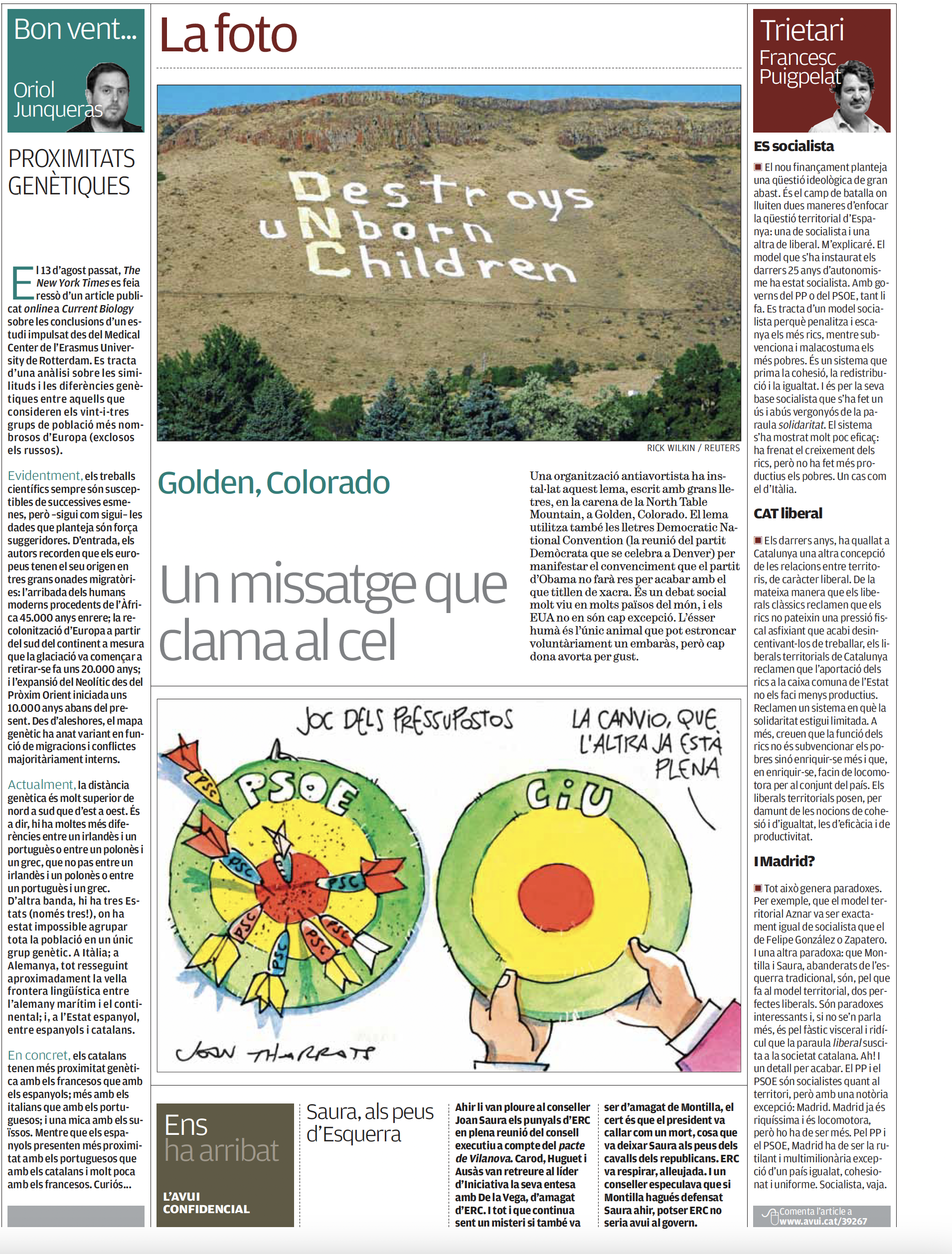
Examples could be multiplied; to conclude with just two, one relatively recent instance is the reflection by Oriol Junqueras on genetic differences between Catalans and the rest of the Spaniards (“the Spaniards,” for Junqueras, who does not regard Catalans as Spanish).
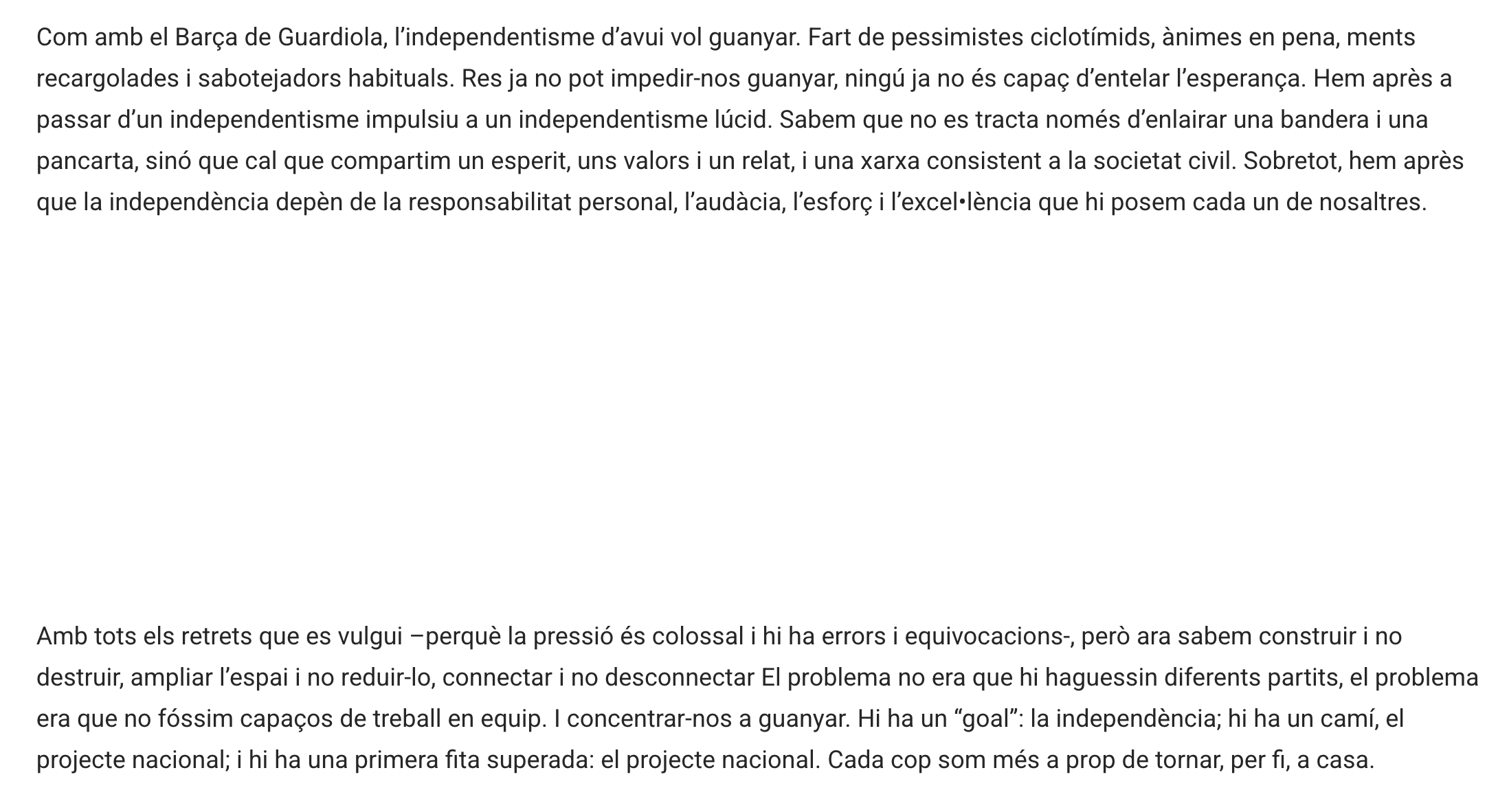
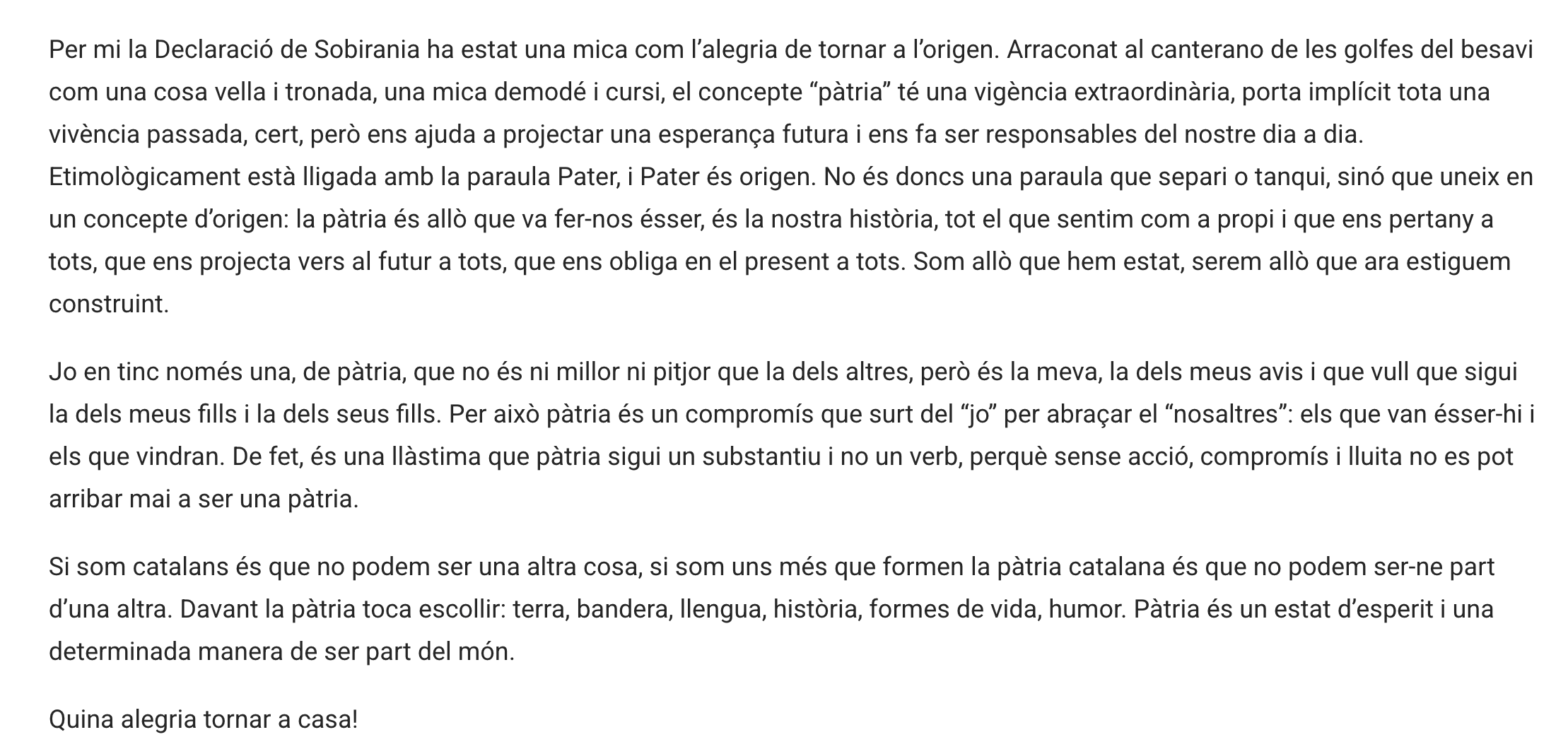
And two articles by the third-to-last President of the Generalitat, Quim Torra. The first, from 2015, in which he states that Catalans have spent 289 years enduring what no civilized people has ever endured. Spain exercises its right of conquest and humiliates with the harshest contempt; a situation that must lead to the recovery of the “homeland,” an exclusionary concept (if we have one homeland—the Catalan one—we cannot have any other) that gives meaning to the struggle.
There are many more examples; but I have chosen these because they come from individuals who have occupied the highest positions within Catalan institutions. Two have served as Presidents of the Generalitat, and Oriol Junqueras is the leader of a party that has held the presidency of the Generalitat and has been part of its government at various times. At present, although not part of the government, he supported the current President of the Generalitat, Salvador Illa.
In other words, the stigmatization of Spain (understood as an entity to which Catalonia should not belong) and of non-Catalan Spaniards (“Castilians”) is an essential part of Catalan nation-building; both through a particular interpretation of history and through the reaction to the arrival of workers from other parts of Spain in the mid-twentieth century—a reaction in which stereotypes about the supposed “superiority” of Catalans (cultured, enterprising, hardworking, and peaceful) over “Spaniards” (uncultured, lazy, primitive, and violent) took hold in certain segments of society. The fact that leaders such as Jordi Pujol or Quim Torra expressed such ideas openly, even in writing, is evidence of this.
Those of us who disagree with nationalism in Catalonia experience this on a daily basis. Insults linked to our condition as “outsiders” (and directed even at people born in Catalonia but from families originating elsewhere) are commonplace and take many forms, especially on social media, where Spain, Spaniards, and their symbols are frequently denigrated.
This connects with a discourse that insists on the “colonization” of Catalonia and on labeling as “colonists” those who do not share nationalist positions.
As can be seen, this is nothing more than a crude translation of the basic premise of Catalan nationalism: nation-building through opposition to an external power that constrains its development. An external power that is also associated with individuals whose values and abilities are portrayed as inferior to those attributed to “Catalans.” I use quotation marks because the concept of “Catalan” employed by nationalism excludes many citizens of Catalonia—either because they do not share the Catalan language as a defining identity marker or because they support Catalonia’s continued integration within Spain.
IV. Hate Speech and Hispanophobia
1. Hate Speech and the Limitation of Rights
Can the foregoing be considered a manifestation of hate speech? From my perspective, the answer is already yes; but in order to justify it, we must first pause to consider what hate speech entails and why it must be addressed—a task I undertook a few months ago in another post.
There, I argued that any intervention against hate speech—that is, its criminal or administrative prosecution, or the restriction by other means of speech deemed hostile toward a given group—affects freedom of expression and must therefore be properly justified. Such justification exists when words (speech) can lead to an effective limitation of the rights of the members of that group, who are harmed precisely because of their belonging to it. Without such an effective limitation of rights, there would be no grounds for restricting freedom of expression, however unpleasant or misguided the speech might be. This is because freedom of expression is the cornerstone upon which public debate in a democratic society rests—the debate that is a necessary precondition for the decisions that determine the course of that society.
This limitation of rights is what, in each historical and geographical context, allows us to identify what constitutes a vulnerable group in the sense required by the hate speech framework. It is important, in my view, to anchor the identification of a group as susceptible to hate speech in the effective limitation of rights, because a priori categorizations can easily turn hate speech regulation into a tool of asymmetric censorship. It is more meaningful to start from the actual limitations of rights suffered by the members of a given group by virtue of belonging to it, and from there to assess how the denigration, stigmatization, or caricaturing of that group may contribute to such limitations of rights—thus justifying their classification as hate speech. This approach is consistent with General Policy Recommendation No. 15 on combating hate speech adopted by the European Commission against Racism and Intolerance.
2. Limitation of Rights and Nationalism in Catalonia
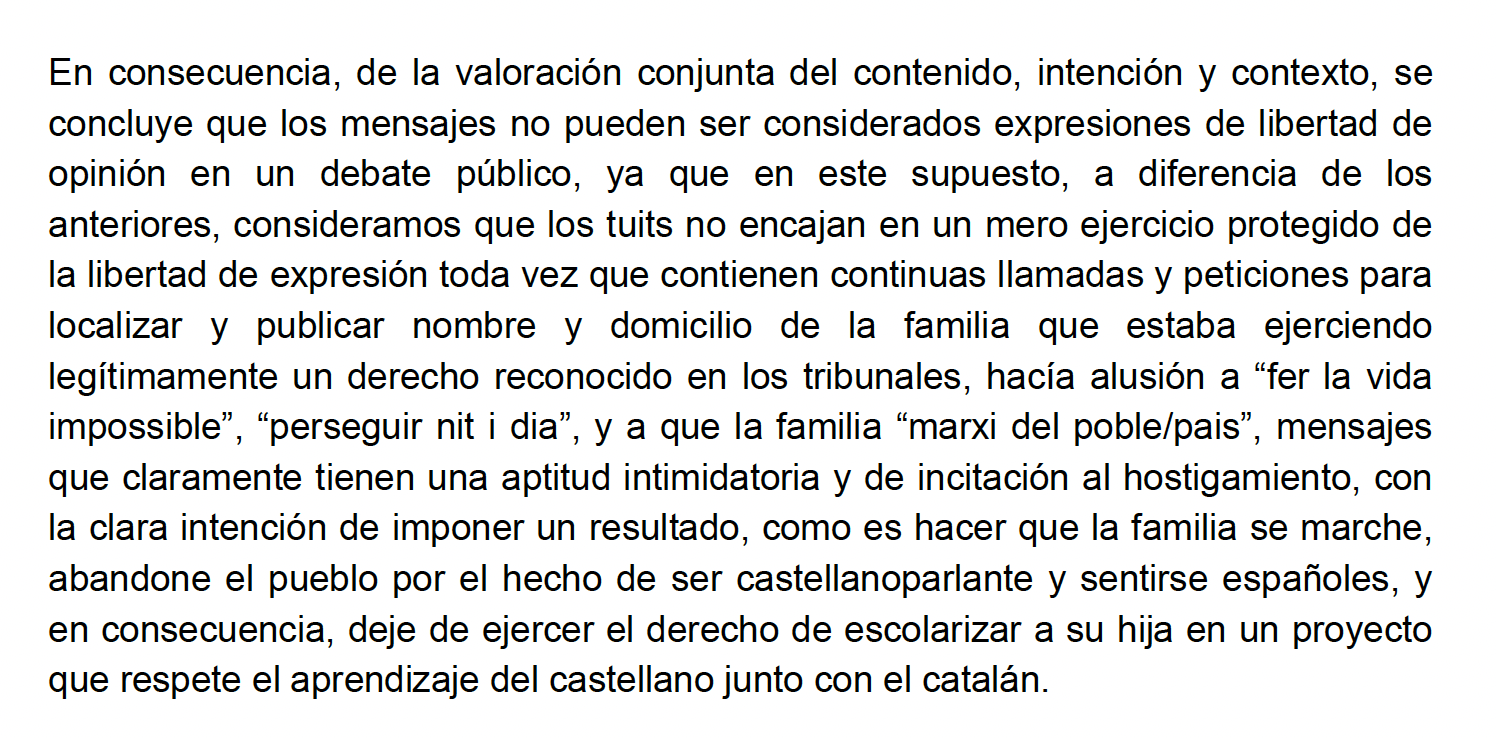
In the case at hand, such limitations of rights—affecting those who belong to groups that dissent from nationalist positions—do exist. Recently, it has been judicially established that hostile messages directed at those who identify with the Spanish language and the Spanish nation may constitute hate speech. This ruling relates to the harassment suffered by the family in Canet de Mar who obtained a court decision guaranteeing their daughter an education in which both Catalan (75%) and Spanish (25%) would be present; this led to calls on social media to identify the family so that they would be forced to leave. In other words, their identification as Spanish speakers and their sense of Spanish identity were decisive factors in attempts to restrict their rights.
Limitations of rights affecting those who dissent from nationalism in Catalonia occur with some frequency. One example is the restriction on access to an education in which Spanish, alongside Catalan, serves as a language of instruction. Beyond the case referred to in the judgment mentioned above, there have been others in which families requesting bilingual education were harassed or had their businesses boycotted, with the clear intention of forcing them to abandon their demand for schooling in which Spanish is used as a language of instruction.
More recently, an amateur theatre group was also boycotted as a result of a play in which it questioned language policy in Catalonia.
Finally, limitations of rights can also be observed affecting non-nationalist students at Catalan public universities. In some cases, it has been judicially declared that academic authorities violated students’ fundamental rights by restricting their activities on campus for ideological reasons; in others, harassment suffered on university campuses at the hands of nationalist groups has led to criminal convictions. I have addressed these issues in some detail here.
This limitation of rights affecting members of a particular group in Catalonia is quite clearly connected to what was noted at the outset: Catalan nationalist identity is, to a significant extent, constructed through opposition to Spanish identity, with Spain and Spaniards also being held responsible for having historically limited the possibilities of the Catalan nation. This narrative is projected onto those who, while living in Catalonia, have family origins in other parts of Spain and do not accept nationalist positions (which translates, for example, into advocating for bilingual education or questioning language requirements for access to employment). There is an additional nuance to consider: individuals of Catalan family origin and with Catalan as their mother tongue may also experience these same limitations of rights if they do not share the nationalist outlook. The label reserved for such individuals is botiflers—that is, traitors (although the term originally had a different meaning).
The necessary conditions are therefore present for the need to monitor, in Catalonia, discourse aimed at fostering hostility or contempt toward “Castilians,” Spain, Spanish identity, including its language. This is not arbitrary; rather, it responds to the real existence of limitations of rights connected to individuals’ belonging to a particular group—a group that is clearly defined by its opposition to Catalan nationalist positions, as explained above.
V. Hate Speech and Public Institutions
From what has been set out so far, it follows that there is a form of hate speech in Catalonia directed at Spain, Spaniards, and those Catalans who dissent from nationalist positions and identify as Spanish. This discourse is also linked to the limitation of certain rights affecting the members of this group—limitations that materialize, above all, in the areas of linguistic rights and freedom of expression.
In light of this reality, it is striking that not only anonymous individuals or those without public relevance take part in this discourse of hate, but that it is also reinforced from within public institutions. In this regard, it is noteworthy that, on the website of Catalonia’s public radio, the following message could be seen just a few days ago:
The issue is not that such a statement might be made by a commentator (although I would invite readers to replace “Castilians” with any other group and consider how it would be perceived); rather, it is that the website of a public radio broadcaster would feature, as a highlighted message, the claim that “Castilians are rude people.” This is, I believe, unacceptable.
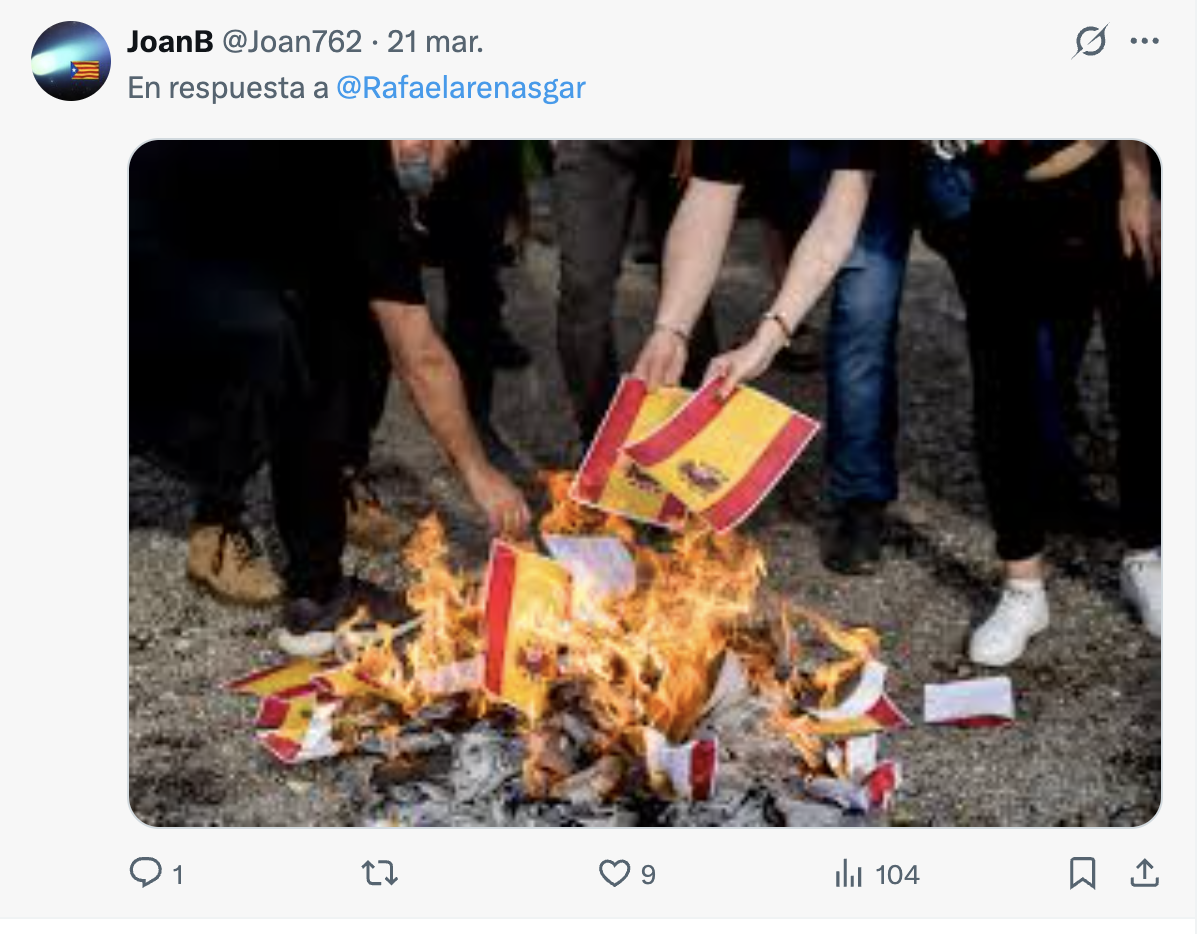
Along the same lines, there is a clear disparity in how groups are treated: the group identified with Spain and Spanish identity is treated differently from others. Offensive messages about Spain on social media, or the burning of Spanish flags, are regarded as expressions of free speech; whereas equivalent actions directed at other groups are investigated as hate crimes.
In other words, public authorities in Catalonia find it difficult to acknowledge that there exists a form of hate speech directed at Spain and Spaniards that also has an impact on the limitation of individual rights. However, in light of what has been discussed so far, this is not surprising; since public power in Catalonia is exercised by openly nationalist parties or by others (such as the PSC) which, despite not defining themselves as nationalist, have nevertheless adopted the nationalist narrative—both symbolically, in linguistic matters, and, to a significant extent, in their understanding of the relationship between Catalonia and the rest of Spain.
As we have seen, from a nationalist perspective there are clearly “good” actors (Catalans) and “bad” ones (Spaniards). The schematic and somewhat naïve framework of early twentieth-century Catalan nationalism has enjoyed institutional continuity and constitutes the foundation upon which the political positions of Catalanist parties are built—including, of course, the PSC and the various configurations of the parliamentary left in Catalonia.
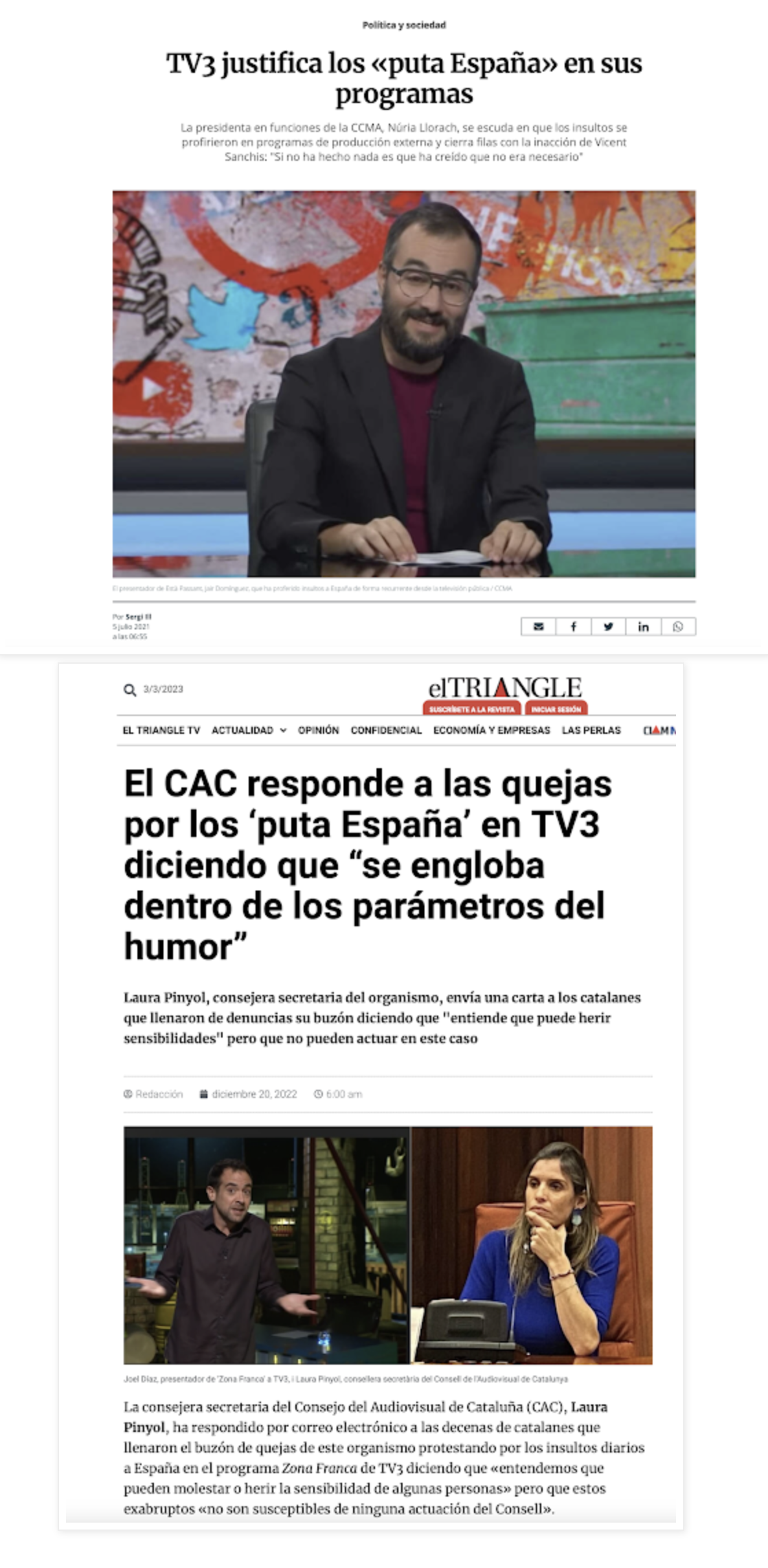
According to this nationalist framework, there is no symmetry between Catalanist positions and—not even “Spanish nationalist” ones—but simply those that defend equality of rights and the validity of constitutional principles. Meanwhile, slogans such as “Puta Espanya” may even receive a degree of institutional tolerance.
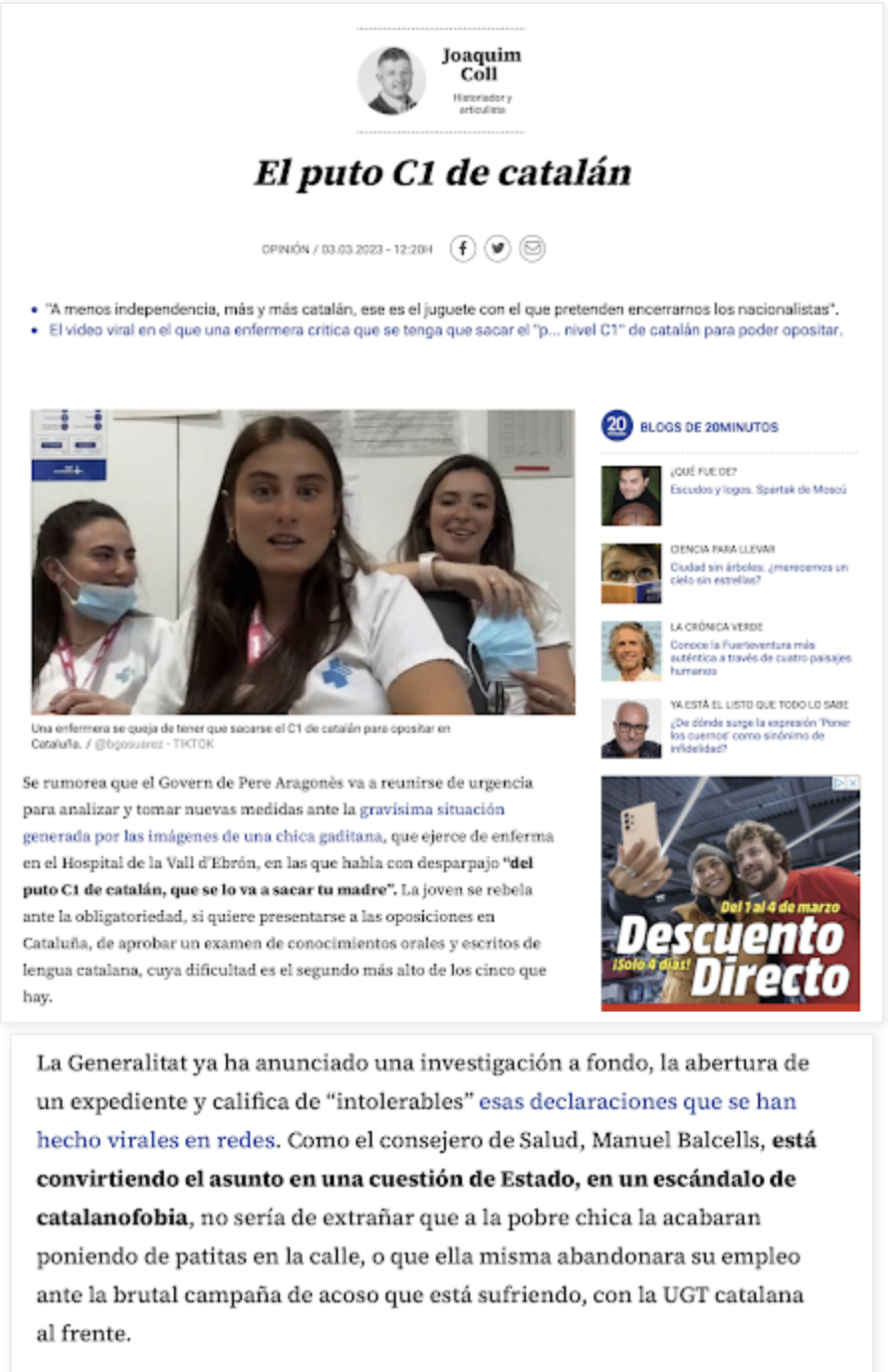
Criticism of the requirement of a C1 level in public healthcare recruitment examinations led to the initiation of disciplinary proceedings against a nurse of Andalusian origin.
From this perspective, it is inconceivable that insults directed at “Spaniards” or threats on social media would be prosecuted or investigated as hate speech. In such cases, they are regarded as legitimate exercises of freedom of expression, whereas any criticism of nationalism is liable to be portrayed as Catalanophobia—because here, it is considered necessary to ensure that freedom of expression does not become hate speech.
The result is that the narrative of hate speech is used by public authorities as a form of censorship, while at the same time preventing that same narrative from being used to challenge contempt or hostility emanating from those very authorities against those who dissent. This is, undoubtedly, a highly dangerous scenario.
VI. Conclusion
Hate speech is a complex concept that must be examined with particular care when it is the public authorities themselves who tolerate—or promote—the delegitimization of a group on identity-based grounds.
In such a context, the risk is twofold: on the one hand, a form of discourse is normalized that erodes social coexistence; on the other, the notion of “hate speech” is instrumentalized to disqualify or limit legitimate criticism of those in power. The result is a troubling inversion of terms: those who engage in hostility are protected, while those who dissent are singled out.
A plural society is grounded in freedom of expression. At the same time, it is legitimate to protect public debate from the disparagement of groups when such disparagement may lead to effective limitations of rights. What is unacceptable is for public authorities to tolerate such disparagement as a legitimate exercise of freedom of expression and, at the same time, invoke hate speech in order to restrict criticism of their own policies.
SUMARIO: I. La construcciónn de la identidad y sus enemigos. II. La construcción de la identidad catalana. III. De España a los españoles. IV. Discurso de odio e hispanofobia: 1. Discurso de odio y limitación de derechos. 2. Limitación de derechos y nacionalismo en Cataluña. V. Discurso de odio e instituciones públicas. VI. Conclusión.
I. La construcción de la identidad y sus enemigos
La construcción de la identidad de un grupo suele implicar la oposición a otro u otros grupos. Es un fenómeno trivial que hemos experimentado casi todos. Desde los clubs de fútbol (¿qué une más que la rivalidad de un Barça-Madrid, Espanyol-Barça, Oviedo-Sporting, Athletic-Real Sociedad, Betis-Sevilla…?) a las rivalidades locales entre pueblos vecinos o entre tribus urbanas. No es diferente con las naciones. La identidad nacional, en parte, surge de la oposición a otros países. Las virtudes propias se destacan y, casi inevitablemente, los conflictos con otras naciones acaban presentándose como una disputa entre «buenos» (la nación propia) y «malos» (los otros). Se ve con claridad en estos 30 segundos de Lady Hamilton, la película de Alexander Korda, donde en menos de un minuto se explica por qué el Imperio Británico es tan bueno y cómo, en consecuencia, son tan malos quienes le atacan.
El Imperio británico es una comunidad en la que cada territorio tiene su fin y propósito; pero hay personas que, por ambición, desean destruir lo que otros han construido. Así se explica y justifica la acción de Inglaterra en otros lugares y, a la vez, se descalifica a quienes se le oponen. Nítido como el cristal.
II. La construcción de la identidad catalana
La construcción de la nación catalana sigue el mismo patrón: hay que encontrar elementos que le den una entidad que, además, ha de permitir diferenciar a los catalanes dentro de la comunidad en la que históricamente se integraban sin mayor debate, la que forman el conjunto de los españoles. Se necesita, por una parte, una determinada explicación de la historia en la que los catalanes reúnen una virtudes especiales. Y aquí, por ejemplo, encaja tanto el fantasioso discurso de Pau Casals en las Naciones Unidas que comparto a continuación.
El molde es siempre el mismo: un pueblo que se identifica a partir de elementos positivos (laboriosidad, carácter pacífico y emprendedor…) que tiene su origen ya en la prehistoria y que ha de enfrentarse a quienes, desprovistos de estas cualidades, intentan obstaculizar su avance. Esto se ve ya con claridad en las obras de los nacionalistas catalanes de principios del siglo XX; la época en la que vivió su juventud Pau Casals; lo que, seguramente, ayuda a entender mejor su discurso en las Naciones Unidas de 1971. Así, en el libro de Rovira i Virgili «Historia de los movimientos nacionalistas», publicado originalmente entre 1912 y 1914 se lee (la traducción al castellano es mía):
Este territorio lingüístico se acerca mucho al área primitiva de la raza íbera, de donde provienen los catalanes. Prat de la Riba dice: «Cuando el viajero fenicio que copió Avienus, ciento cincuenta años antes de Cristo, recorría la costa del mar Sardo, se encontró allí la etnos ibérica, la nacionalidad íbera, extendida desde Murcia hasta el Ródano, esto es, desde los pueblos libiofenicios de Andalucía oriental hasta los ligures de la Provenza. Aquellas gentes son nuestros antepasados, aquella etnos ibérica, el primer anillo que la historia nos deja ver de la cadena de generaciones que han forjado el alma catalana».
Pronto el territorio de la ráza íbera, fácil para las incursiones, fue invadido por otras razas (…). Pero al romperese el Imperio romano por el empuje de los bárbaros, y al aparecer los núcleos medievales que darán lugar a las nacionalidades históricas, la vieja raza ibérica resurgió, marcada por la huella poderosa de Roma, pero conservando una viva individualidad étnica.
(…) Pero este hecho histórico [el descubrimiento de América] ho habría tenido una influencia tan funesta sobre nuestra patria, si Castilla no hubiese cometido una gran injusticia. Por el famoso codicilo al testamento de Isabel la Católica, los ciudadanos de la Corona catalanoaragonesa fuero excluidos, bajo pena de muerte, del comercio con las Indias (…). Sin esta prohibición injusta, Cataluña habría llevado su genio de trabajo y de creación a las tierras ultramarinas, se habría convertido, como Inglaterra, en una gran potencia marítima y comercial. La lengua catalana se habría expandido por las Américas; hoy habría, en el nuevo continente, al lado de las naciones de lengua castellana y portuguesa, naciones de lengua catalana, y esta sería una de las grandes lenguas mundiales. La antipatía de Castilla, que se manifiesta en el codicilio de Isabel, destruyó en aquel momento histórico el magnífico futuro que le esperaba a Cataluña».
Y aún sigue el relato; pero con lo que se ha recogido creo que basta: identidad propia y diferenciada frente a los enemigos externos que luchan porque no prospere la nación. Lo mismo que veíamos en la explicación del Imperio británico que le hacen a Emma Hamilton en la película de Alexander Korda.
En principio, este planteamiento debería formar parte de una etapa superada; y en buena medida creo que es así en la mayoría de los lugares. No creo que a nadie en el Reino Unido le parezca sensato lo que veíamos en la película de 1941. Las construcciones nacionales basadas en hipóteticas diferenciaciones étnicas que se remontan a la prehistoria hacen, como mínimo, sonreír; cuando no levantan señales de alarma. Sin embargo, en Cataluña sigue siendo la doctrina oficial. No es baladí recordar que una universidad pública catalana, la de Tarragona, lleva el nombre del autor de los párrafos que reproducía antes, y el discurso de Pau Casals -disparatado en su contenido- está tomado del canal de Youtube del Parlamento de Cataluña.
Es decir, en Cataluña se sigue asumiendo una visión distorsionada de la historia en la que «Castilla» es la causante de que Cataluña no sea una nación con estado propio y próspera; una nación que, en el planteamiento de Rovira i Virgili, hubiera sido equivalente a la Inglaterra del siglo XIX y comienzos del XX.
III. De España a los españoles
Es un planteamiento problemático en sí; pero que todavía es susceptible de empeorar cuando damos el paso de «Castilla» a «los castellanos», que es como algunos denominan a todos los españoles que no tienen origen catalán (entendido catalán como extensivo a Valencia y Baleares). Aquí los castellanos se presentan como colonizadores, dominadores y extractores de la riqueza de Cataluña. Además, sobre ellos se proyectan los tópicos que son propios de todo proceso de construcción de la identidad basados en la oposición a otros grupos. Igual que los catalanes son modernos, trabajadores, cultos y amantes de la paz; los «castellanos» son vagos, violentos, incultos y primitivos.
¿Exagero? Recordemos lo que escribía Jordi Pujol, presidente de la Generalitat entre 1980 y 2003 y la figura más influyente en Cataluña en el último medio siglo:
«El hombre andalúz no es un hombre coherente, es un hombre anárquico. Es un hombre destruido. (…) El otro tipo de inmigrante es, generalmente, un hombre poco hecho. Es un hombre que hace centenares de años que pasa hambre y vive en un estado de ignorancia y de miseria cultural, mental y espiritual».
Esto que escribe Jordi Pujol es relevante, pues lo hace en un momento (años 70 del siglo XX) en el que en Cataluña conviven aquellos cuyas familias vivían desde hacía generaciones en la región con más de dos millones de personas que procedían de otras partes de España. Esto es, los que entonces se denominaban charnegos y que incluían no solamente a los recién llegados, sino también a sus hijos, muchas veces ya nacidos y criados en Cataluña. La reflexión de Pujol, por tanto, no era abstracta o una reconstrucción histórica al estilo de la de Rovira i Virgili, sino que era relevante para una sociedad en la que era posible diferenciar grupos de personas en función de su origen familiar. Las palabras despectivas del que fue durante más de veinte años presidente de la Generalitat estigmatizaban a un colectivo con una presencia significativa en la región que luego gobernó.
Es decir, el catalanismo se construye, en cierta forma, sobre la caricaturización de la historia que convierte a los «castellanos» en malos para Cataluña y su desarrollo y, a la vez, a partir de estereotipos en los que el carácter «elevado» del alma catalana y su capacidad de trabajo e innovación se enfrenta a la miseria económica, moral e intelectual de otros pueblos de España o, en general, de los españoles. No es algo subterráneo, sino que encontramos reflejos de este planteamiento en instituciones oficiales (la Universidad Rovira i Virgili que mencionaba antes, el callejero, lleno de los nombres de los ideólogos del nacionalismo catalán de principios del siglo XX) y en personas de relevancia pública, empezando por el nombre más destacado del nacionalismo catalán de finales del siglo XX y comienzos del XXI, Jordi Pujol y su hombre andaluz «destruido».
Los ejemplos podrían extenderse, por concluir con dos, tenemos relativamente reciente la reflexión de Oriol Junqueras sobre las diferencias genéticas entre los catalanes y el resto de los españoles («de los españoles» para Junqueras, que no considera a los catalanes como españoles).
Y dos artículos del antepenúltimo presidente de la Generalitat, Joaquim Torra. El primero, del año 2015, en el que dice que los catalanes llevan 289 años aguantando lo que ningún pueblo civilizado ha soportado. España ejerce su derecho de conquista y humilla con el desprecio más descarnado; lo que ha de conducir a recuperar la «patria», un concepto excluyente (si tenemos una patria, la catalana, no podemos tener ninguna otra) que da sentido a la lucha.
Y el segundo, más conocido, en el que tacha de bestias a quienes no comparten sus planteamientos sobre la lengua catalana.
Hay muchos más ejemplos; pero he escogido estos porque son de personas que ocupan las posiciones más altas en las insstituciones catalanas. Dos han sido presidentes de la Generalitat y Oriol Junqueras es el líder de un partido que ha ejercido la presidencia de la Generalitat y que ha formado parte de su gobierno en diversos momentos. Ahora mismo, aunque no es parte del gobierno, sí que dio apoyo al actual presidente de la Generalitat, Salvador Illa.
Es decir, la estigamtización de España (entendida como una entidad en la que no se debería incluir Cataluña) y de los españoles no catalanes (los «castellanos») es parte esencial de la construcción nacional catalana; tanto por una determinada explicación de la historia como por la reacción a la llegada de trabajadores de otras partes de España en las décadas centrales del siglo XX; una reacción en la que los tópicos sobre el presunto carácter «superior» del catalán (culto, emprendedor, trabajador y pacífico) sobre el «español» (inculto, vago, primitivo y violento) calaron en ciertas partes de la sociedad; como muestra que líderes como Pujol o Torra no tuvieran problema en expresar esas ideas incluso por escrito.
Quienes discrepamos del nacionalismo en Cataluña lo vivimos cada día. Los insultos vinculados a nuestro carácter de «forasteros» (y que se dirigen, incluso, contra personas nacidas en Cataluña, pero de familias procedentes de otros lugares) son habituales y adoptan formas de lo más diverso, especialmente en redes sociales, donde se denigra a España, a los españoles y a sus símbolos.
Lo que se conecta con un discurso en el que se insiste en la «colonización» de Cataluña y en considerar «colonos» a quienes no comparten los planteamientos nacionalistas.
Como se puede apreciar, no es más que la traducción «grosera» del planteamiento básico del catalanismo: construcción nacional a partir de la oposición con un poder externo que limita el desarrollo propio. Un poder externo que, además, viene de personas con valores y capacidades inferiores a las que identifican a los «catalanes». Y empleo las comillas porque el concepto de catalán que utiliza el nacionalismo excluye a muchos ciudadanos de Cataluña que o bien no comparten la lengua catalana como signo de identidad o defienden la continuidad de Cataluña en España.
IV. Discurso de odio e hispanofobia
1. Discurso de odio y limitación de derechos
¿Puede considerarse lo anterior como una manifestación de discurso de odio? Desde mi perspectiva, ya adelanto que sí; pero para poder justificar la respuesta antes hemos de detenernos en lo que implica el discurso del odio y por qué ha de ser tratado. Una tarea que abordaba hace unos meses en esta otra entrada.
Ahí sostenía que la incidencia en el discurso del odio; esto es, su persecución penal o administrativa o la limitación por otras vías de los discursos que pudieran ser considerados hostiles hacia un determinado grupo de personas, incidía en la liberta de expresión y que, por tanto, cualquier regulación del discurso de odio debía justificarse de manera suficiente. Esa justificación existiría cuando las palabras (el discurso) pudiera incidir en la limitación efectiva de derechos de los integrantes del grupo, que se verían perjudicados precisamente por su pertenencia al grupo. Sin esa limitación efctiva de derechos, no habría razón para limitar la libertad de expresión, por desagradable o equivocado que pudiera ser lo que se dijera; porque la libertad de expresión es la piedra angular sobre la que descansa el debate público en una sociedad democrática, el debate que es antecedente necesario para la adopción de las decisiones que determinen el rumbo de dicha sociedad.
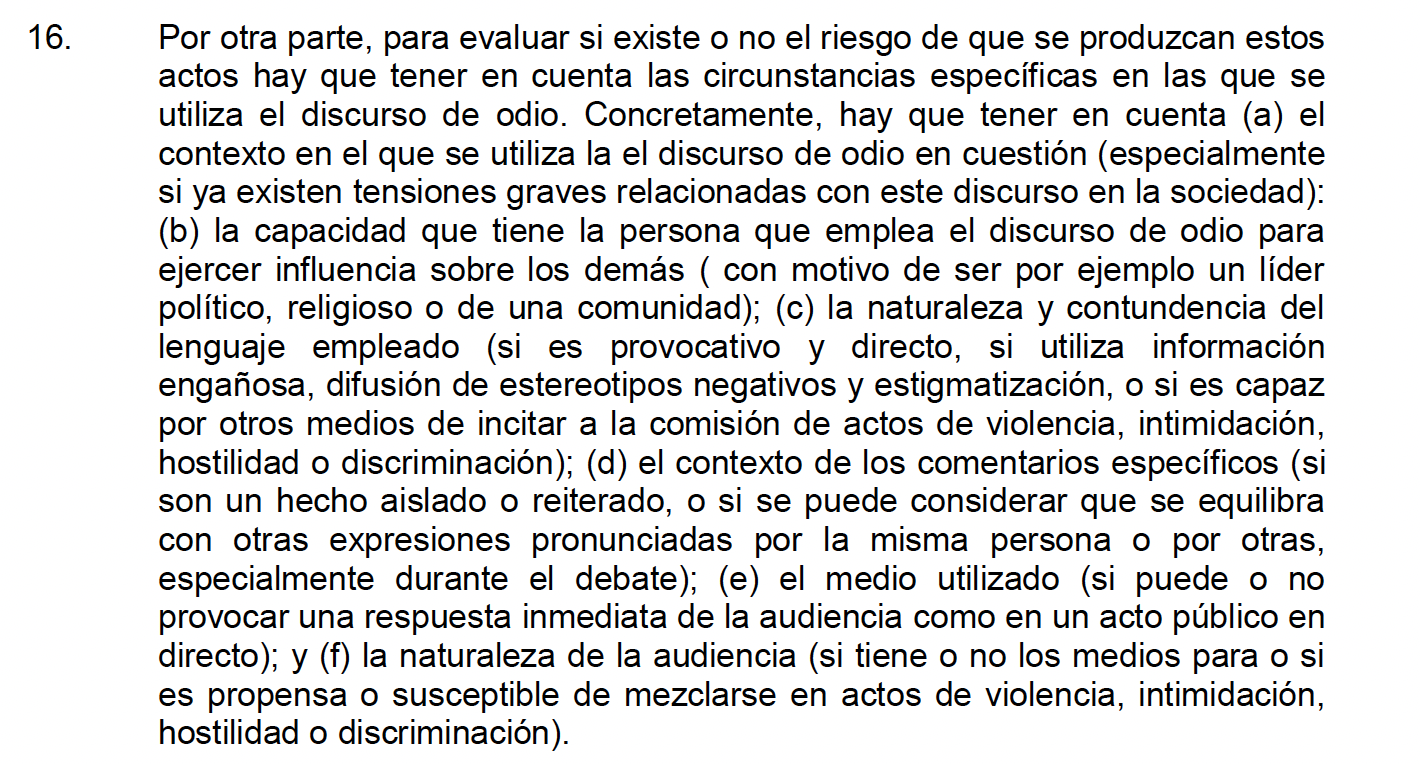
Esta limitación de derechos sería lo que, en cada contexto histórico y geográfico nos permitiría identificar qué es un grupo vulnerable en el sentido requerido por la narrativa del discurso de odio. Me parece importante anclar la identificación de un colectivo como suscpetible de ser víctima del discurso de odio a la efectiva limitación de derechos porque una categorización apriorística puede convertir fácilmente la regulación del discurso de odio en una herramienta de censura asimétrica. Creo que es más significativo partir de las limitaciones de derechos que sufren los integrantes de un determinado colectivo por pertenecer al mismo y, a partir de ahí, ver cómo la denigración de ese colectivo, su estigmatización o caricaturización pueden incidir en esa limitación de derechos; lo que justificaría, precisamente, que tales estigmatizaciones, denigraciones o caricaturizaciones fueran consideradas como discurso de odio. Es una aproximación en línea con la Recomendación de Política General nº 15 relativa a la lucha contra el discurso de odio adoptada por la Comisión Europea contra el Racismo y la Intolerancia.
2. Limitaciones de derechos y nacionalismo en Cataluña
En el caso que nos ocupa ahora, esas limitaciones de derecho, por pertenecer a colectivos que discrepan de los planteamientos nacionalistas existen. Recientemente, se ha declarado judicialmente que los mensajes hostiles hacia quienes se identifican con la lengua castellana y la nación española pueden ser constitutivos de delito de odio. El pronunciamiento se hace en relación al acoso sufrido por la familia de Canet de Mar que obtuvo una decisión judicial que garantizaba a su hija una educación en la que estuviera presente tanto el catalán (75%) como el castellano (25%); lo que motivó que se exigiera en redes sociales identificar a la familia para que tuviesen que marcharse. Es decir, la identificación como castellanoparlantes y el sentimiento de españolidad fue determinante para que se intentase limitar sus derechos.
Las limitaciones de derechos en Cataluña de quienes discrepan del nacionalismo se producen con cierta frecuencia. Así, está la limitación en el aceso a una educación en la que la lengua española, junto con el catalán, sean lenguas vehiculares. Aparte del caso al que se refiere la sentencia que acabo de citar ha habido otros en los que las familias que solicitaban la educación bilingüe fueron acosadas o boicoteados sus negocios con la clara intención de que se desista en la petición de una enseñanza en la que esté presente el castellano como lengua de enseñanza.
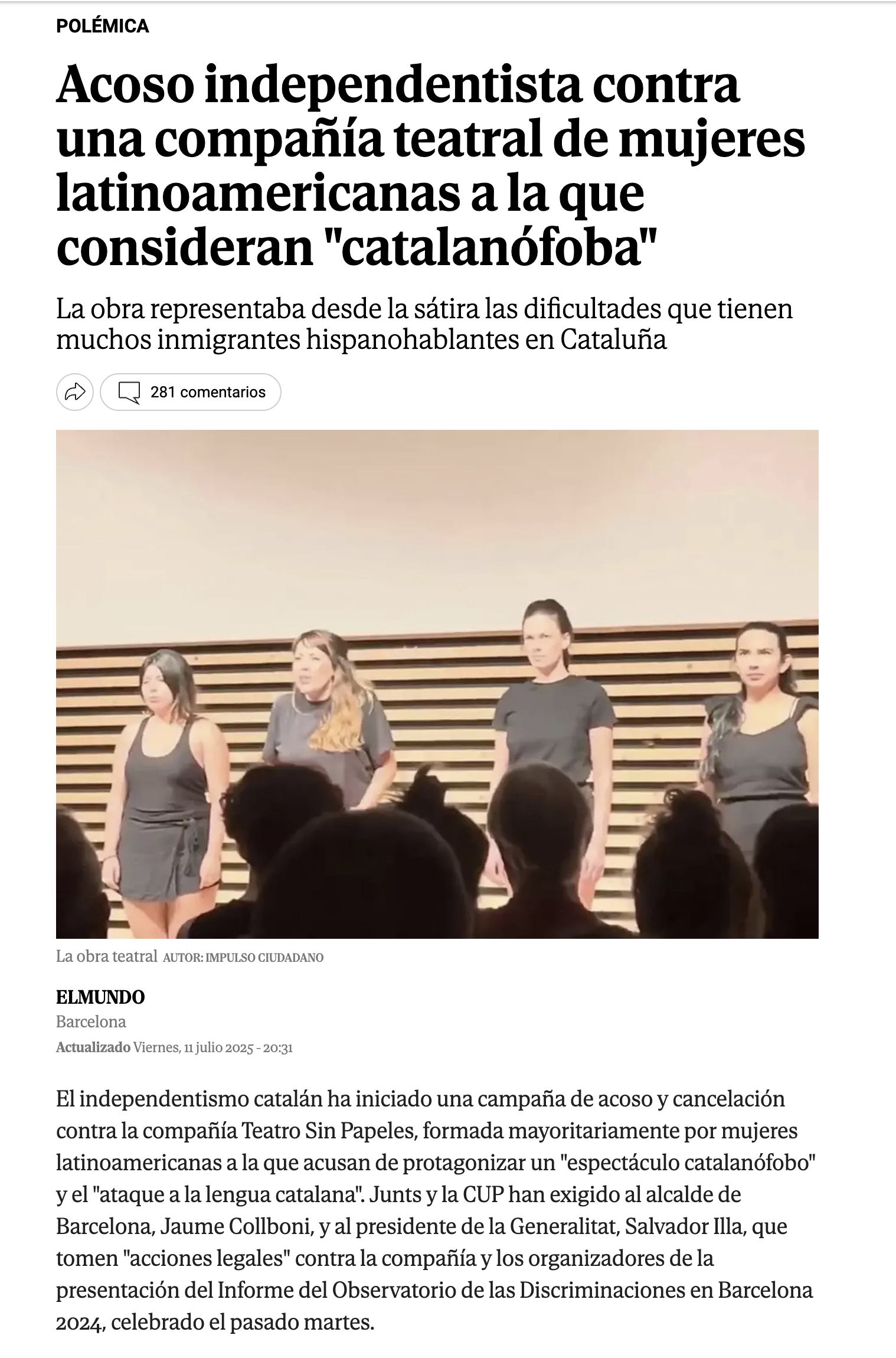
Más recientemente, un grupo de teatro aficionado también fue boicoteado como consecuencia de una obra de teatro en la que cuestionaba la politica lingüística en Cataluña.
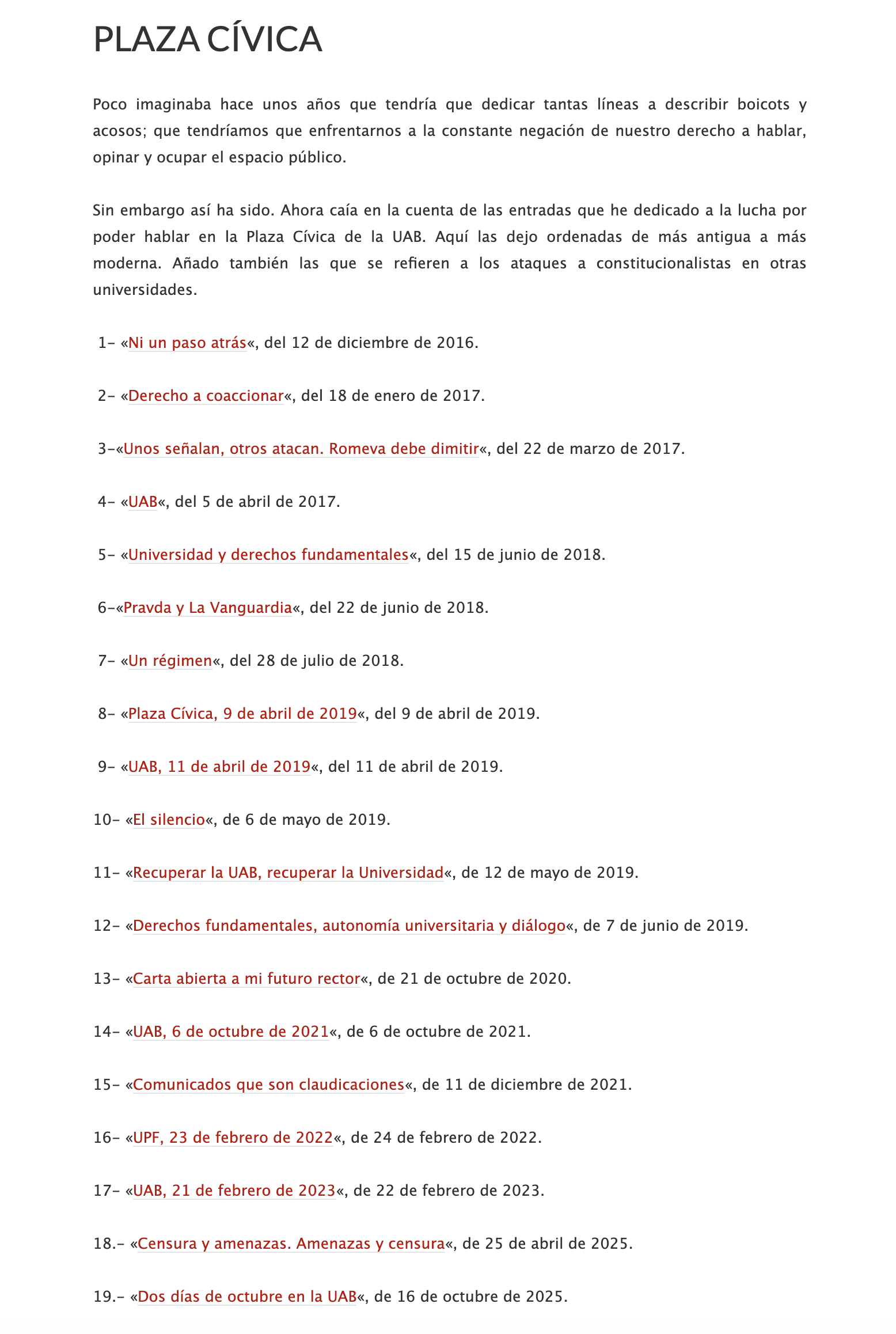
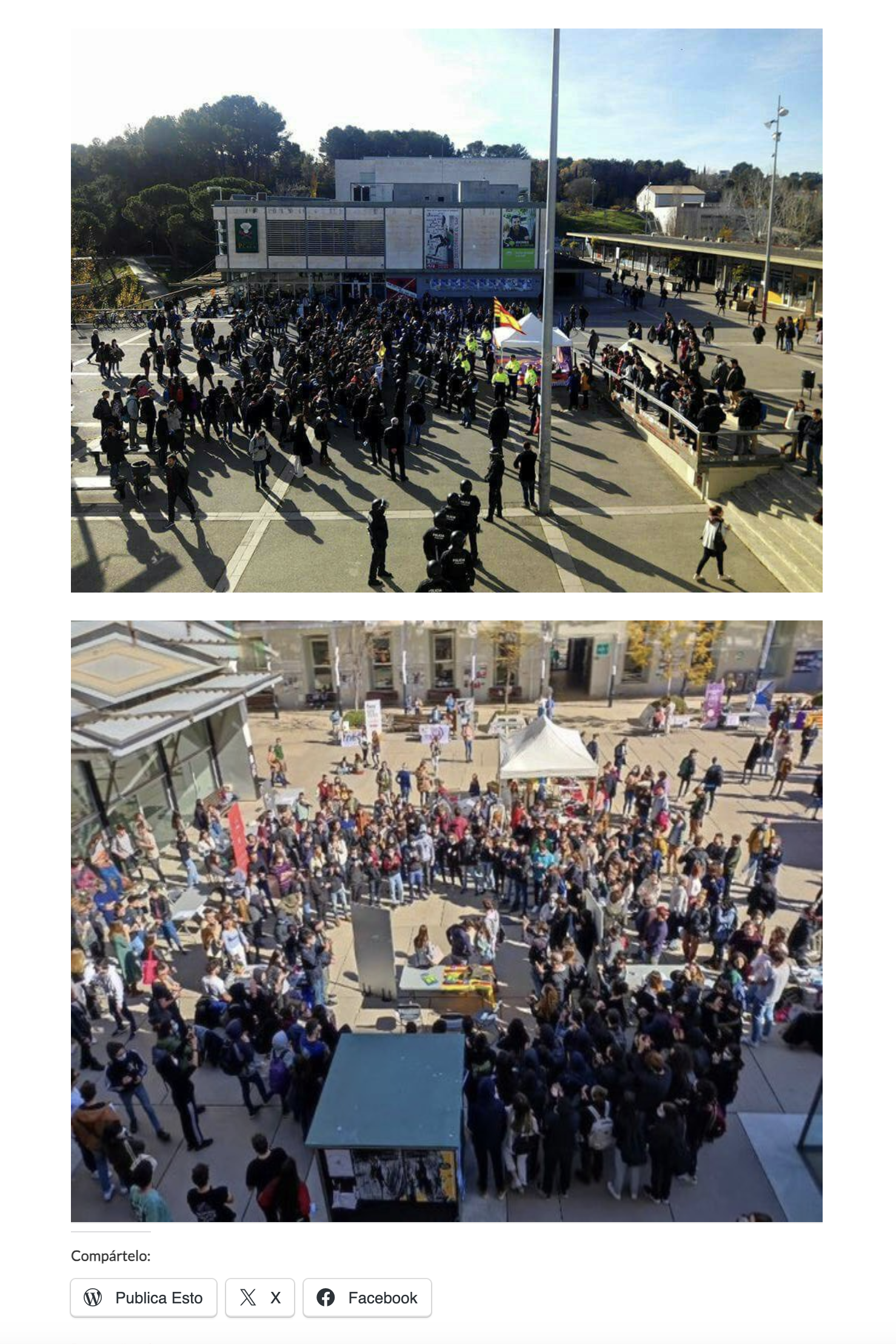
Por concluir, también se aprecia limitación de derechos para los estudiantes no nacionalistas en las universidades públicas catalanas, habiéndose declarado en algún supuesto que las autoridades académicas habían vulnerado los derechos fundamentales de los estudiantes al limitar su actividad en el campus por motivos ideológicos y, en otras ocasiones, se ha condenado penalmente el acoso que sufren en los campus universitarios por parte de grupos nacionalistas. Me he ocupado con algún detalle de todo esto aquí.
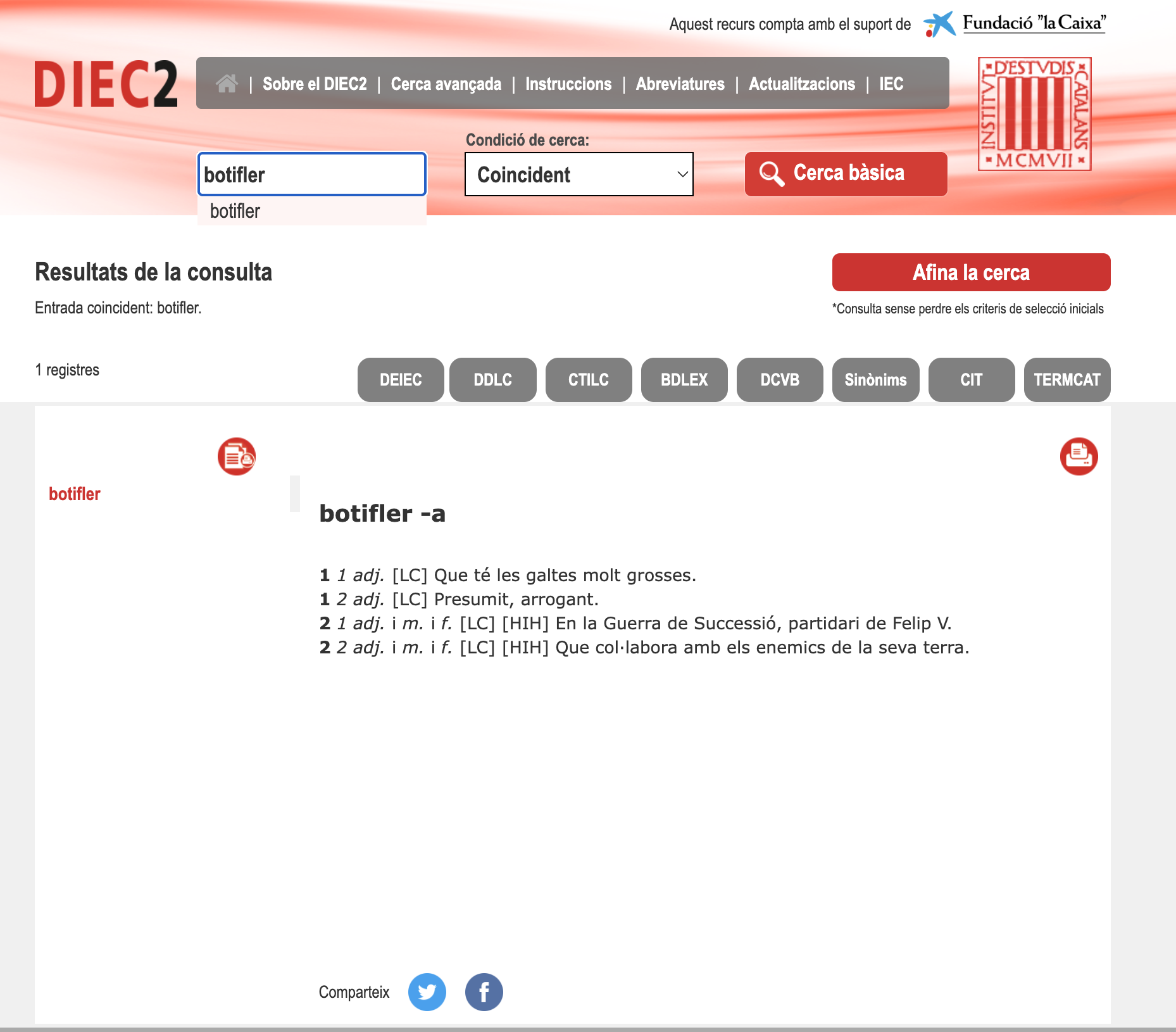
Esta limitación de derechos en Cataluña a los integrantes de un determinado grupo se conecta de manera bastante evidente con lo que comentaba al comienzo: la identidad nacionalista catalana se construye, en buena medida, por medio de la oposición a la identidad española, atribuyéndose, además, a España y a los españoles, haber limitado las posibilidades históricas de la nación catalana. Este discurso se proyecta sobre aquellas personas que, viviendo en Cataluña, tienen sus orígenes familiares en otras partes de España y no aceptan los planteamientos nacionalistas (lo que se traduce, por ejemplo, en reivindicar una enseñanza bilingüe o en cuestionar los requisitos lingüísticos para acceder a un puesto de trabajo). A esto aún hay que añadir un matiz: personas de orígenes familiares catalanes y de lengua materna catalana pueden sufrir esta misma limitación de derechos si no comparten el planteamiento nacionalista. El calificativo que se reserva para estas personas sería el de «botiflers«, esto es, traidores (aunque el origen del término es otro).
Se dan, por tanto, las circunstancias necesarias para que deba vigilarse en Cataluña el discurso que tiene por objeto fomentar la hostilidad o el desprecio hacia «los castellanos», España, la identidad española, incluida su lengua. No es un capricho, sino que responde a la existencia real de limitaciones de derechos conectadas a la pertenencia de los individuos a un determinado grupo, un grupo que se identifica, de manera precisa, por su oposición a los planteamientos nacionalistas catalanes de acuerdo con lo que se ha explicado hasta aquí.
V. Discurso de odio e instituciones públicas
De lo expuesto hasta ahora, se desprende que existe un discurso de odio en Cataluña dirigido a España, los españoles y aquellos catalanes que discrepan del planteamiento nacionalista y se identifican como españoles. Este discurso se conecta, además, con la vinculación de determinados derechos que experimentan los integrantes de este grupo; limitaciones que se concretan, fundamentalmente, en los derechos lingüísticos y la libertad de expresión.
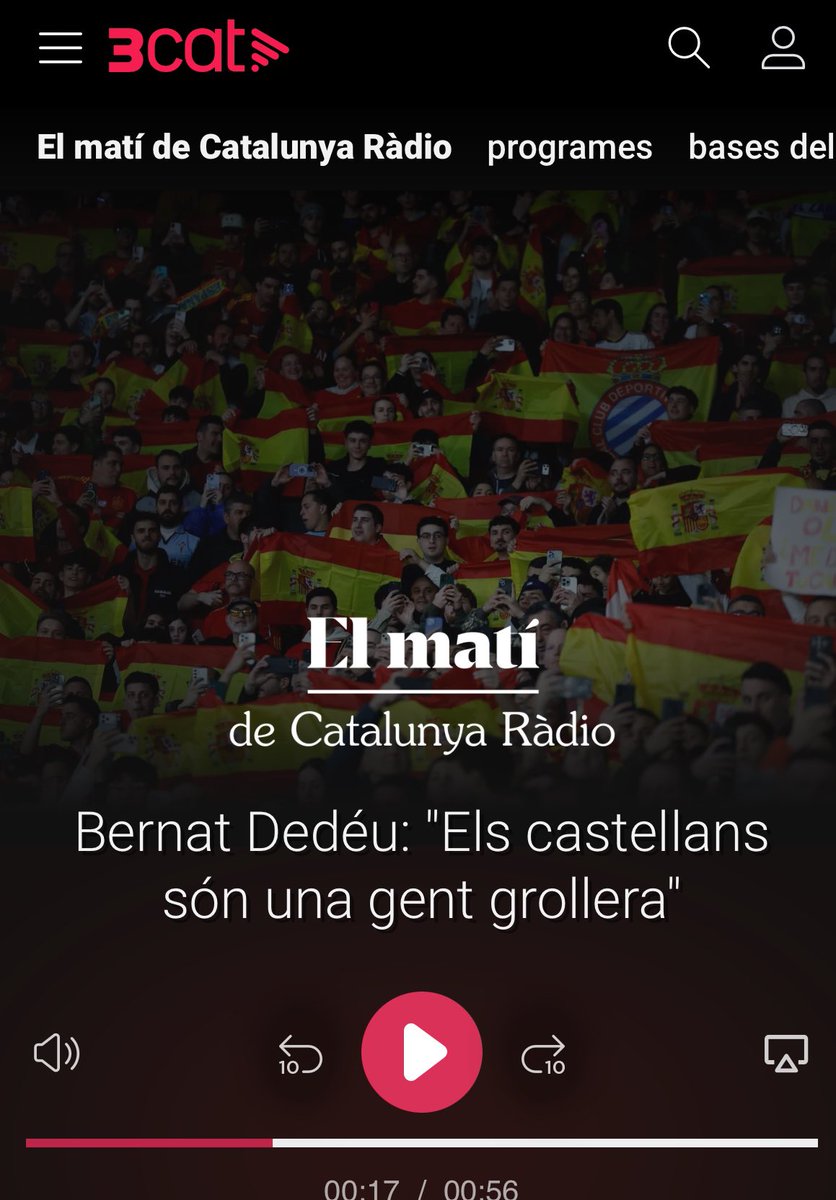
Ante esta realidad, llama la atención que no solamente personas anónimas o sin relevancia pública participen en este discurso de odio, sino que desde el poder público se profundice en él. En este sentido, es llamativo que en la web de la radio pública de Catalunya pudiera verse, hace pocos días, este mensaje:
No se trata de que lo diga un tertuliano (aunque invito a que sustituyan «castellanos» por cualquier otro colectivo y ver qué les parece); sino que la web de la radio pública mantenga como destacado este mensaje, «los castellanos son personas groseras». Resulta, creo, inadmisible.
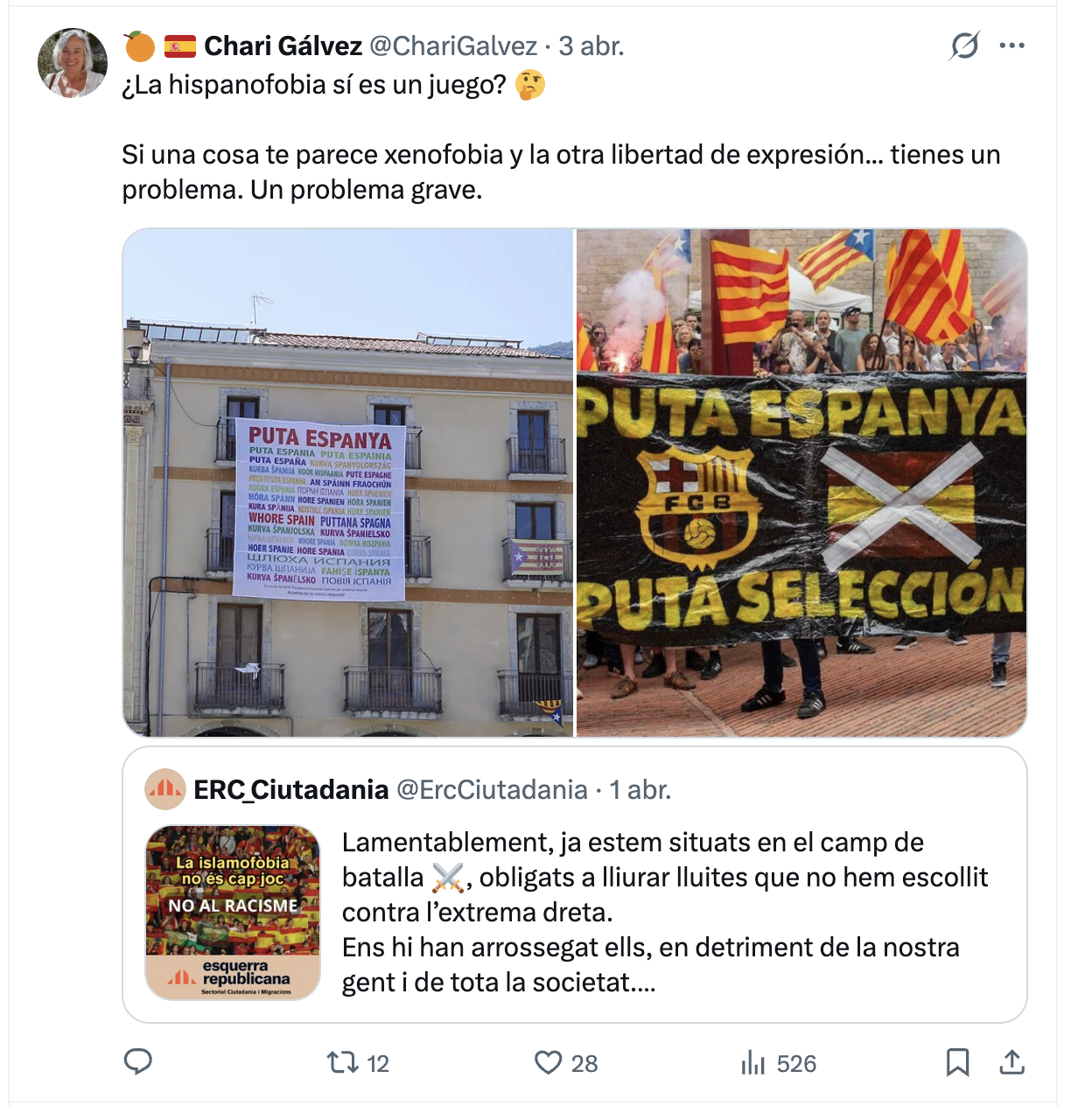
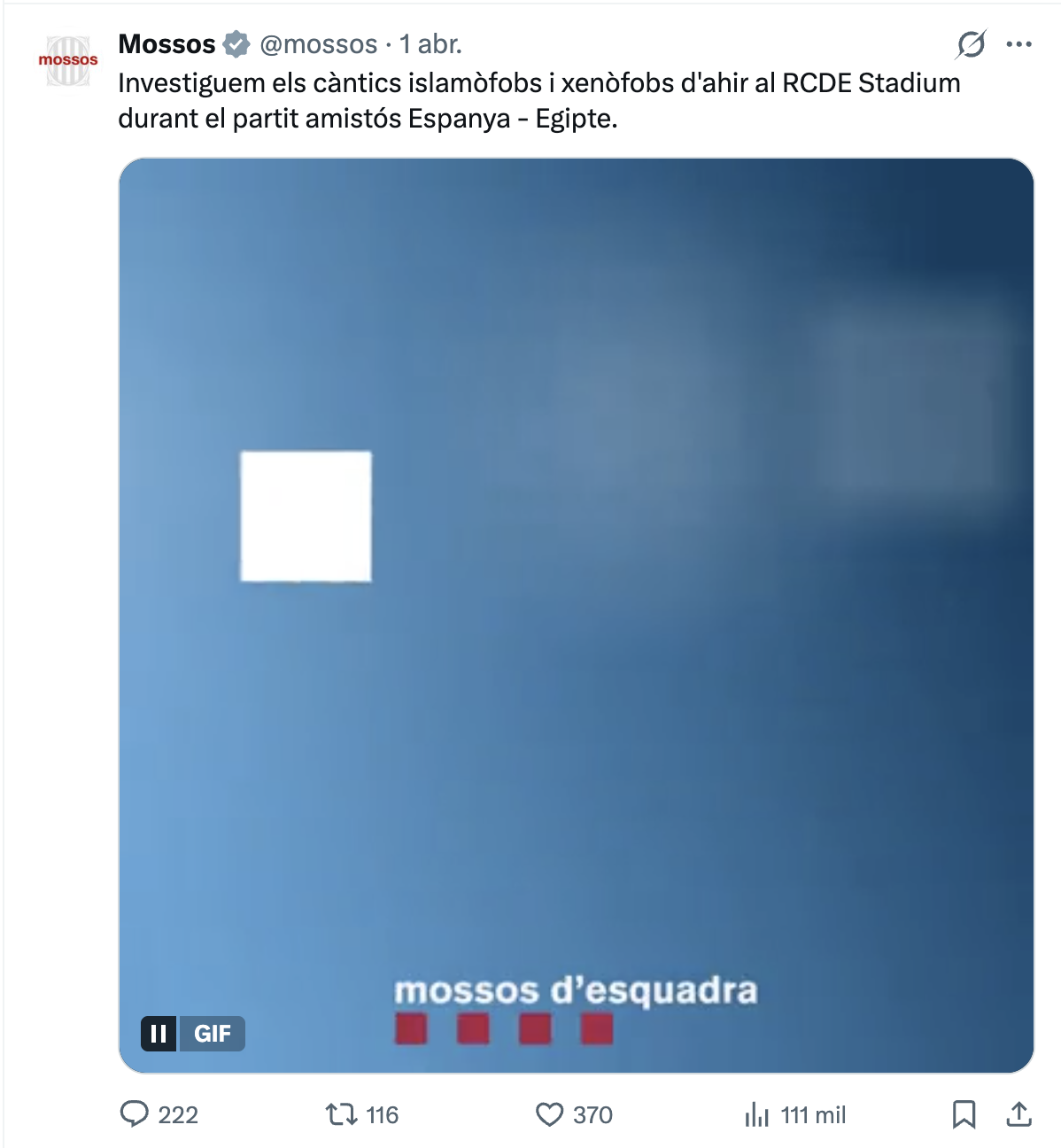
En la misma línea, se aprecia una evidente desigualdad de trato entre el colectivo identificado con España y la identidad española y otros colectivos. Mensajes ofensivos para España en redes sociales o quema de banderas españolas se consideran libertad de expresión; mientras que acciones equivalentes en relación a otros colectivos son investigados como delitos de odio.
Es decir, al poder público en Cataluña le cuesta asumir que existe un discurso de odio hacia España y los españoles que tiene incidencia, además, en la limitación de derechos individuales. Ahora bien, de acuerdo con lo que se ha visto hasta ahora, no es extraño que así sea; puesto que el poder público en Cataluña se ejerce por partidos abiertamente nacionalistas o por otros (PSC) que, pese a no declararse nacionalistas, han asumido el relato nacionalista, tanto en lo simbólico, como en temas lingüísticos y también, en buena medida, en la relación entre Cataluña y el resto de España.
Y, como hemos visto, desde el punto de vista nacionalista hay claramente unos «buenos» (los catalanes) y unos «malos» (los españoles). El planteamiento esquemático e ingenuo del nacionalismo catalán de principios del siglo XX ha tenido continuidad institucional y es el sustrato sobre el que se construyen los planteamientos políticos de los partidos catalanistas, incluido aquí, por supuesto, el PSC y las diferentes configuraciones de la izquierda con representación parlamentaria en Cataluña.
De acuerdo con este sustrato nacionalista no hay simetría entre los planteamientos catalanistas y, ya no los «españolistas»; sino simplemente aquellos que defienden la igualdad de derechos y la vigencia de los principios constitucionales. Mientras el «Puta Espanya» puede tener hasta reconocimiento institucional.
La crítica a la exigencia del nivel C1 en las oposiciones sanitarias condujo a iniciar un procedimiento sancionador contra una enfermera de origen andaluz.
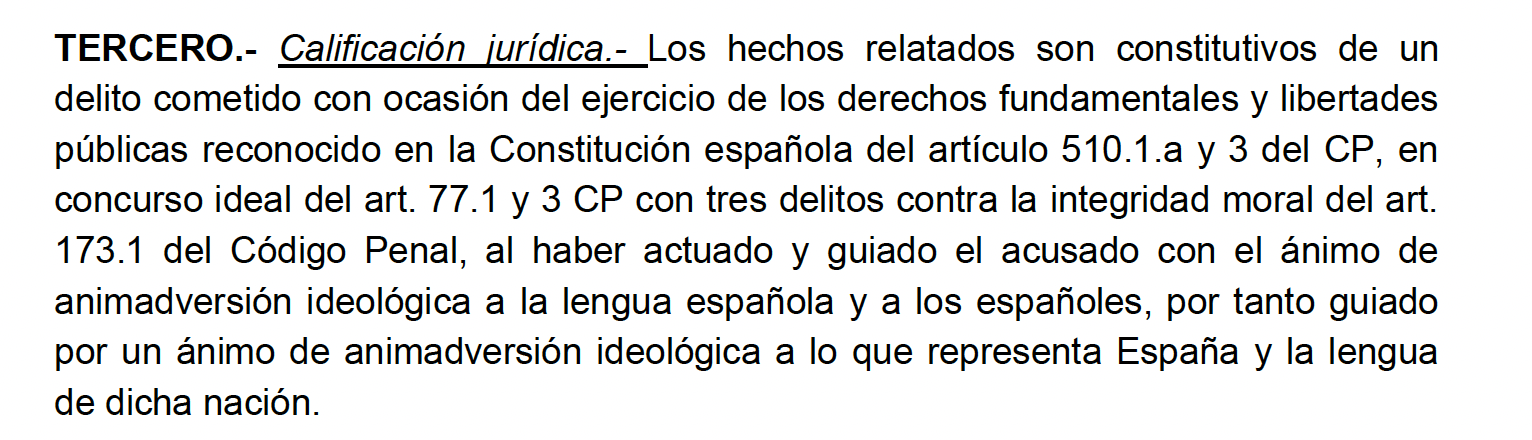
Desde esta perspectiva, es impensable que los insultos a los «españoles», las amenazas en redes sean perseguidas o investigadas como discurso de odio. En estos casos se entenderá que son ejercicios legítimos de la libertad de expresión, mientras que cualquier crítica al nacionalismo intentará ser utilizada como muestra de catalanofobia, porque aquí sí que ha velarse porque la libertad de expresión no se convierta en discurso de odio.
El resultado de lo anterior es que desde el poder público se utiliza la narrativa del discurso de odio como una forma de censura, a la vez que se cierran las puertas a que esa misma narrativa pueda ser empleada para cuestionar el desprecio u hostilidad, desde el propio poder, contra los que discrepan de él. Es, desde luego, un escenario muy peligroso.
VI. Conclusión
El discurso de odio es un concepto complejo, que ha de examinarse con especial cuidado cuando es el propio poder público el que ampara —o promueve— la deslegitimación de un colectivo por motivos identitarios.
En ese contexto, el riesgo es doble: por un lado, se normaliza un discurso que erosiona la convivencia; por otro, se instrumentaliza la noción de “discurso de odio” para descalificar o limitar críticas legítimas al poder. El resultado es una inversión preocupante de los términos: se protege al que agrede y se señala al que discrepa.
Una sociedad plural se basa en la libertad de expresión. Al mismo tiempo, es legítimo proteger el debate público frente a la descalificación de colectivos cuando esta puede traducirse en limitaciones efectivas de derechos. Lo que resulta aberrante es que el poder público admita esa descalificación como ejercicio legítimo de la libertad de expresión y, simultáneamente, invoque el discurso de odio para restringir las críticas a sus propias políticas.
Próximamente se publicará, en un libro colectivo, el estudio que hemos escrito Antoni Abat Ninet y yo sobre “State-Building, Global Integration, and Transformation of the Social Contract”. Comparto aquí la versión en inglés del trabajo, que aparecerá en castellano en unos meses.
En el estudio analizamos cómo, desde la Baja Edad Media, se ha producido en Europa un proceso sostenido de concentración del poder público: desde el mundo relativamente descentralizado del orden feudal hasta las naciones-estado de los siglos XIX y XX. Estos Estados se construyeron sobre fronteras que delimitaban no solo el territorio político, sino también el espacio económico y social. Durante siglos existió una correspondencia sustancial entre economía y poder público: cada Estado regulaba su mercado, organizaba su fiscalidad y estructuraba su sociedad dentro de límites relativamente cerrados.
Ese modelo, sin embargo, implicaba también competencia y conflicto. La culminación de esa lógica fueron las dos guerras mundiales de la primera mitad del siglo XX, que generaron un trauma profundo, no solo europeo, sino global.
De ese trauma nacieron dos grandes proyectos de integración económica. Por un lado, el proceso que desembocó en la actual Unión Europea, concebido como una integración económica, social y política destinada, ante todo, a hacer imposible una nueva guerra entre Francia y Alemania. Por otro, la apuesta por la liberalización del comercio mundial, que condujo del GATT a la OMC tras el fin de la Guerra Fría, bajo la convicción de que el incremento del comercio favorecería la paz.
La globalización ha alterado radicalmente el equilibrio previo. Hoy la economía es global, mientras que el poder público sigue siendo esencialmente territorial. Esta ruptura entre el ámbito económico y el ámbito político debilita la posición del individuo como ciudadano —capaz de influir, a través del Estado, en la economía— y refuerza sus roles económicos: propietario, trabajador y consumidor.
La integración europea constituye una excepción: en ella existe una estructura política que se superpone al espacio económico integrado. Esa coincidencia marca una diferencia esencial respecto de la integración económica mundial, donde no existe un poder político que se corresponda con el ámbito de la economía.
Esta ausencia de un poder político global abre un problema de legitimidad. Si los Estados ya no controlan plenamente el espacio económico en el que se desarrolla la vida de sus ciudadanos, ¿sobre qué bases se sostiene la legitimidad del orden resultante?
En este contexto, la metáfora del contrato social adquiere una relevancia renovada. No se trata únicamente de una construcción filosófica del siglo XVII o XVIII, sino de un instrumento conceptual destinado a responder a una pregunta permanente: ¿por qué obedecemos? Cuando el poder público coincidía con el espacio económico y social, la legitimidad podía articularse en torno a la promesa de seguridad, prosperidad y protección dentro de fronteras definidas. Pero cuando el espacio decisivo de la economía se desplaza más allá del alcance efectivo del Estado, esa promesa se debilita. El contrato social, entonces, deja de ser un relato fundacional cerrado y se convierte en una cuestión abierta: ¿quién garantiza hoy las condiciones mínimas de justicia, estabilidad y expectativa razonable de bienestar?
Además, la idea de contrato social permite observar una transformación más profunda: el paso de un modelo en el que los ciudadanos delegaban poder en una autoridad capaz de estructurar el orden económico, a otro en el que la economía global condiciona y limita la capacidad de esa autoridad. Si el contrato social clásico legitimó la concentración del poder en el Estado-nación, la globalización obliga a preguntarse si es posible —y bajo qué condiciones— reconstruir un marco de legitimidad en espacios supranacionales. En el caso europeo, existe ya una arquitectura institucional que puede servir de base para ese nuevo pacto. A escala global, en cambio, la ausencia de una autoridad política equivalente convierte la cuestión en mucho más problemática.
En el trabajo se estudian tanto las vías para la construcción de un contrato social europeo como las dificultades a las que se enfrentaría un hipotético contrato social global.
Economía, poder público y legitimidad. Un debate necesario. Porque cuando la legitimidad se debilita, las expectativas frustradas se transforman en crisis; y las crisis, en tensiones que terminan afectando al conjunto de la sociedad.
The study that Antoni Abat Ninet and I have written on “State-Building, Global Integration, and Transformation of the Social Contract” will soon be published in a collective volume. I share here the English version of the work, which will appear in Spanish in a few months.
In the study, we analyse how, since the Late Middle Ages, Europe has undergone a sustained process of concentration of public power: from the relatively decentralised world of the feudal order to the nation-states of the nineteenth and twentieth centuries. These states were built upon borders that delimited not only political territory but also economic and social space. For centuries, there was a substantial correspondence between the economy and public authority: each state regulated its market, organised its taxation, and structured its society within relatively closed boundaries.
That model, however, also entailed competition and conflict. The culmination of that logic was the two World Wars of the first half of the twentieth century, which generated a profound trauma—not only European, but global.
Out of that trauma emerged two major projects of economic integration. On the one hand, the process that led to the present-day European Union, conceived as an economic, social, and political integration project aimed, above all, at making another war between France and Germany impossible. On the other hand, the commitment to the liberalisation of world trade, which moved from the GATT to the WTO after the end of the Cold War, based on the conviction that increased trade would foster peace.
Globalisation has radically altered the previous balance. Today, the economy is global, while public authority remains essentially territorial. This rupture between the economic sphere and the political sphere weakens the position of the individual as a citizen—capable of influencing, through the state, the economy—and reinforces his or her economic roles: owner, worker, and consumer.
European integration constitutes an exception: within it, a political structure overlaps with the integrated economic space. That coincidence marks an essential difference with respect to global economic integration, where no political authority corresponds to the scope of the economy.
This absence of a global political authority opens a problem of legitimacy. If states no longer fully control the economic space in which their citizens’ lives unfold, on what grounds does the legitimacy of the resulting order rest?
In this context, the metaphor of the social contract acquires renewed relevance. It is not merely a philosophical construction of the seventeenth or eighteenth century, but a conceptual instrument designed to answer a permanent question: why do we obey? When public authority coincided with economic and social space, legitimacy could be articulated around the promise of security, prosperity, and protection within defined borders. But when the decisive space of the economy moves beyond the effective reach of the state, that promise weakens. The social contract thus ceases to be a closed foundational narrative and becomes an open question: who guarantees today the minimum conditions of justice, stability, and a reasonable expectation of well-being?
Moreover, the idea of the social contract allows us to observe a deeper transformation: the shift from a model in which citizens delegated power to an authority capable of structuring the economic order, to one in which the global economy conditions and limits that authority’s capacity. If the classical social contract legitimised the concentration of power in the nation-state, globalisation compels us to ask whether—and under what conditions—a framework of legitimacy can be reconstructed in supranational spaces. In the European case, an institutional architecture already exists that may serve as the basis for such a renewed pact. At the global level, by contrast, the absence of an equivalent political authority makes the issue far more problematic.
The study examines both the possible paths towards the construction of a European social contract and the difficulties that a hypothetical global social contract would face.
Economy, public authority, and legitimacy. A necessary debate. For when legitimacy weakens, frustrated expectations easily turn into crises—and crises into tensions that ultimately affect society as a whole.
He enviado a La Ley Unión Europea un comentario a la sentencia del Tribunal de Luxemburgo de 23 de octubre de 2025 en el caso E.B. (C-682/23).
El caso es muy interesante. Hasta ahora contábamos con decisiones en las que el Tribunal de Justicia había mantenido que las cláusulas de elección de tribunal podían oponerse a terceros que sucedían en todos sus derechos y obligacionea a alguna de las partes iniciales del contrato. En el caso E.B. se da el paso a afirmar que estas cláusulas no solamente son oponibles a terceros, sino que pueden ser alegadas por terceros que no habían suscrito inicialmente el acuerdo de elección de foro.
Además de esto, la sentencia establece que en los casos de cesión de créditos, incluso aunque el cesionario no suceda en todos los derechos y obligaciones a la parte originaria del contrato, puede servirse de la cláusula si ésta es considerada como un derecho accesorio al crédito que se le ha cedido.
Me parece que es un acercamiento que plantea algunos problemas, que intento poner de manifiesto en el comentario. Sorprende, en cualquier caso, que dada la trascendencia de la decisión, se haya adoptado sin Conclusiones del Abogado General. No estamos ante un caso que sea mera reiteración de lo ya existente, sino que amplia y modifica la doctrina existente sobre efectos frente a terceros de las cláusulas de elección de tribunal.
Compartiré el texto en castellano del comentario cuando se publique y, de momento, dejo aquí su traducción al inglés.
___________________________________________
I have submitted to La Ley Unión Europea a comment on the judgment of the Court of Justice of 23 October 2025 in E.B. (C-682/23).
The case is particularly interesting. Until now, the Court of Justice had held that choice of court clauses could be relied upon against third parties who succeeded to one of the original contracting parties in all its rights and obligations. In E.B., the Court goes a step further and holds that such clauses are not only enforceable against third parties, but may also be invoked by third parties who were not parties to the original choice of court agreement.
Moreover, the judgment establishes that, in cases of assignment of claims, even where the assignee does not succeed to all the rights and obligations of the original contracting party, it may nevertheless rely on the choice of court clause if that clause is regarded as an accessory right to the assigned claim.
In my view, this approach raises a number of difficulties, which I attempt to highlight in the comment. It is striking, in any event, that given the significance of the decision, it was adopted without an Opinion of the Advocate General. This is not a case of mere repetition of existing case law, but one that extends and modifies the Court’s established doctrine on the effects of choice of court clauses vis-à-vis third parties.
I will share the Spanish version of the comment once it is published. For the time being, I leave here its English translation.
SUMMARY: I. Genocide. II War and Barbarity. III. Gaza: 1. Before Hamás. 2. Hamás. 3. Israel: A) Right to War (ius ad bellum). B) Law in War (ius in bello). C) Genocide. IV. Us
I. Genocide
The word genocide is relatively recent. Ninety years ago, it did not exist. It was coined by Raphael Lemkin, who included it in his book Axis Rule in Occupied Europe, published in 1944 and now relatively difficult to find. Here I share a digitized version of the chapter devoted to genocide.
The creation of the term was not without controversy. Philip Sands, in his book East West Street, explained it very clearly, as well as the divergences between Lemkin and his “genocide” and Hersch Lauterpacht, the Cambridge professor who put forward the concept of “crimes against humanity.” Both Lemkin and Lauterpacht were deeply aware of the context of the Second World War and the atrocities committed during it; both had influence at the Nuremberg Trials (as Sands also explains in his book), and their work continued thereafter, as we shall soon see. Yet, the existence of grave attacks against groups of people targeted precisely for belonging to a particular ethnic, national, or religious group long predated the Second World War.
During the First World War, there was what is known as the “Armenian Genocide,” in which a significant part of the Armenian population in Turkey (perhaps more than half) was exterminated. At the same time, also in Turkey, the Assyrians and the Pontic Greeks were subjected to persecutions that could be qualified as genocide, insofar as they were directed against members of certain ethnic groups precisely for being such members. There are also known cases of persecution of ethnic groups in colonial Africa that resulted in the death of a significant portion of the group’s population—for instance, the actions of Germany against the Herero and Namaqua in present-day Namibia in the early years of the 20th century. Of course, in the more distant past we can also find examples of persecutions of religious or ethnic groups aimed at their physical extermination.
In any case, one of the most chilling aspects of genocides is that, as a rule, they entail an enormous loss of life in relation to the group that is targeted. In the case of the Armenian Genocide, as noted, at least 50% of the Armenians living in Turkey died (there is no consensus among sources regarding either the total number of victims or the size of the Armenian population in Turkey at the beginning of the 20th century). In the Jewish Holocaust during the Second World War, between 60% and 67% of Europe’s Jewish population perished. During the genocide of the Tutsis in 1994, estimates range from 50% to 80% of the entire Tutsi population in Rwanda. Harrowing.
It should come as no surprise that, despite the technical doubts raised by the concept of genocide created by Lemkin, it was embraced, because it reflected a profound and essential horror. Thus, in 1948 an international convention was concluded for the prevention and punishment of the crime of genocide. The convention provides a more limited definition of genocide than that found in Lemkin’s text. According to Article II of the 1948 Convention, two elements must be present in order to qualify as genocide: on the one hand, the commission of one of the acts listed in Article II, which we shall examine shortly. On the other hand, those acts must be carried out with the intent to destroy, in whole or in part, a national, ethnic, racial, or religious group “as such”; that is, the group itself is the target, so that the harm inflicted upon individuals is instrumental to the destruction of the group.
As for the acts that must be committed, these are:
The killing of members of the group.
Causing serious bodily or mental harm to members of the group.
Deliberately inflicting on the group conditions of life calculated to bring about its physical destruction, in whole or in part.
Imposing measures intended to prevent births within the group.
Forcibly transferring children of the group to another group.
As can be seen, the text of the Convention leaves out actions such as, for example, the confiscation of the group’s property, which Lemkin did consider a manifestation of genocide if carried out to weaken the national entities to which the victims belonged. In any case, for conduct to be classified as genocide, the intent to destroy, in whole or in part, a national, ethnic, racial, or religious group—or part thereof—is indispensable. Proving such intent is not straightforward, since attacks or persecution against specific groups may occur for reasons other than the intention to exterminate the group.
The above helps explain why, in many cases where the existence of genocide is alleged, the lack of proof of that element of intent leads to the conduct being classified instead as crimes against humanity.
Thus, for example, it is not easy to assert that the persecution of Christians in some African countries, or other religious persecutions on the continent, can be classified as genocide, since proving that specific intent—the will to destroy a group as such—is generally not straightforward, as already noted.
Genocide, however, does not exhaust the catalogue of international crimes. These also include crimes against humanity, war crimes, and the crime of aggression. Crimes against humanity encompass certain offenses committed in the context of a widespread or systematic attack against civilians; war crimes, on the other hand, generally punish actions carried out during war that lack valid military justification or that are disproportionate. In armed conflicts, it may sometimes be difficult to determine whether we are dealing with war crimes or crimes against humanity, since wars always produce civilian victims alongside combatants. In this context, crimes against humanity and war crimes serve as tools to regulate barbarity—because war is, ultimately, barbarity.
Looking at history, we see that there have been no “clean” wars (or, if there have been, they are exceedingly rare). Wars have meant massacres, torture, threats, mistreatment of prisoners, attacks on civilian populations, starvation, slavery, mutilations… One need only read The Gallic War to see this. For example, when the massacre of Avaricum is recounted:
Cum viderent in nullam partem sese dimicare audere neque ab his qui murum tuebantur locum virtuti relinqui, universi, iactis armis, signo dato ex oppido ad extremas portas concurrunt; pars a militibus impeditis in angustiis caeditur, pars equitatu circumventa interficitur. Neque ulla praedae neque captivorum petendae facultas datur: sic enim omnes sunt atrocitate recentis supplici et laboris longinqui taedio ad caedem sublati, ut ne senibus quidem, mulieribus, pueris pepercissent. Quo facto ex iis qui numero ad quadraginta milia fuerunt, vix octingenti qui primo clamore audito ex oppido eruperant, incolumes ad Vercingetorigem pervenerunt (Julio Cesar, De Bello Gallico, VII).
«When they saw that they did not dare to fight in any direction and that those who were defending the wall left no room for valor, all together, after throwing down their arms, at a given signal rushed from the town to the farthest gates. Some were cut down by the soldiers, hampered in the narrow passage, others were surrounded by the cavalry and slain. No opportunity was given to seek booty or to take prisoners: for so much were all carried away to slaughter by the cruelty of the recent punishment and the weariness of the long toil, that not even the aged, nor women, nor children were spared. As a result, of the number which had amounted to about forty thousand, scarcely eight hundred, who had burst out of the town at the first alarm, reached Vercingetorix in safety».
It is but one example among many. To mention just two others: on the one hand, the sack of Rome in 1527 by the troops of Charles V, where looting, rapes, killings, and other atrocities were committed against the civilian population; and on the other, Goya’s depictions of the Peninsular War at the beginning of the 19th century.
War, barbarity, and civilian victims are, therefore, terms that can hardly be separated. This explains why the dead in armed conflicts go far beyond the combatants; and not only because of the atrocities committed against the population, but also due to the consequences of military actions themselves (on June 6, 1944 alone, some 3,000 French civilians died as a result of the preparatory bombings for the Allied landing in Normandy) and the deprivations caused by the lack of food or medical resources.
An analysis of the total victims of wars illustrates this. Thus, in the Spanish War of Independence, between 1808 and 1814, it is estimated that around 500,000 people died—approximately 5% of Spain’s population at that time. Fifty years later, the U.S. Civil War also caused about half a million deaths in the Confederacy. Considering that its population was just over nine million inhabitants, the percentage of deaths relative to the total population rose to 6%. In 1870–1871, during the siege of Paris in the Franco-Prussian War and the subsequent Commune uprising, it is estimated that nearly 4% of the city’s population perished as a consequence of the fighting and the broader effects of the conflict.
During the Second World War, the impact of the conflict on the overall population was even greater. I have already mentioned the 3,000 French civilian victims killed by Allied bombings in Normandy on a single day, June 6, 1944. That figure was probably higher than the number of German soldiers killed that same day and not far below the number of Allied soldiers who died during the landing (around 4,000).
The total death toll of the conflict confirms the extreme lethality of that war—not only among combatants but also among civilians. In Poland and France, for instance, civilian deaths outnumbered military ones. In France, there were about 200,000 combatants killed, while civilian victims numbered nearly 400,000. In Poland, the imbalance was even more extreme: around 240,000 combatants killed and more than five million civilian victims. In this case, a very large part of those victims were Jews exterminated during the Holocaust, meaning that it was the combination of genocide with the barbarity of war that explains such extraordinarily high mortality in Poland.
In the Soviet Union, too, civilian deaths exceeded military ones (around 16 million civilian victims compared with about 10 million combatants killed). In Italy, civilian and military deaths were almost equal (a little over 300,000 each), and in Germany, despite the extraordinarily high number of civilian deaths (several million), the number of combatants killed was even higher (between four and five million). Even in the case of the United Kingdom, which did not suffer the war on its own territory, there were more than 60,000 civilian victims, mainly due to the bombings of 1940 and the V-1 and V-2 rockets launched by Germany in the final phase of the war.
In any case, the percentage of deaths in those countries that endured the war on their own soil is truly harrowing.
The conflicts that followed the Second World War were also enormously lethal. Thus, for example, in the Vietnam War, between 1965 and 1973, according to the most conservative estimates, about 900,000 Vietnamese were killed, roughly half of whom were civilians—representing more than 2% of the population. In the Second Iraq War, between the start of operations in 2003 and the withdrawal of U.S. troops in 2011, there were at least 300,000 deaths, well over half of them civilians. Those 300,000 deaths amounted to roughly 1% of Iraq’s population.
The most recent conflicts are likewise terrible in terms of mortality. More than 600,000 people have died in the Syrian Civil War, which represents nearly 3% of the country’s population. Again, the percentage of civilian deaths is close to half of the total. In Yemen, a civil war has been raging for years, involving foreign actors (as in Syria), and it has caused nearly 400,000 deaths (according to the most widely cited sources, about 1% of the population), in addition to food crises and other humanitarian disasters (displacement, persecution, torture…).
The combination of armed conflict with torture, arbitrary detentions, summary executions, and other atrocities is not, as we have seen, a rarity but—unfortunately—the norm in the wars the world has known; and the existence of regulations on crimes against humanity or war crimes does not seem to have changed this reality. Examples could also be drawn from the wars in Yugoslavia in the 1990s and, more recently, from the war in Ukraine or the war in Syria.
In the case of Syria, for instance, it is striking that the country’s current president, Ahmed al-Sharaa, was once a member of Al Qaeda and Jabhat al-Nusra, and later leader of Hay’at Tahrir al-Sham (HTS)—the latter two being fighting organizations in the Syrian war accused, for example, of carrying out public executions of women accused of adultery.
Which has not prevented the leader of that organization from addressing the United Nations General Assembly a few days ago in his capacity as President of Syria.
The message is clear: the barbarity of war may not seem so barbaric if, in the end, one emerges victorious. In fact, it is no secret that some of the actions carried out by the Allies during the Second World War might well have been judged as crimes against humanity had they lost the war. A pilot who fought in Europe with the American forces made this very remark to his superior after receiving a particular order.
According to what we have seen, atrocities in the course of wars appear to be consubstantial to them; which means that conflicts cause victims not only among combatants but also among the civilian population. These include not only deaths, but also those who suffer torture, rape, arbitrary detention, hunger, or other consequences of the conflict.
III. Gaza
1.Before Hamas
Right now we are witnessing a conflict in Gaza that is nothing more than one episode in a much broader confrontation between the State of Israel and certain countries and groups that oppose its existence. Over the decades, this confrontation has evolved; some countries that were once fierce enemies of Israel no longer maintain such an attitude toward the Jewish state, while at the same time there are now actors that did not even exist a few years ago. Moreover, among the countries and organizations opposed to Israel there are also deep divisions, which makes the situation anything but simple.
As is well known, after World War I the United Kingdom assumed control of Palestine, which at that time included present-day Jordan and the territories west of the Jordan River. Relatively soon, however, the British established separate administrations for Transjordan (today’s Jordan) and “Palestine,” the territory stretching from the Jordan River to the Mediterranean, bordering Lebanon and Syria to the north and the Sinai Peninsula to the south.
In Palestine, Jewish communities began to settle as early as the late 19th century. Some were fleeing persecution in various places (Tsarist Russia, for example), while others pursued the dream of rebuilding a Jewish nation in the land that had been their ancestral home centuries earlier. The persecution of Jews in Europe in the years leading up to and during World War II increased Jewish immigration to Palestine, which in turn provoked tensions with the Arab population already established in the territory. The British, who were responsible for the territory, proposed the partition of Palestine into a Jewish state and an Arab state. This solution was approved by the United Nations General Assembly on November 29, 1947.
A few months later, on May 14, 1948, coinciding with the departure of the last British troops from Palestine, the provisional government of Israel—established by the various organizations representing the Jewish population in Palestine—proclaimed the State of Israel. The Arab countries did not recognize it, and for months hostilities unfolded that ended with a ceasefire in which Israel expanded the territory originally assigned to it under the proposed partition of Palestine, and which led to the displacement of hundreds of thousands of Palestinians, both during and after the armed clashes.
Israel went to war again in 1956, facing Egypt in the conflict triggered by the latter’s attempt to gain effective control of the Suez Canal (which was in the hands of a Franco-British company). Later, in 1967, during the Six-Day War, Israel came to control the Sinai Peninsula, the West Bank, and the Golan Heights (on the border with Syria), as well as the Gaza Strip, which had previously been under Egyptian administration.
After 1967, all of Palestine (distinct from Transjordan, present-day Jordan) came under Israeli control. The Palestinians, without a nation of their own (except for those who are Israeli citizens, approximately two million), found themselves subject to a foreign power and facing restrictions on their rights. Terrorism intensified and violence continued. There was yet another large-scale war between the Arab countries and Israel: the Yom Kippur War in 1973 (after which Israel returned the Sinai Peninsula to Egypt), as well as other military operations against terrorist groups harassing Israel, such as the campaign in southern Lebanon in 1982, which aimed to destroy the infrastructure of the Palestine Liberation Organization (PLO). During the course of that campaign, the Sabra and Shatila massacre took place, in which Lebanese militiamen allied with Israel killed several hundred Palestinian and Lebanese refugees in the camps where they were settled—camps that by the time of the attack had already become neighborhoods of Beirut.
This, however, did not mean the end of the conflict. The Palestinian National Authority (PNA) assumed administrative functions in the occupied territories, but tensions continued as a result of the settlement policy, which involved Jewish populations being established in those territories—something rejected by the Palestinians.
he PLO abandoned terrorism and became Israel’s political partner in its new role as the civil administrator of the occupied territories; but other terrorist organizations, such as Palestinian Islamic Jihad, the Popular Front for the Liberation of Palestine, and Hamas, continued carrying out attacks—some of them suicide bombings—causing several hundred deaths. Added to this were the sustained Palestinian uprisings known as the Intifadas: the first preceded the Oslo Accords (1987–1993), and the second took place between 2000 and 2005. In the context of this second Intifada, Israel began constructing a barrier that separated certain areas of the West Bank from Israel and from some of the Jewish settlements in the occupied territories. The construction of that barrier was declared contrary to international law by the International Court of Justice.
In this context, elections were held in the occupied territories in 2006, which Hamas won. Fatah, the organization once led by Yasser Arafat and which had played a leading role for decades, lost to a group that was more violent and advocated direct confrontation with Israel. Despite its victory, Hamas did not take control of the West Bank, where the PNA under Fatah remained in power; but it did take over the governance of the Gaza Strip.
2. Hamas
Hamas was created in 1987, during the First Intifada in Palestine, and presented itself as a branch of the Muslim Brotherhood movement. Its ideology is Islamist and nationalist (Palestinian). Its 1988 Charter had a strongly anti-Israeli character, to the point that it can be interpreted as advocating not only the elimination of the State of Israel but also of the Jewish population itself (see especially Article 28). The text also refers to the role assigned to women (Articles 17 and 18) and to the notion that the practice of religions other than Islam is only conceivable “under the shadow of Islam” (Article 6). Strikingly, in the second paragraph of the Charter appears the well-known statement: “Israel will be established and will stay established until Islam nullifies it as it nullified what was before it.”
n 2017, Hamas published a new document in which, although it maintained its claim to the entire territory of Palestine (from the river to the sea, point 2), it stated that a sovereign Palestinian state with Jerusalem as its capital, within the territory defined by the 1967 borders, could represent a national consensus solution (point 20). This statement, however, did not imply renouncing the view that the rest of the territory of Palestine remained occupied territory. In addition, the document emphasized that its conflict was with Zionism, not with the Jews (point 16).
Since 2007, Hamas has controlled the Gaza Strip, having established a parallel administration to that of the PNA, which no longer exercises any function in the Strip. According to international organizations, executions—both public and private—as well as torture are carried out in Gaza. Freedom of expression and political dissent are restricted, and the role of women is secondary, in line with what was set out in Hamas’s Founding Charter (as noted earlier). The Strip also became a base for terrorist attacks against Israel, mainly through rocket launches or the construction of tunnels used to infiltrate the south of the country. However, everything changed in scale with the attacks of October 7, 2023.
n the attack, several thousand Hamas fighters likely took part, killing more than a thousand people in a single day and taking several hundred hostages to Gaza. The images of the hostages being taken into Gaza, humiliated by their captors and by parts of the population, shocked the entire world and, I assume, also Israel.
The images of what happened on October 7 are horrific; but, as I have already noted, wars are horrible, they always have been and, unfortunately, they always will be, and the existence of rules on war crimes or crimes against humanity does not change that.
And what exists between Hamas and Israel is a war; the difficulty lies in the fact that it is not an easy war to characterize legally, since one of the parties is not a state entity, but rather an organization whose goal is the creation of a Palestinian state, which does not exclude—and indeed employs—violence to try to achieve that goal, and which exercises effective control over the population and territory of Gaza, although Israel controls the borders, territorial waters, and airspace. Moreover, formally Gaza continues to be part of the occupied territories over which the PNA could exercise its administrative functions, although in fact this is not the case.
Would international law legitimize a response by Israel against Hamas, which would entail attacking Gaza with the possibility of causing harm to the civilian population? It would appear so (with the qualifications that will be examined below). It would be absurd, I believe, to argue that in the face of an attack such as that of October 7 the only legitimate legal reaction would be to request Hamas’s cooperation in handing over to Israel those responsible for the attacks and in obtaining the release of the hostages. Regardless of the legal status of Gaza, what is evident is that those responsible for both the attacks and the kidnappings are the authorities who exercise effective control over the territory and population of the Gaza Strip. We are not dealing with a terrorist organization operating clandestinely; rather, we are dealing with those who exercise public power in a territory. This is what makes the difference between a war and a police operation. That is the perspective we must adopt in order to assess Israel’s actions.
3. Israel
A) Right to War (ius ad bellum)
Thus, Israel’s operations in Gaza are acts of war. Another matter is whether there is justification from the perspective of international law, which is not as clear as it might seem, as we shall see below.
First of all, reference is often made to Israel’s right of “self-defense”; but it does not appear that Israel has formally invoked Article 51 of the United Nations Charter (the right of self-defense) as justification for its operations in Gaza. In the letter that Israel’s ambassador to the United Nations addressed to the Secretary-General of the Organization and to the Presidency of the Security Council, it is stated that Israel “will take all necessary measures to protect its citizens and defend its sovereignty against the ongoing terrorist attacks perpetrated by Hamas and other terrorist organizations originating from the Gaza Strip”; but it does not explicitly invoke the right of self-defense.
And there are reasons for this. The right of self-defense is conceived for aggressions by one State against another State, and the actions it legitimizes are limited not only by the principle of proportionality but also by that of necessity; that is, only those measures aimed at neutralizing the aggressor’s attack capabilities are justified. Moreover, the seriousness of the attack must be assessed in “international” terms. In other words: is Israel’s existence threatened by Hamas’s attacks? Is its territorial integrity at risk? It does not seem so. Of course, this does not mean that Israel can do nothing; but from the strict perspective of the right of self-defense as regulated in Article 51 of the United Nations Charter, I am not convinced that one could justify an operation aimed at taking control of Gaza. Consider, for example, if Ukraine were to claim—if it had the capacity to do so—that the exercise of its right of self-defense against Russian aggression entitled it to occupy the whole of Russia. In fact, there has already been debate as to whether that right of self-defense justified its attack in Kursk, which led it to control part of Russian territory for a time.
Too little attention is paid to how limited the right to use force is, even in cases of self-defense, after the United Nations Charter. If the current doctrine on the use of force between States had been applied in 1945, the Allies should have stopped their advance on Germany at the Rhine River, and the Soviets would not have been able to go beyond East Prussia; or they would only have been allowed to penetrate Germany as far as necessary to neutralize its military capability. The United States would not have been able to invade Okinawa and, later, occupy Japan. Unconditional surrender is not a legitimate objective for the use of force.
And yet, in the face of an attack such as that of October 7, and with more than 200 hostages in Gaza, one must ask whether it is reasonable to expect a State to limit itself to requesting that the Security Council condemn such attacks. On the other hand, in this case we are not dealing with aggression by another State, nor even from the territory of another State, since Gaza is neither another State nor part of Egypt or of any other internationally recognized country—except for Palestine itself, but together with the West Bank, not as an autonomous entity. Moreover, Israel has never relinquished control of Gaza’s land borders, airspace, and territorial waters; therefore, in a certain sense, it continues to be the “occupying power” of the territory. From this perspective, and with qualifications, Israel’s position vis-à-vis Hamas would be similar to that of any State facing an armed group that manages to control part of its territory. In such cases, the use of force to regain effective control of the territory would indeed be justified, which would entitle Israel to an operation aimed at achieving total control of the Strip; with the caveat, however, that the Gaza Strip is not territory of the State of Israel, but rather, in its case, occupied by Israel. That said, Israel does not emphasize this argument, because doing so would imply that it must assume responsibility over the territory; something that, nevertheless, it now curiously seems willing to do.
B) Law in War (ius in bello)
Thus, doubts can be raised about the legal fit of Israel’s military operations in Gaza; but, broadly speaking, there has been less discussion of that than of the conformity, with international law, of the way those operations are carried out. In other words, whatever the justification or argument used regarding Israeli actions, from an international perspective they must be actions directed against military objectives and that cause the civilian population the least possible harm. If these requirements are not met, we could be facing war crimes or crimes against humanity. In the almost two years we have been in this phase of the conflict (because the conflict, in reality, as we have seen, began much earlier), accusations of excesses by the IDF (Israel Defence Forces) have been frequent. Moreover, the images of bombed hospitals, displaced civilians and civilian deaths, including children, have impacted world public opinion.
The previous images are apparently genuine; others that have been circulated, however, have been proven to be false or are likely false, even generated with AI tools.
In war, controlling the narrative also matters; this is why each side will try to draw international sympathies to its cause, and it is natural to attempt to portray the adversary as bloodthirsty and oneself as a victim. Israel disseminated in various ways the images of the October 7 attacks, and since the beginning of the offensive in Gaza the consequences of Israel’s military actions have been widely circulated, with emphasis placed on the targeting of civilian objectives such as hospitals, journalists, or people waiting for food deliveries.
What is being investigated is whether Israel’s actions are directed against civilians as part of a widespread and systematic attack on the civilian population in Gaza. If this were the case, it would constitute crimes against humanity.
From the Israeli perspective, however, the argument put forward is that, despite efforts made to minimize harm to the civilian population, the operation to dismantle Hamas—given the organization’s penetration into the territory and among the population—makes it impossible to carry it out without civilian casualties.
Of course, it will surely be difficult to carry out a large-scale military operation in a territory with a population density of more than 6,000 inhabitants per square kilometer without the number of civilian casualties being high. To get an idea: the Gaza Strip has a surface area similar to that of the Maresme region in Barcelona, but with five times the population.
Naturally, the immediate question is why the population of Gaza does not flee. There is a border with Egypt (the Rafah crossing) that would allow an exit for civilians, or at least for part of the civilian population (children, the elderly, women), as happened in Ukraine after the Russian invasion, or as we have seen in so many conflicts (such as Spanish Republican refugees who crossed into France in 1939). The problem here is that Egypt does not allow this flow of refugees, which leaves the population of Gaza trapped. Israel, before carrying out operations in a given area, warns the population to evacuate; but where are they to go? It is a situation similar to a siege, but one in which there is an escape door that is not used. In fact, considering the besieged area and the population affected, the war in Gaza resembles the siege of Paris in the years 1870–1871 that has already been mentioned, even in terms of the order of magnitude of the deaths. The siege of Paris is estimated to have cost the lives of 4% of the population, and so far in Gaza it is estimated that 2.5% of its population has died.
In addition to the high population density, there is another factor that makes operations more difficult: the fighters do not wear uniforms. From the perspective of international humanitarian law, this requires the duty of distinction to be applied with the utmost rigor in order to avoid civilian casualties, but it is not a negligible factor when legally assessing the actions of the IDF in Gaza.
With regard to the attacks on hospitals, mosques, and other civilian buildings, Israel’s argument is that they are used as weapons depots or infrastructure by Hamas, which does not distinguish between military and civilian facilities, or even exploits Israel’s obligation to respect the latter for military purposes. The evidence presented by Israel has been questioned, insofar as independent verification is limited or non-existent, and also because—even admitting the military use of certain civilian facilities—it could still be debated whether the Israeli attacks are proportionate. Moreover, it has been argued that some of those attacks (for example, on the Al-Ahli hospital in October 2023) were in fact the result of failed Hamas rockets aimed at Israel.
In short, it is obvious that Israel’s operations in Gaza have caused numerous civilian casualties. Unfortunately, this was to be expected in a war taking place in such a densely populated area, where fighters tend to blend in with the civilian population and where those controlling hospitals, schools, and infrastructure are the same ones doing the fighting. However, this difficulty does not exempt Israel from responsibility, since the obligation to apply the principle of distinction and proportionality with the utmost rigor in such cases is beyond dispute.
The fact that what is happening in Gaza corresponds point by point with what is common in all conflicts—especially those fought in urban centers—does not alter the legal characterization that Israel’s actions may merit. Nothing we are witnessing is different from what the Allies did during World War II; but, as we noted earlier, under today’s rules the Allies would not have been able to move beyond Germany’s borders in 1939 nor demand its unconditional surrender. If the bombings of Dresden or Tokyo were to be filtered through the lens of current humanitarian law, many people who today have streets named after them, pictures in institutions, or even Nobel Prizes should be standing trial before the ICC.
(Dresden in 1910)
(Dresden after the bombing of 1945)
Thus, the legal assessment of Israel’s actions cannot rest on comparisons with the past. The fact that today, as we have seen, it is common for armed conflicts (international or civil) to be accompanied by acts that must objectively be classified as war crimes or crimes against humanity, and that are not prosecuted (see supra section II), does not affect the characterization of Israel’s actions either. What must be examined is whether civilian casualties could have been avoided and whether all necessary diligence was exercised to that end; this requires an individualized analysis of each action, an examination that, at this point, is difficult to carry out objectively.
Another issue that must be considered is that of humanitarian aid, including food aid, in Gaza. One of the accusations against Israel is that it prevents the delivery of such humanitarian aid; however, Israel argues that the international agencies distributing that aid are not neutral, that in some of them there are workers who have collaborated with Hamas, and that instead of being distributed neutrally among the entire population according to their needs, the aid is used to assist Hamas or to strengthen Hamas’s role among the population (by indirectly controlling the delivery of aid). For this reason, Israel has proposed that the aid be delivered by Israel itself, a proposal that has been rejected by the UN and other international agencies.
The problem has a certain complexity. Israel controls access to Gaza and, in addition, controls part of the territory, although another part remains under Hamas control. The distribution of humanitarian aid should be carried out by neutral actors, but Israel denies that, for example, UNRWA (the United Nations Relief and Works Agency for Palestine Refugees in the Near East) acts as a neutral agent. Thus, for instance, while UNRWA refuses to cooperate with Israel in the delivery of humanitarian aid, it does not raise the same issue with Hamas when delivering aid in the areas still under that organization’s control. Since it does not consider UNRWA a neutral agent, Israel claims its right, as the power that de facto controls the territory, to inspect the aid and verify that it is not intended to benefit the fighters.
That is to say, the problems of lack of humanitarian aid in Gaza do not have a direct and obvious answer such as: “Israel wants to starve Gazans”; rather, they involve responsibilities on the part of several actors, including Hamas and also the humanitarian agencies that have not been able to present themselves as neutral agents in the conflict.
From what we have seen so far, the ICC has already begun to act with regard to the Israeli authorities for the possible commission of war crimes and crimes against humanity. Obviously, these are accusations that are not entirely without basis, given current international humanitarian law; but they must be examined carefully in light of the circumstances of an armed conflict taking place in a fundamentally urban, densely populated environment, in which one of the combatants is at the same time the party controlling hospitals, schools, mosques, and, until the beginning of the Israeli operation, the only de facto public authority on the ground. This is compounded by the tendency to blur the line between civilians and combatants who are not part of a uniformed and formally organized army.
C) Genocide
Despite all of the above, the debate—especially in some countries, and we will have to return to this a little later—focuses on whether or not Israel is committing acts of genocide in Gaza. South Africa filed a case against Israel before the International Court of Justice (ICJ) to this effect, which resulted in a ruling by the Court in January 2024. While it did not affirm that genocide was being committed, it did consider South Africa’s allegations to be plausible and adopted provisional measures.
Apart from these provisional measures (and others that followed along the same lines), which do not qualify Israel’s actions as genocide, there are no resolutions by either the UN Security Council or the UN General Assembly that characterize Israel’s actions in Gaza as genocide. There is, however, a report by the Independent International Commission of Inquiry on the Occupied Palestinian Territory, including East Jerusalem, and Israel (COI-OPT), which we will address shortly, as well as numerous statements by political leaders around the world, artists, organizations, and ordinary commentators who do not hesitate to describe what is happening in Gaza as genocide.
On this issue, the only thing I am certain of is that it is not possible to be certain. I will say in advance that my impression is that genocide is not being committed in Gaza, and I will give my reasons; but always with the caution that what is happening on the ground is not sufficiently known, and that in situations of conflict it is difficult to know the reality of what is taking place because propaganda comes from all sides involved. Only in the future, with more data and testimonies available, could a balanced judgment be made.
As I have just indicated, however, my impression is that what is happening in Gaza cannot be qualified as genocide. As I mentioned in Section I, proving the crime of genocide is difficult, because it requires establishing an animus, the intent to destroy all or part of an ethnic, national, or religious group, which is not easy. Moreover, since genocide is regarded as the most heinous of crimes, the standard of proof must be even more compelling; that is, there can be no doubt about genocide—or, better put, if there is doubt, then it is not genocide.
By this I do not mean that the doubts we have now invalidate the accusation of genocide; what I mean is that once all the evidence is available, it must be clear that there was a will to exterminate all or part of a particular group, as such (we emphasized the importance of that “as such” in Section I); if that clarity is absent, the classification should be different.
But before addressing that animus, I want to pause on another point: although it may seem cold or dehumanizing, the question of numbers is not entirely irrelevant; and if we consider the death toll in Gaza, we see that it is closer to that of an armed conflict than to that of a genocide.
Of course, the above is not definitive. Genocide can exist where there is a clear will to extinguish an ethnic, national, or religious group, even if—fortunately—that purpose does not succeed; but if we want to be objective, when the percentage of victims resembles so closely that of a military conflict, it is necessary to explain the reasons why the alleged perpetrator of genocide fails to carry out his purpose.
In the case of Gaza, where there are military explanations for the actions, the burden of proof rests on those who claim that these military operations are in fact concealing a genocidal intent, which, in my view, fits poorly, for example, with the prior warnings issued by the IDF before bombings or attacks. The existence of such warnings does not make the actions legitimate, and it cannot be ruled out that they may be considered war crimes or crimes against humanity, as we noted earlier; but it does make it more difficult for them to be considered genocidal acts.
The COI-OPT report, however, takes this step—although, in my view, without being convincing.
When it comes to proving genocidal intent, inferences that allow for another interpretation are not sufficient; the only reasonable conclusion must be the purpose of exterminating an ethnic, national, or religious group “as such.”
(ICJ Judgment of 26 February 2007 in the case Bosnia and Herzegovina v. Serbia and Montenegro)
(ICJ Judgment of 3 February 2015, Croatia v. Serbia)
In the COI-OPT report, however, the approach is the opposite: in statements that could be interpreted as excluding genocidal intent, emphasis is placed instead on those aspects that would lead to the conclusion that such a will to exterminate does exist. For example, in paragraph 168 of the Report it is noted that, although Netanyahu explicitly addresses Hamas, it is considered to show genocidal intent that he uses the expression “wicked city.”
In paragraph 169, for its part, genocidal intent is inferred from statements by Israel’s Minister of Defense that explicitly refer to Hamas; although, read in their entirety, they could be interpreted as referring only to the combatants and not to all Palestinians.
In this regard, the COI-OPT considers relevant statements by President Herzog that did not explicitly call for genocide and that were later qualified; that is, a pattern of conduct can be observed on the part of the Commission consisting in emphasizing those statements that may support genocidal intent and downplaying those that contradict it, which is precisely the opposite of what should be done in such cases.
In conclusion, the COI-OPT document appears to show a certain confirmation bias toward the thesis of genocide, which does not seem consistent with the regulation of this international crime or with the interpretation given by the International Court of Justice.
As we saw in the previous section, Israel’s actions in Gaza—setting aside their ultimate justification (ius ad bellum)—could amount to war crimes or crimes against humanity, even though they do not depart from what have—unfortunately—been common practices in past wars and even in present ones (the war in Syria, to name just one example). However, attempting to go further and qualify them as genocide, I believe, does not withstand objective analysis. The crime of genocide, precisely because of its gravity, because of the examples we have had of it, because of the millions of victims it has claimed, and because of the role played in the international order by the mechanisms for its prevention, prosecution, and punishment, must be used with rigor and must not be instrumentalized.
IV. Us
The war in Gaza is not something distant from us. At the same time, it is profoundly divisive in Western societies, including Spanish society.
Being fully aware of the complexity of the Middle East conflict, when the attacks of October 7, 2023 took place I was deeply affected. These, moreover, are not feelings one chooses; but the truth is that, although there are other examples of massacres and atrocities, this one struck me deeply.
In the state of mind I was in on October 7 and 8, I was surprised by the calls for pro-Palestinian demonstrations on those days. Indeed, Palestinians are one thing and Hamas is another, but at that moment such demonstrations—which, as was later confirmed, were anticipatory reactions to Israel’s response—could be understood as support, even if indirect, for the massacre perpetrated by Hamas.
These demonstrations also coincided with statements by politicians and authorities which, in that context, could be interpreted as support for the Palestinian claims that had led to the October 7 attacks.
In those days I could not stop thinking that those demonstrations and statements would not have taken place had the October 7 attacks not occurred. The idea that there was a connection between those atrocities, demonstrations in Madrid or Barcelona, and statements by leaders of my own country sent a chill through me.
And let me be clear: I am aware, as I have said, that in the Middle East conflict Israel, or those who support (or are supported by) Israel, have committed many atrocities; but just as I would have found it nauseating to see a pro-Israeli demonstration immediately after the Sabra and Shatila massacre mentioned in Section III.1, I was repulsed by the pro-Palestinian demonstrations after the October 7 attacks.
Since October 2023, as the images of October 7 have faded and the actions of the Israeli army have come to the forefront, condemnation of Israel has grown in many countries; and in some, such as ours, the Palestinian cause has become an instrument of polarization. The insistence on demanding that Israel’s actions be labeled genocide—even though, as I explained in Section III.3.C), the only clear thing is that it is not clear—is, in my view, indicative of this instrumental use of the Gaza conflict. In Spain, for example, faced with almost any criticism the opposition raises against the government, the argument is that the PP must call the situation in Gaza genocide.
An insistence on the use of the term “genocide” that has penetrated many institutions. Thus, for example, a few days ago, at my university, the Autonomous University of Barcelona, we received the following collective email from our Rector:
As can be seen, he states that the UN has confirmed genocide in Gaza, which is quite far from the truth, since he is referring to the COI-OPT report, which, as its very name indicates, is independent; that is, it does not express the position of the UN as an international organization. Moreover, he refers to an earlier statement in which he had already addressed the university community, asserting in advance that what is happening in Gaza constitutes genocide.
From my perspective, this kind of institutional stance on an issue of such difficulty (as we have seen) contributes neither to a calm debate nor to a better understanding of the problems at stake. As I have said, I am outraged by the instrumentalization of the conflict, an instrumentalization that, as I have already suggested, seems intended to deepen the division of society rather than to help address the many problems we face, both in our own country and elsewhere.
Beyond this instrumentalization, there is another dimension that must be considered. With all the complexity of the Middle East conflict, it is still possible to identify its sides. To simplify greatly: on one side, Israel; on the other, the Palestinians. In Spain there are those who unreservedly adhere to the Palestinian cause—they are “their own,” and they defend Palestinian advances as if they were their own and lament any setbacks as if they were personal. The demonstrations that followed immediately after the October 7, 2023 attacks, to which I referred earlier, cannot be explained without this “they are our side” component.
I do not identify with either side. I do not hide the fact that, as I said, the October 7 attacks had a deep impact on me, nor do I hide my sympathy with the Jewish people, especially in light of what they have suffered in the past century and of the ties they have with my own country, Spain. That said, this does not prevent me from recognizing their abuses and mistakes. I have always criticized the settlement policy, the construction of the barrier, and, moreover, I disagree with the conception of Israel as a state based on a particular religion (or ethnicity). I believe that countries should be built on citizenship, not religion, and on radical equality among all people—something which, in my view, is not the case in Israel.
Still less could I ever identify with Hamas. It is enough to read its founding documents to realize that its outlook is Islamist, in the sense that in the state it seeks Islam would stand above all other religions. It does not regard women as equal to men, and it carries out violence against civilians without even asking whether they are combatants or not. I would be repulsed to do anything that could be understood as support for Hamas.
And yet, from my own country, from my own city, a flotilla sets out in which a group of people head toward Gaza in an attempt to break the Israeli blockade and in explicit support of the Palestinian cause.
Ada Colau anuncia que se embarcará en la flotilla que zarpa este domingo 31 de agosto desde Barcelona para romper el asedio en Gaza Ha aprovechado para denunciar la falta de acción y la «cobardía» por parte de los Gobiernos europeos, incluido el de España #AdaColau#Gaza#activista#ayudahumanitaria#Palestinalibre
The discourse of the two sides is that one must stand with one of them. It is significant that at the time of the flotilla’s departure Ada Colau said that if Gaza does not surrender, neither could they surrender.
It is significant because the ones who can (or cannot) surrender are those who are fighting; and in this war, the ones fighting are Israel and Hamas. Gaza is the battlefield. Thus, Colau’s statement can only be understood to mean that if Hamas does not surrender, neither will they.
Who knows if in the future we will see Netanyahu in prison and one of Hamas’s leaders speaking before the United Nations General Assembly, just as Ahamda Al-Sharaa—now President of Syria and not so long ago the leader of an organization that practiced summary executions, torture, and arbitrary detentions—did a few days ago. If that happens, I believe it would not be good news. If you do not treat all criminals equally, in the end no one will believe in justice, and it will be assumed that the only things that matter are force and propaganda.
It is not the world I would like, but, unfortunately, in the world closest to me it is dramatic to see how concern for rigor and objectivity has been replaced by the instrumentalization of others’ suffering, the pursuit of polarization, and the subordination of institutions—which should be neutral and foster open debate—to propaganda.
El jardín de las hipótesis inconclusas. Un espacio abierto a todas las ideas, por locas que sean, y a todos los planteamientos, por alejados que estén de los pareceres comunes.