A few days ago I published a piece on Nolan’s The Odyssey (in Spanish here and in English here). I have now seen the film again, this time in the original IMAX version — that is, the format in which it was shot and which, presumably, governed the planning of the framing. Here I will set down what the comparison between the two versions suggested to me, with the caveat throughout that I am speaking from memory. Ideally one would have both versions side by side in order to verify each impression, but since that is not possible, I will content myself with trusting what I remember from each viewing, and rely on the reader’s indulgence.
From my point of view, the most important change from the IMAX format to the widescreen version used in the overwhelming majority of screenings of The Odyssey lies not in image quality or screen size, but in the proportions. In widescreen we are dealing with a rectangle considerably wider than it is tall, whereas in IMAX we are closer to a square, even though the width still exceeds the height.
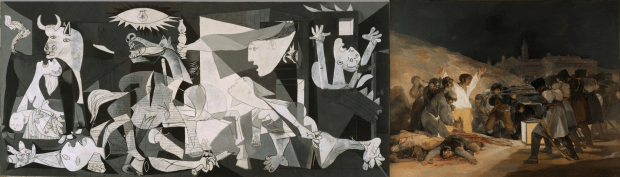
For framing purposes, it is not the same thing to work in widescreen proportions (2.39:1) as in the 15/70 IMAX ratio used in The Odyssey, where the relationship between width and height is 1.43:1. It is not the same thing to project Guernica (whose proportions are 2.22:1) as The Third of May 1808 (at 1.29:1).
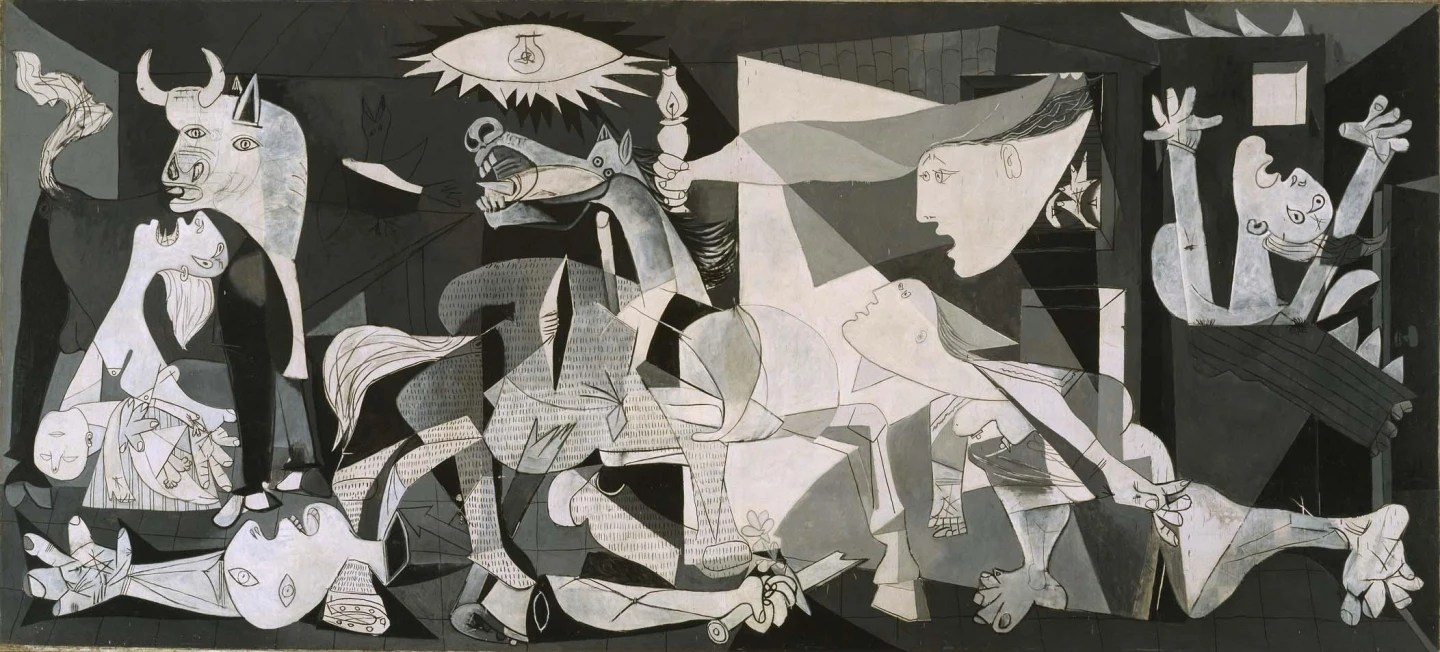
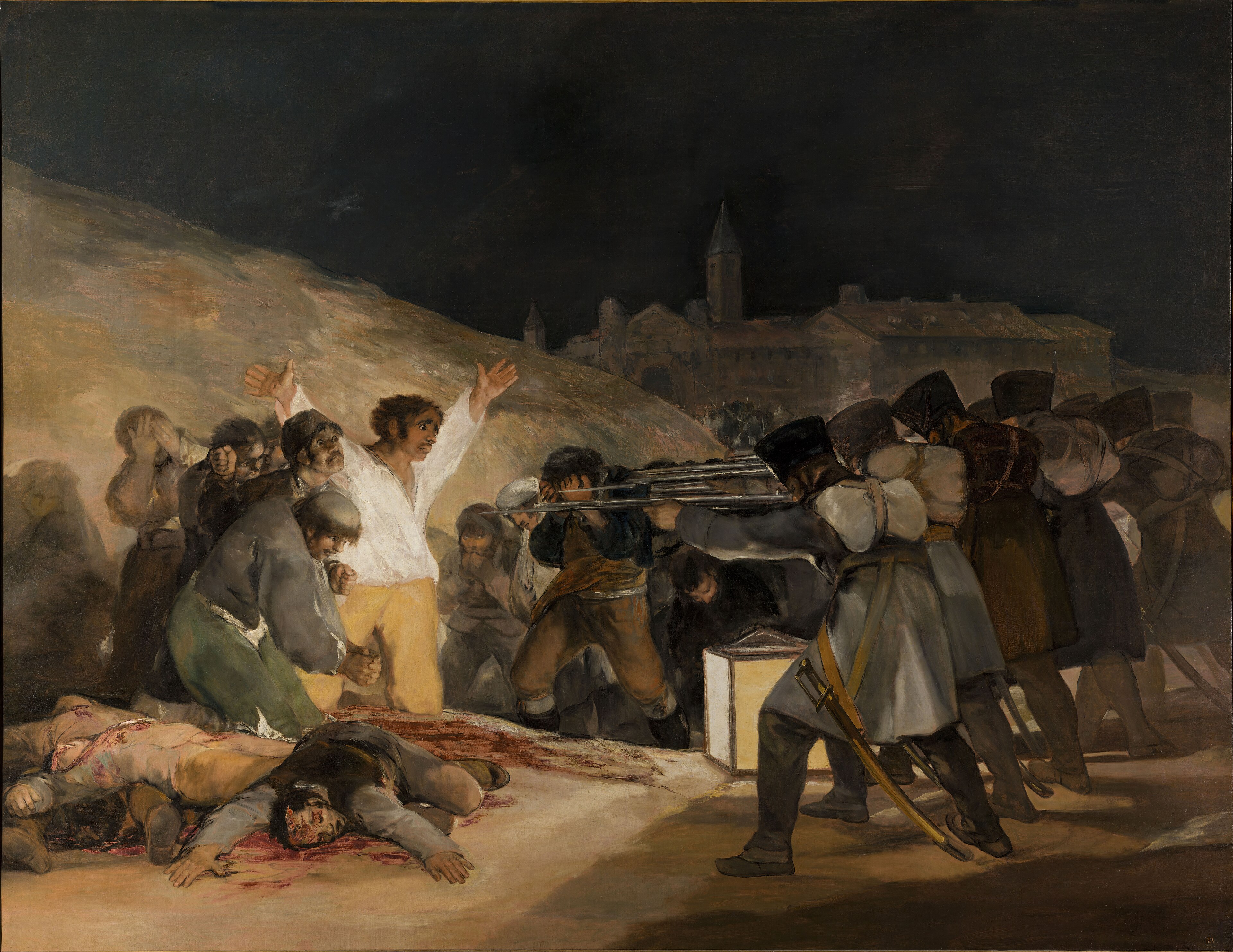
To get a sense of this, let us see how the latter painting would look in IMAX and in widescreen.

The differences between the two options are obvious. Shooting with one format or the other in mind is no trivial matter. In the case of The Odyssey, Nolan was thinking in IMAX; although, I imagine, he was also well aware that the vast majority of viewers would see the film in widescreen (there are only 41 cinemas in the world showing The Odyssey in 15/70 IMAX — meaning that fewer than 1% of all viewers will have seen it in the format in which Nolan imagined it), so the widescreen framings will also have been carefully attended to. It would not simply be a matter of «cropping wherever it falls»; there will have been a process of adjustment so that the film makes as much sense as possible in widescreen too.
Now then, are there differences to be perceived between one format and the other? Speaking from my experience as a viewer, I would say yes, that there are differences at certain points. I repeat, however, the warning that I am speaking from memory, on the basis of two viewings of the film in widescreen and a single viewing in IMAX.
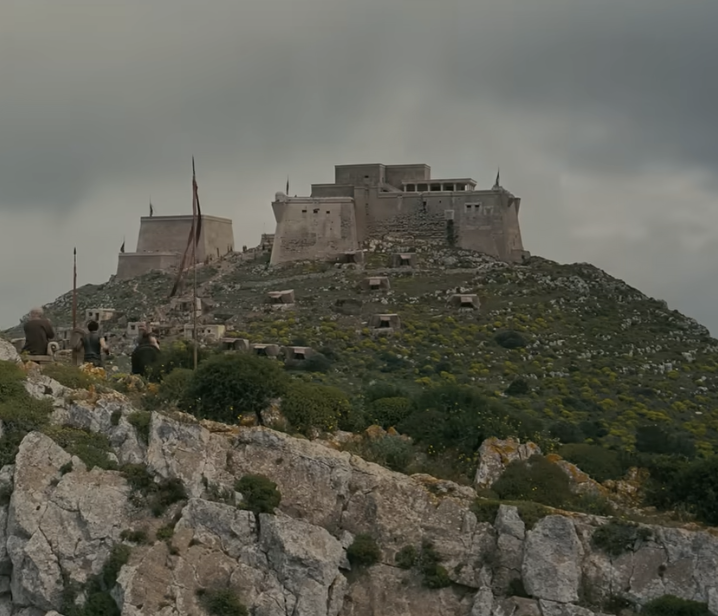
Specifically, where I perceive the greatest difference is in the scenes set in the city of Troy. In the widescreen version, the arrival of the horse at the city does not allow you to see the whole of it, with air above the buildings. In the IMAX version the horse appears in the lower part of the frame and the walls and houses rise until they reach a sky that can also be taken in. The sensation is one of greater calm, as though the scene were better composed. I would say that the beach scenes also gain from this extra space above and below. Likewise, in the scenes of the burning of Troy one perceives a different composition. The collapsing towers register perfectly well in widescreen too, but the very construction of the scene feels more suited to an almost square format than to an elongated one.
There is also a difference in some of the scenes featuring Agamemnon. The king’s imposing presence requires a plume of feathers that in the widescreen version is sometimes not fully visible. Two scenes come to mind: the sacrifice of his daughter and the encounter with Ulysses on leaving Troy. Another scene in which that small amount of space at the top makes the difference, I think, is the transformation of Ulysses’ companions into pigs. In the widescreen version I had the sense that everything was «too close». Finally, I also think there is a considerable gain in the scene showing the Greeks climbing the hill that leads to Polyphemus’ cave — I mean the one in which they are seen from the sea, where the IMAX format allows a better appreciation of the sheer mass of the hill. In widescreen the sensation is different.
Beyond this, if one pays attention, one notices that there are several moments in the film where the camera moves from bottom to top or from top to bottom. From bottom to top in the scene where Telemachus is seen practising swordplay with Mentor, or in the aforementioned scene on Polyphemus’ island. From top to bottom, in the fall of the burning towers of Troy and in the beheading of the statue of Athena. This kind of movement is perhaps better suited to a format tending towards the square than to a widescreen one. In other words, the choice of format conditions the use of the camera.
From here, the question is why Nolan opts for a format as specific as 15/70 IMAX — a format that inevitably means few viewers will be able to see the film the way the director originally conceived it. The reasons he has given are that image quality is higher (which has nothing to do with the proportions), that a larger screen is the scale the story demands, thereby satisfying his long-held wish to shoot an entire film in IMAX, that the format achieves the viewer’s immersion without resorting to 3D, and that it offers something that cannot be reproduced at home.
Some of these reasons do not match my experience. If there is higher image quality, to me it is imperceptible compared with the widescreen version, nor did I have any greater sense of immersion than the one you get from widescreen screenings in good theatres. If you sit in the front half of the auditorium you achieve a fine sense of immersion without needing IMAX at all. That said, in terms of what I experienced as a viewer there are differences between seeing the film in widescreen and in its original format, as I have described. Broadly speaking, I would say the film flows more naturally in IMAX, without that sense that in certain images «something is missing». I do not rule out the possibility that this sense of absence was conditioned by my already knowing, while watching the widescreen version, that this was not the original format; but I confirmed it when I was able to see the film in IMAX. And I find it hard to believe that the choice of that format, in terms of framing, has had no influence on the way the story is told.
I am probably over-reading it; but what the hell — that is what art is for: so that the viewer too can turn the director’s choices over in his mind and consider how they affect him. This is part of the fun of watching a film. So let us get to it.
One of the things that has struck me about The Odyssey is that the film rests, to a considerable extent, on the dialogues Ulysses holds with various characters — above all female ones: Athena, Penelope and Calypso. The film is full of scenes in which Ulysses is confronted with these three women; nor are there any shortage of intense moments with Telemachus and the suitors, though these, from my perspective, play a different role. I have in my head shots that Ulysses shares with those three women, but not with Telemachus (where the film relies more on shot and reverse shot, as it does with Circe). By contrast, with the three axes of the story Nolan wants to tell us (which is not, as I tried to explain in the pieces cited at the outset, the same one Homer wants to tell us), those joint shots do appear, and they need nothing around them. In a widescreen format, either the camera is excessively close to the actors or the sides must be filled with «something». In a less elongated format, the human figures occupy the scene naturally. That is to say, the IMAX format is, curiously, less suited to «epic» scenes than widescreen is. I think this can be clearly appreciated in the moment when we see the burials on the beach at Troy. In a widescreen composition one could show a line of armour and helmets stretching from one side to the other. In Nolan’s Odyssey, however, the play is with depth. It is not an expanse of remains to the right and left, but one running from the foreground to the far distance, balanced on the right-hand side by the figure of Ulysses — if memory serves.
The composition of these encounters cannot be accidental. In Penelope’s case we have the scenes before his departure, in which Odysseus and Penelope share a bed, and those at the end, where Ulysses is outside the women’s quarters and Penelope is behind the lattice and positioned slightly higher. In Calypso’s case, when they are seen together (in the same shot) they are standing on the beach. Most striking of all is Athena’s case, because she appears at Ulysses’ side and, at a given moment, vanishes. This happens both on Calypso’s beach and on the beach at Ithaca. That disappearance conveys the character’s solitude very effectively, since suddenly there appears the empty space the goddess has left behind (let us grant, for these purposes, that she is a goddess). In her final disappearance — precisely during the dialogue between Odysseus and Penelope before the slaughter of the suitors — an open door appears behind the place Athena had occupied. I do not know whether it is as clearly visible in the widescreen version; I noticed it in IMAX, and it strikes me as highly significant for the character’s function.
In all these cases the more nearly square IMAX format favours the composition of the scene. In widescreen there would have to be something at the sides that the 1.43:1 ratio simply does not require. This holds too for what I take to be the most significant scene in the film: the imagined beheading of the young woman in the temple of Athena (a priestess, perhaps). The composition of the image resembles a cross, and I do not think that is a coincidence.
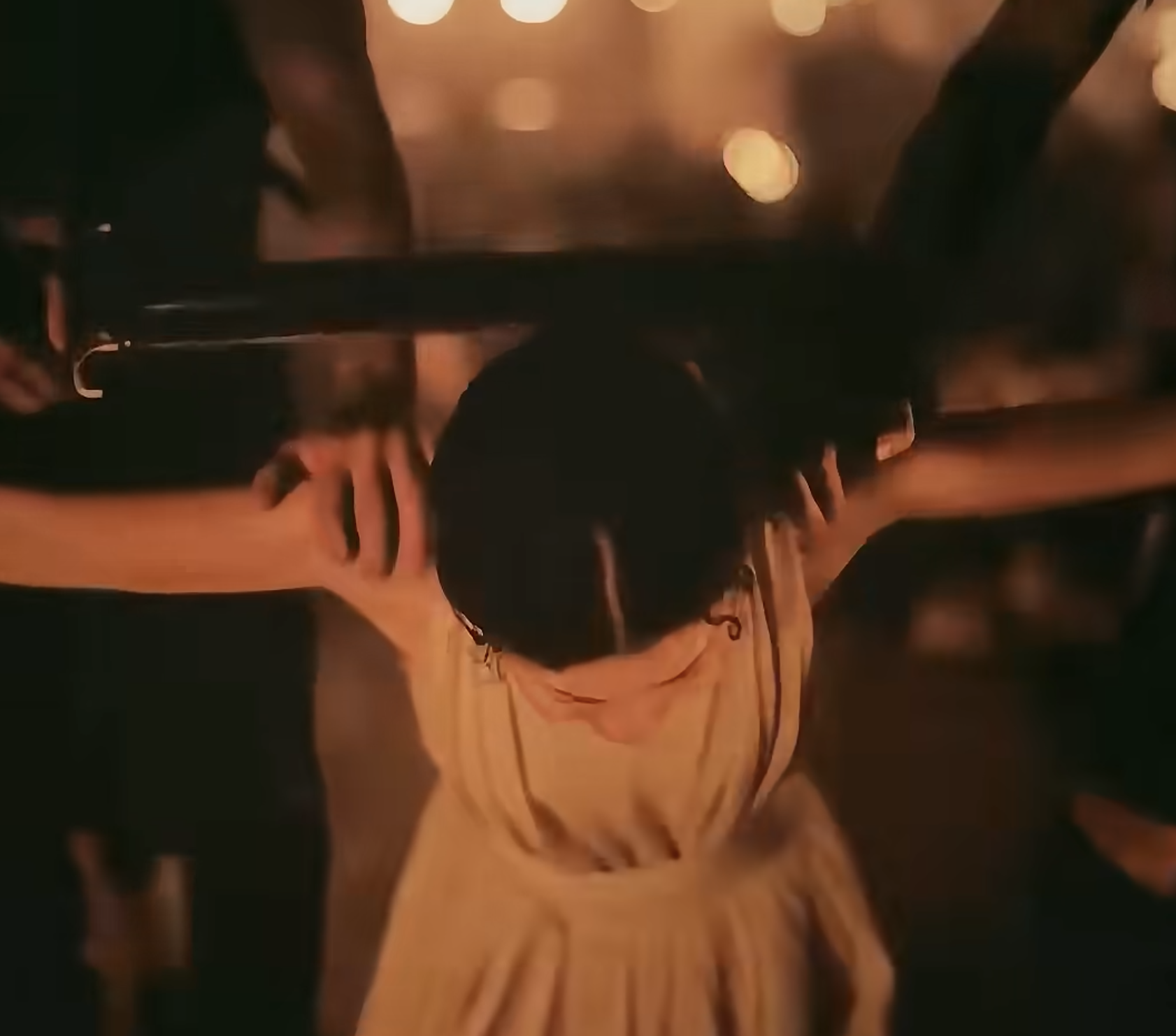
It has been said, and rightly, that Nolan uses the Odyssey to construct a moral tale that has nothing to do with Homer. Nolan’s Ulysses is modern, not Homeric. He is a man tormented by guilt and remorse, and it is not until the scene I am discussing that we fully realize it. That guilt and remorse are entirely absent from Homer’s Ulysses and are, in a sense, nothing other than the continuation in this film of the exploration Nolan had begun in Oppenheimer: the remorse of the man who uses his ingenuity to win a war, but at the cost of unleashing an evil that cannot be contained and that leads, in one way or another, to expiation. One might say that he turns a story of the classical world into one that breathes a Christian morality. If that is so, the moment that embodies it is this scene: on the one hand, we see that what we took for a goddess is the memory of guilt; on the other, a pagan statue is beheaded (of a goddess who was, incidentally, a Greek goddess too) at the same time as her priestess is sacrificed. The shift, as I say, from the classical world — with fame and recognition as its goal — to the Christian morality of forgiveness and redemption. Introducing a cross at that moment is, as I say, no accident, and a cross sits badly in a widescreen format.
In short, Nolan has not painted Guernica; he has painted The Third of May 1808. Instead of making a film of great battles and epic camera movements, he creates — though it may not seem so — an almost intimate tale, based on dialogue, in which the grandeur lies in what is told, not in how it is told. Ulysses living out his guilt and his responsibility, confronted with home (Penelope), remorse (Athena) and impossible peace (Calypso). A triad that cannot be satisfactorily resolved, and that leads to the confusion of the slaughter of the suitors.
This is not an Apollonian film; it does not conclude with the warrior’s rest after surmounting the adventures and trials set by the gods. In reality there are no gods (we have already seen that the character of Athena is not, in fact, Athena) but only a man who, trying to do what is right, destroys the world he lived in.
And Nolan chose to shoot it in an almost square format. Probably for none of the reasons I have set out here — but, as I said, this is the eternal game between the creator and those who admire his work.

