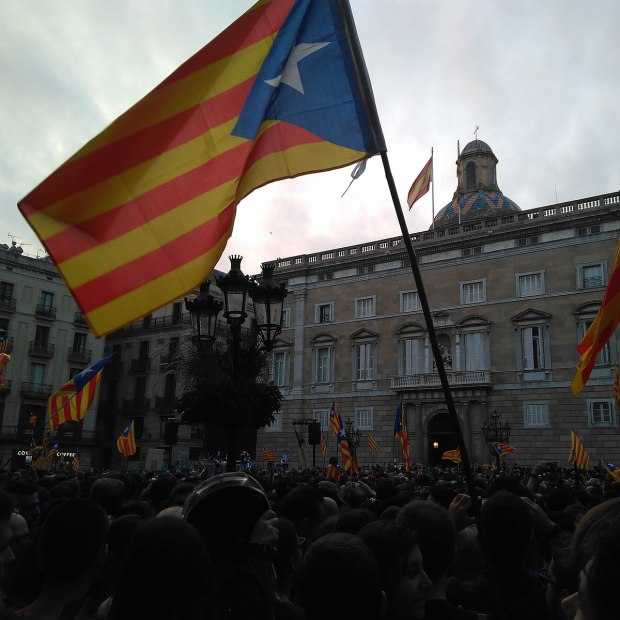
On 1 October 2017, a secession referendum was held in Catalonia. The Generalitat and many local administrations abandoned their role as constitutional institutions and placed the public power entrusted to them at the service of a plan (the so-called procés) aimed at creating an independent Catalan Republic on the territory of Catalonia. 1 October was the culmination of that process; but actions geared towards secession had been under way for at least six years beforehand, and after 2017 there were still attempts to revive the secession process, particularly in 2019, in the wake of the Supreme Court judgment convicting some of the leaders of the attempt to set aside the Constitution in Catalonia.
There were several sets of court proceedings relating to the secession process. Among them were a claim for accounting liability for the diversion of public funds to an unlawful purpose (secession) and the arrest of several people who, according to the investigations, were preparing explosives that could be used to press for the independence of Catalonia.
These judicial proceedings have been affected by the Amnesty Law agreed between the PSOE, the nationalist parties involved in the procés and other political forces. It was argued at the time that the Organic Law on Amnesty (the LOA) was contrary to the Constitution and to EU law. On the latter basis, several Spanish courts that had been asked to apply the Amnesty Law in order to bring the pending proceedings to an end asked the Luxembourg Court for guidance on the interpretation of the EU law relevant to determining whether the LOA was indeed incompatible with EU law. Among these references for a preliminary ruling were the two decided by the Luxembourg Court in its judgments of 16 July 2026. One had been made by the Court of Auditors (Tribunal de Cuentas) in relation to the accounting liability of the authorities who had diverted public funds, and the other by the Audiencia Nacional in relation to persons charged with terrorist offences for possession of material that could eventually be turned into explosives.
The Luxembourg Court rules on these references, and it does so clearly: apart from a few minor nuances, the LOA does not infringe the Directive on combating terrorism, Article 19 TEU or any other provision of EU law.
I will shortly publish in Spanish a commentary on the Luxembourg Court’s judgments on the LOA. I am sharing here, in advance, the English version of that commentary.
As readers will see, it is critical of the judgments. Quite critical.
___________________________________________________________________________________
El 1 de octubre de 2017 se celebró un referéndum de secesión en Cataluña. La Generalitat y muchas administraciones locales abandonaron su papel de instituciones constitucionales y pusieron el poder público que se les había entregado al servicio de un plan (el denominado procés) que tenía como objetivo la creación de una República Catalana independiente en el territorio de Cataluña. El 1 de octubre fue la culminación de ese proceso; pero desde al menos seis años antes se habían desarrollado actuaciones orientadas a la secesión y tras 2017 aún se intentó avivar el proceso de secesión, especialmente en 2019, al hilo de la sentencia del Tribunal Supremo que condenaba a algunos de los líderes del intento de derogación de la Constitución en Cataluña.
Hubo varias actuaciones ante los tribunales en relación al proceso de secesión. Entre ellas, la petición de responsabilidad contable por el desvío de fondos públicos a un propósito ilegal (la secesión) y la detención de varias personas que, según las investigaciones realizadas, preparaban explosivos que podrían ser utilizados con el fin de exigir la independencia de Cataluña.
Las actuaciones judiciales anteriores se han visto afectadas por la Ley de Amnistía pactada entre el PSOE, los partidos nacionalistas implicados en el procés y otras fuerzas políticas. Se arguyó en su momento que la Ley Orgánica de Amnistía (la LOA) era contraria a la Constitución y al Derecho de la UE. A partir de esto último, varios tribunales españoles a los que se les solicitó la aplicación de la Ley de Amnistía para poner fin a los procesos judiciales abiertos solicitaron al Tribunal de Luxemburgo que les orientara en la interpretación del Derecho de la UE relevante para determinar si, efectivamente, la LOA era incompatible con el Derecho de la UE. Entre estas cuestiones prejudiciales planteadas se encontraban las dos resueltas por el Tribunal de Luxemburgo en sus sentencias de 16 de julio de 2026. Una de ellas había sido planteada por el Tribunal de Cuentas en relación a la responsabilidad contable de las autoridades que habían desviado fondos públicos y la otra por la Audiencia Nacional en relación a los acusados de delitos de terrorismo por tenencia de material que podría acabar convirtiéndose en explosivos.
El Tribunal de Luxemburgo se pronuncia sobre estas cuestiones y lo hace con claridad: pese a algunos matices menores, la LOA ni vulnera la Directiva sobre persecución del delito de terrorismo ni el art. 19 del TUE ni otros preceptos del Derecho de la UE.
Próximamente publicaré en español un comentario sobre las sentencias del Tribunal de Luxemburgo sobre la LOA. Adelanto aquí la versión en inglés de ese comentario.
Como se podrá ver, es crítico con las sentencias. Bastante crítico.

