ABSTRACT: I. The Construction of Identity and Its Enemies. II. The Construction of Catalan Identity. III. From Spain to Spaniards. IV. Hate Speech and Hispanophobia: 1. Hate Speech and the Limitation of Rights. 2. Limitation of Rights and Nationalism in Catalonia. V. Hate Speech and Public Institutions. VI. Conclusion.
I. The Construction of Identity and Its Enemies
The construction of a group’s identity often involves opposition to one or more other groups. It is a commonplace phenomenon that most of us have experienced. From football clubs (what unites more than the rivalry of a Barça–Madrid, Espanyol–Barça, Oviedo–Sporting, Athletic–Real Sociedad, Betis–Sevilla…?) to local rivalries between neighbouring towns or even between urban tribes. Nations are no different. National identity, in part, arises from opposition to other countries. One’s own virtues are highlighted and, almost inevitably, conflicts with other nations come to be portrayed as a struggle between “good” (one’s own nation) and “bad” (the others). This can be clearly seen in these 30 seconds of Lady Hamilton, the film by Alexander Korda, where in less than a minute it is explained why the British Empire is so good and, consequently, why those who attack it are so bad.
The British Empire is a community in which each territory has its own purpose and function; yet there are those who, driven by ambition, seek to destroy what others have built. In this way, England’s actions elsewhere are explained and justified, while at the same time those who oppose it are discredited. Crystal clear.
II. The Construction of Catalan Identity
The construction of the Catalan nation follows the same pattern: elements must be identified that give it a distinct identity, one that also serves to differentiate Catalans within the broader community in which they were historically integrated without major controversy—the Spanish people as a whole. This requires, on the one hand, a particular interpretation of history in which Catalans are endowed with special virtues. In this regard, for example, the fanciful speech by Pau Casals at the United Nations, which I share below, fits well.
As do the arguments now put forward by the Institut Nova Història.
The template is always the same: a people defined by positive traits (industriousness, a peaceful and enterprising character…) whose origins can be traced back to prehistory, and which must confront those who, lacking such qualities, seek to hinder its progress. This can already be clearly seen in the works of Catalan nationalists from the early twentieth century—the period in which Pau Casals spent his youth—which likely helps to better understand his speech at the United Nations in 1971. Thus, in the book by Antoni Rovira i Virgili, History of Nationalist Movements, originally published between 1912 and 1914, we read:
This linguistic territory closely corresponds to the original area of the Iberian race, from which the Catalans descend. Prat de la Riba states: “When the Phoenician traveller whose account was recorded by Avienus, one hundred and fifty years before Christ, travelled along the Sardinian Sea coast, he encountered there the Iberian ethnos, the Iberian nationality, extending from Murcia to the Rhône, that is, from the Libyco-Phoenician peoples of eastern Andalusia to the Ligurians of Provence. Those peoples are our ancestors; that Iberian ethnos is the first link that history allows us to see in the chain of generations that have forged the Catalan soul.”
Soon, the territory of the Iberian race, open to incursions, was invaded by other races (…). But when the Roman Empire collapsed under the pressure of the barbarians, and the medieval nuclei that would give rise to the historical nationalities emerged, the old Iberian race resurfaced, marked by the powerful imprint of Rome, yet preserving a vivid ethnic individuality.
(…) Yet this historical event [the discovery of America] would not have had such a disastrous influence on our homeland had Castile not committed a great injustice. By the famous codicil to the will of Isabella the Catholic, the citizens of the Catalan-Aragonese Crown were excluded, under penalty of death, from trade with the Indies (…). Without this unjust prohibition, Catalonia would have carried its genius for work and creation overseas; it would have become, like England, a great maritime and commercial power. The Catalan language would have spread throughout the Americas; today there would be, in the New World, alongside nations of Spanish and Portuguese language, nations of Catalan language, and Catalan would be one of the great world languages. The antipathy of Castile, manifested in Isabella’s codicil, destroyed at that historical moment the magnificent future that awaited Catalonia.”
The narrative continues; but what has been quoted is sufficient: a distinct identity set against external enemies who strive to prevent the nation from flourishing. The same pattern we saw in the explanation of the British Empire given to Emma Hamilton in the film by Alexander Korda.
In principle, this line of thinking should belong to a bygone stage; and to a large extent, I believe that is indeed the case in most places. It is hard to imagine that anyone in the United Kingdom today would find persuasive what we saw in the 1941 film. National constructions based on hypothetical ethnic distinctions stretching back to prehistory tend, at best, to provoke a smile; if not to raise serious concerns. Yet in Catalonia this remains the official doctrine. It is not insignificant to recall that a Catalan public university—the University of Tarragona—bears the name of the author of the passages quoted above, and that the speech by Pau Casals—outlandish in its content—was taken from the official YouTube channel of the Parliament of Catalonia.
In other words, in Catalonia a distorted view of history continues to be embraced, one in which “Castile” is held responsible for the fact that Catalonia is not a sovereign and prosperous nation—a nation which, in Antoni Rovira i Virgili’s account, would have been comparable to nineteenth- and early twentieth-century England.
III. From Spain to Spaniards
This is already a problematic approach in itself; yet it can become even more troubling when the shift is made from “Castile” to “Castilians,” a term some use to refer to all Spaniards who are not of Catalan origin (with “Catalan” understood as extending to Valencia and the Balearic Islands). In this framing, “Castilians” are portrayed as colonizers, dominators, and extractors of Catalonia’s wealth. Moreover, they are burdened with the stereotypes typical of any identity-building process based on opposition to other groups. Just as Catalans are depicted as modern, hardworking, cultured, and peace-loving, “Castilians” are cast as lazy, violent, uncultured, and primitive.
Am I exaggerating? Let us recall what Jordi Pujol, President of the Generalitat between 1980 and 2003 and the most influential political figure in Catalonia over the past half century, wrote:
“The Andalusian man is not a coherent man; he is an anarchic man. He is a destroyed man. (…) The other type of immigrant is, generally, an unformed man. He is a man who for hundreds of years has gone hungry and has lived in a state of ignorance and of cultural, mental, and spiritual poverty.”
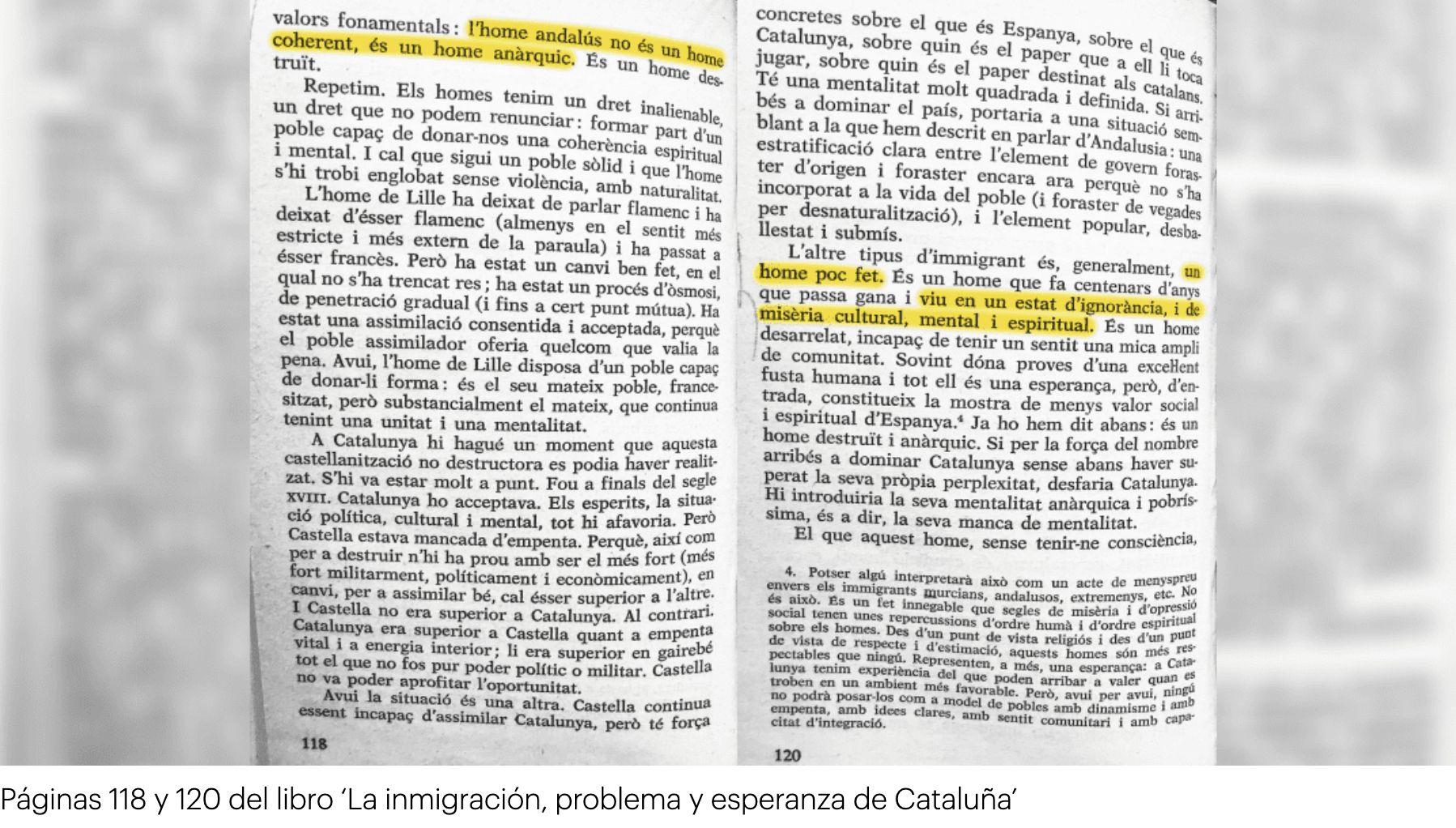
What Jordi Pujol wrote is particularly relevant, as he did so at a time (the 1970s) when Catalonia was home both to those whose families had lived in the region for generations and to more than two million people who had come from other parts of Spain. These were the people then referred to as charnegos, a term that included not only recent arrivals but also their children, many of whom had already been born and raised in Catalonia. Pujol’s reflection was therefore not abstract, nor a historical reconstruction in the manner of Antoni Rovira i Virgili; rather, it was directly relevant to a society in which groups of people could be distinguished on the basis of their family origins. The disparaging words of the man who would later serve for more than twenty years as President of the Generalitat stigmatized a collective that had a significant presence in the region he would go on to govern.
In other words, Catalan nationalism is, to some extent, built upon a caricature of history that portrays “Castilians” as harmful to Catalonia and its development and, at the same time, upon stereotypes in which the supposedly “elevated” character of the Catalan spirit and its capacity for work and innovation are contrasted with the economic, moral, and intellectual poverty attributed to other peoples of Spain—or to Spaniards more generally. This is not a subterranean phenomenon; rather, it finds expression in official institutions (the Rovira i Virgili University mentioned earlier, street names filled with the figures of early twentieth-century Catalan nationalist ideologues) and in public figures, beginning with the most prominent name in Catalan nationalism of the late twentieth and early twenty-first centuries, Jordi Pujol and his “destroyed” Andalusian man.
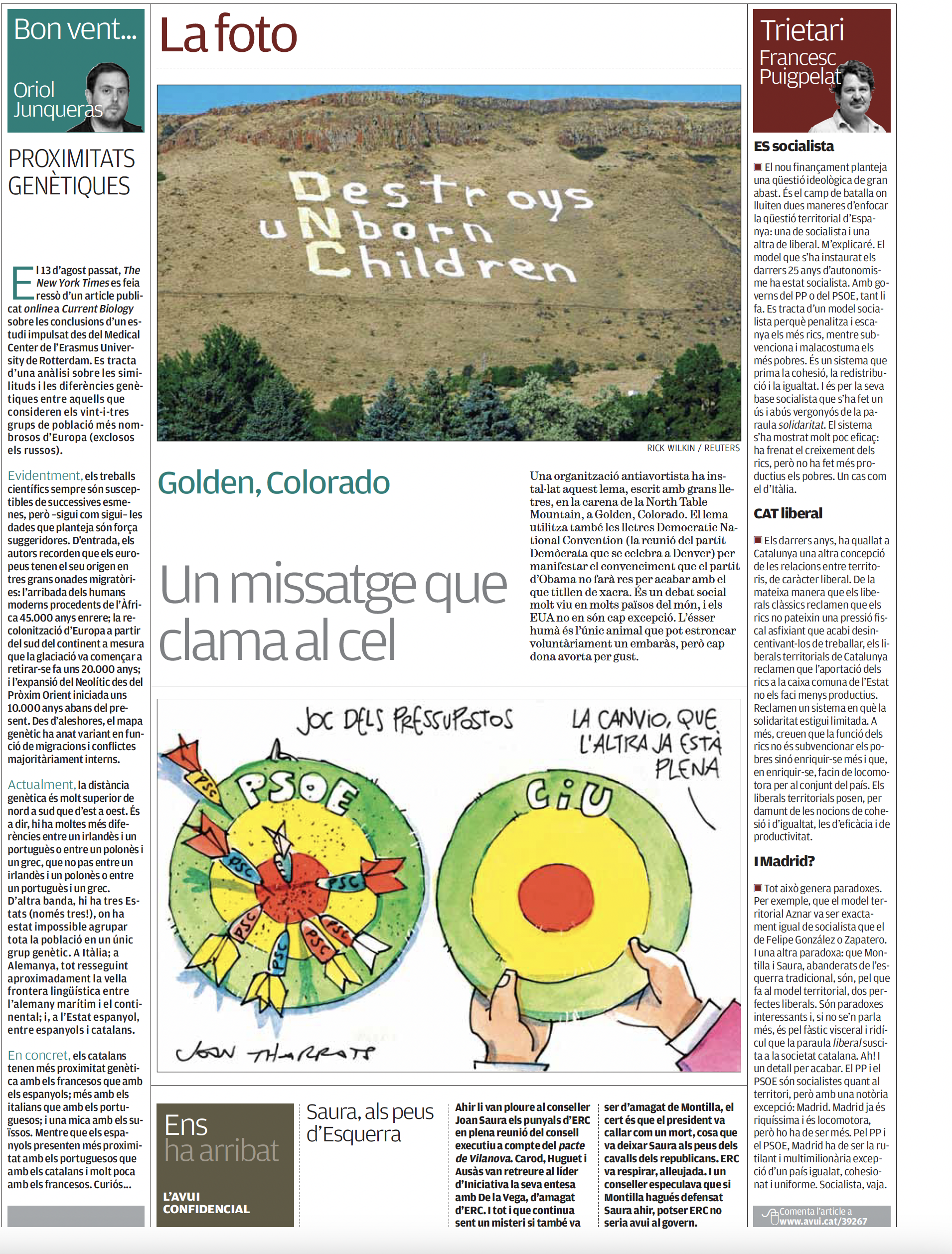
Examples could be multiplied; to conclude with just two, one relatively recent instance is the reflection by Oriol Junqueras on genetic differences between Catalans and the rest of the Spaniards (“the Spaniards,” for Junqueras, who does not regard Catalans as Spanish).
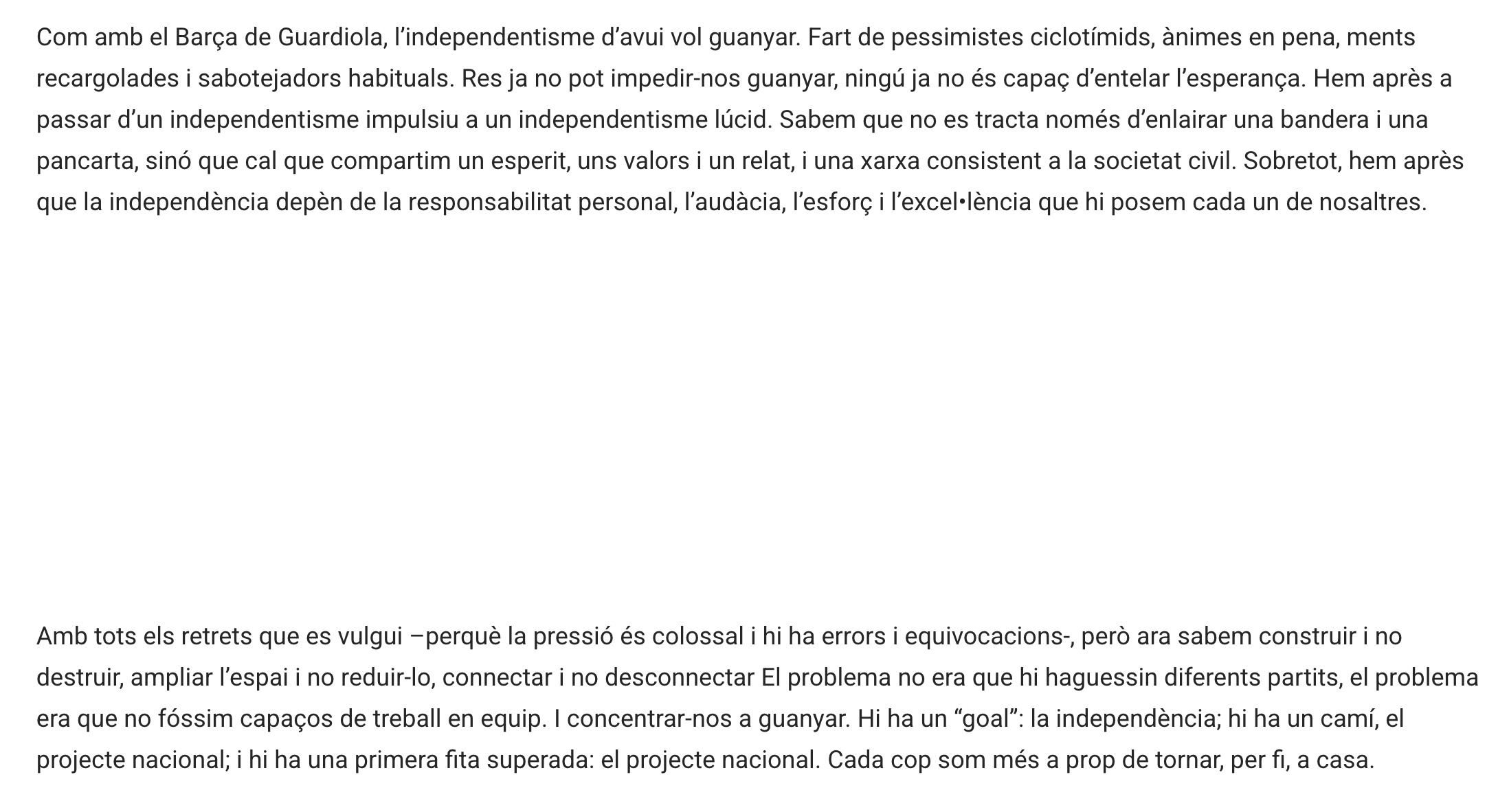
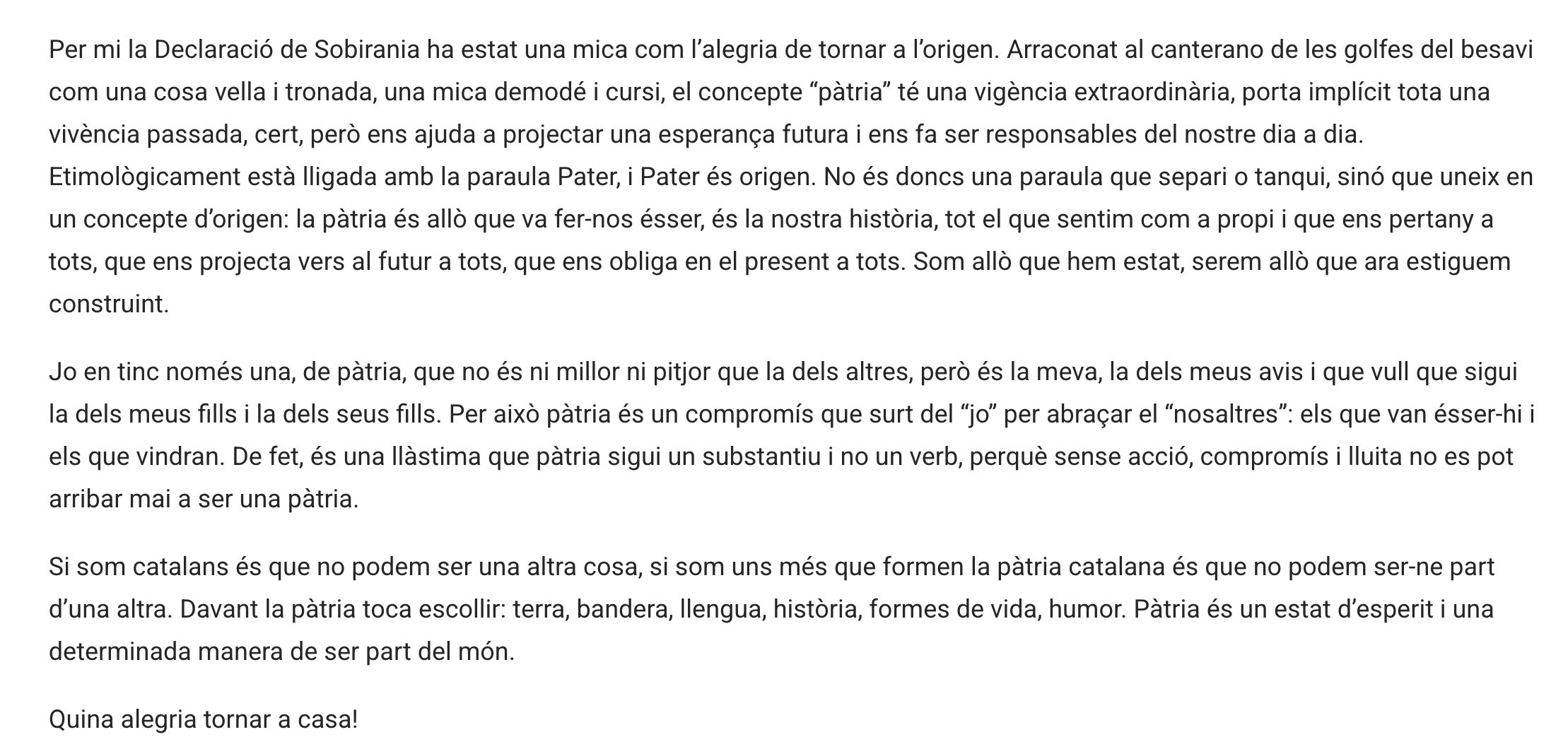
And two articles by the third-to-last President of the Generalitat, Quim Torra. The first, from 2015, in which he states that Catalans have spent 289 years enduring what no civilized people has ever endured. Spain exercises its right of conquest and humiliates with the harshest contempt; a situation that must lead to the recovery of the “homeland,” an exclusionary concept (if we have one homeland—the Catalan one—we cannot have any other) that gives meaning to the struggle.

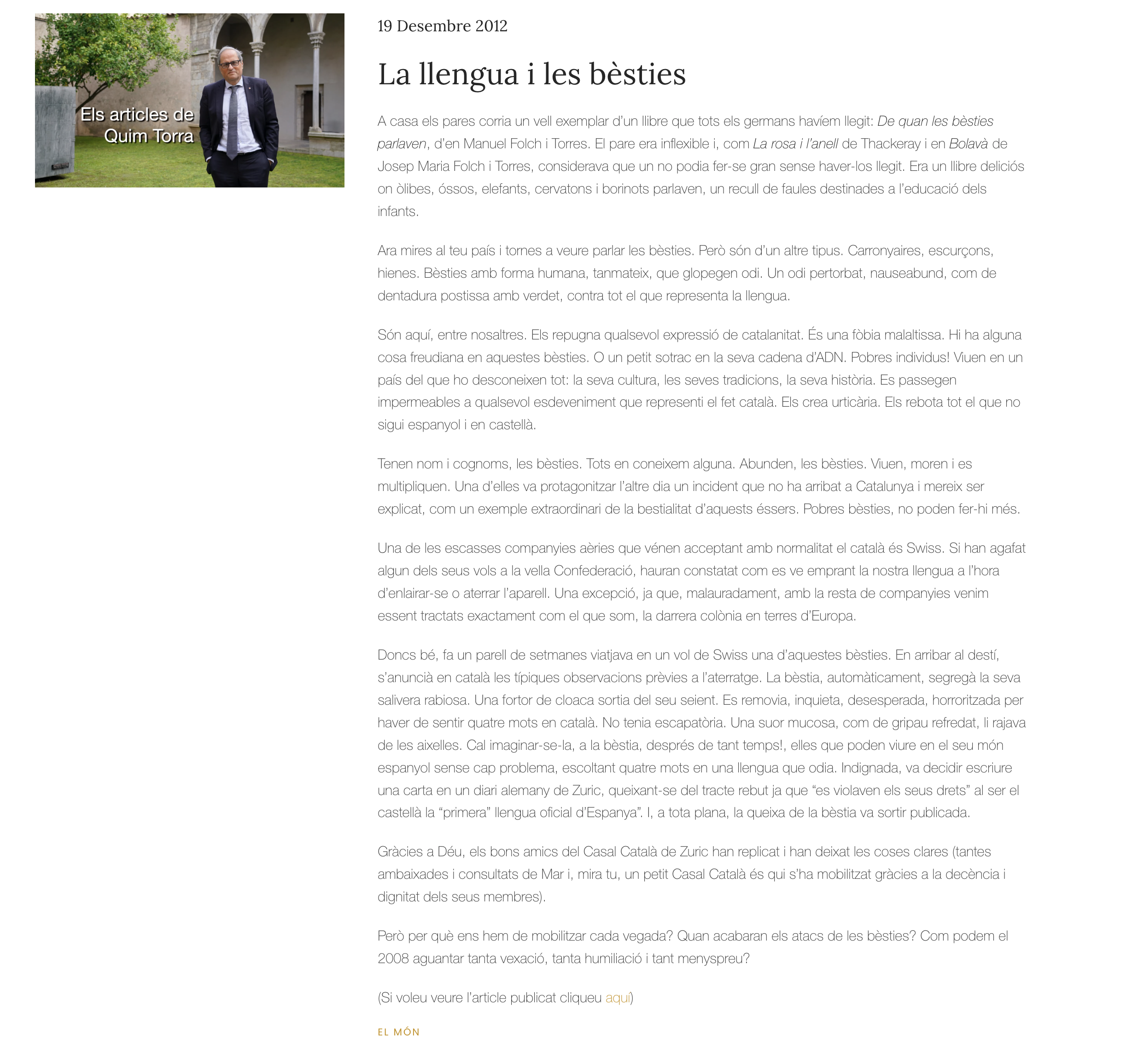
And the second, more widely known, in which he describes as beasts those who do not share his views on the Catalan language.
There are many more examples; but I have chosen these because they come from individuals who have occupied the highest positions within Catalan institutions. Two have served as Presidents of the Generalitat, and Oriol Junqueras is the leader of a party that has held the presidency of the Generalitat and has been part of its government at various times. At present, although not part of the government, he supported the current President of the Generalitat, Salvador Illa.
In other words, the stigmatization of Spain (understood as an entity to which Catalonia should not belong) and of non-Catalan Spaniards (“Castilians”) is an essential part of Catalan nation-building; both through a particular interpretation of history and through the reaction to the arrival of workers from other parts of Spain in the mid-twentieth century—a reaction in which stereotypes about the supposed “superiority” of Catalans (cultured, enterprising, hardworking, and peaceful) over “Spaniards” (uncultured, lazy, primitive, and violent) took hold in certain segments of society. The fact that leaders such as Jordi Pujol or Quim Torra expressed such ideas openly, even in writing, is evidence of this.
Those of us who disagree with nationalism in Catalonia experience this on a daily basis. Insults linked to our condition as “outsiders” (and directed even at people born in Catalonia but from families originating elsewhere) are commonplace and take many forms, especially on social media, where Spain, Spaniards, and their symbols are frequently denigrated.
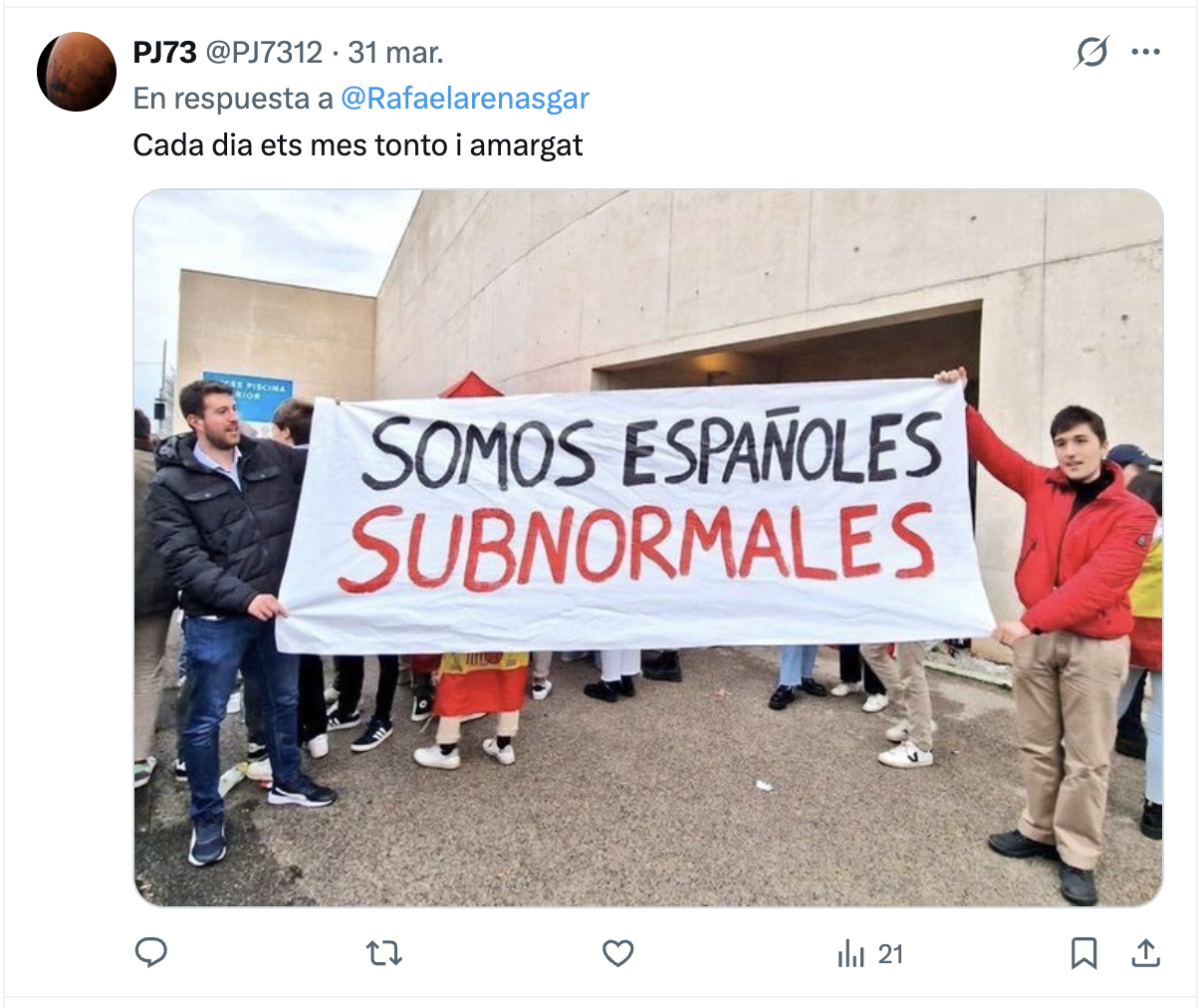
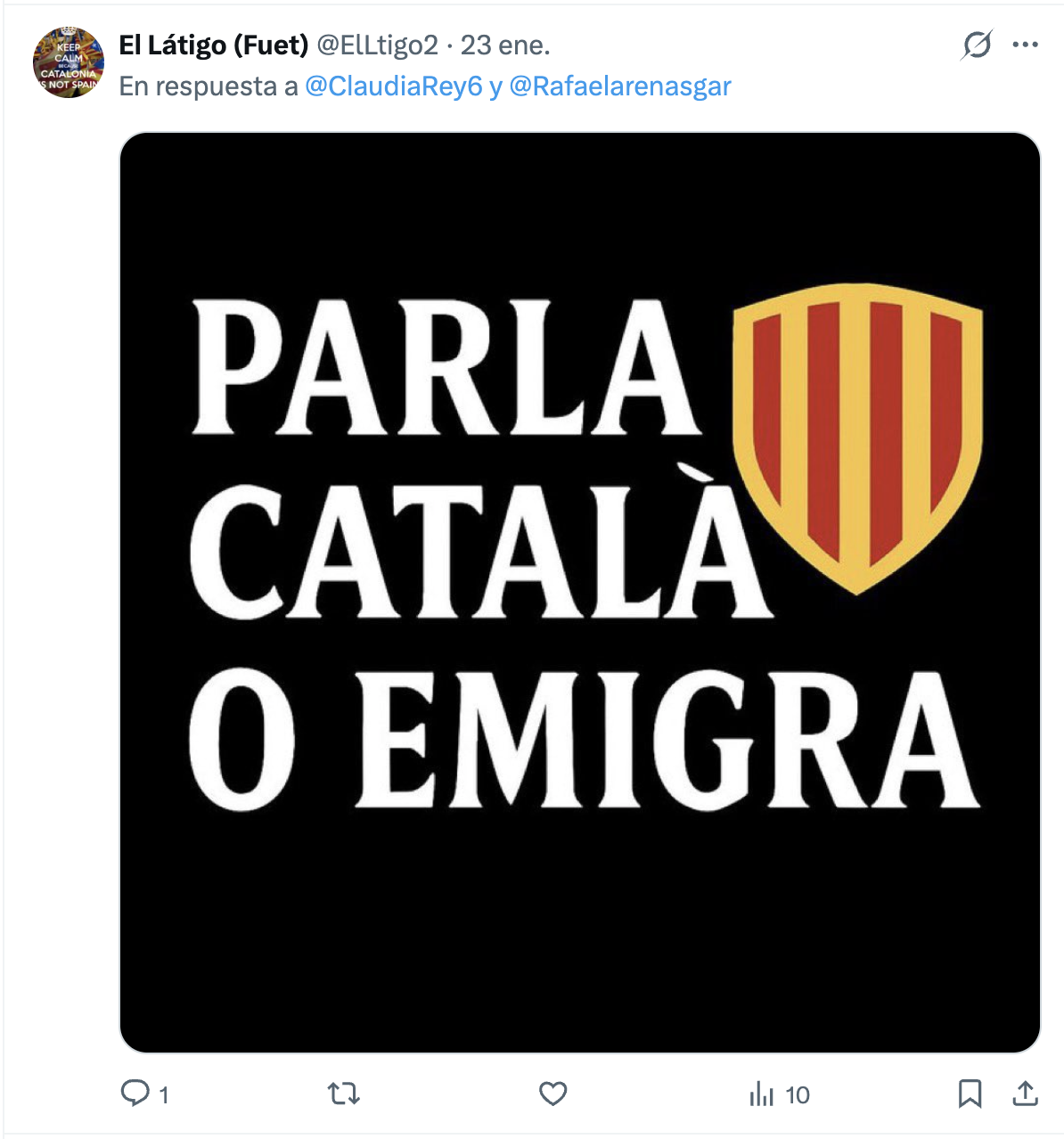
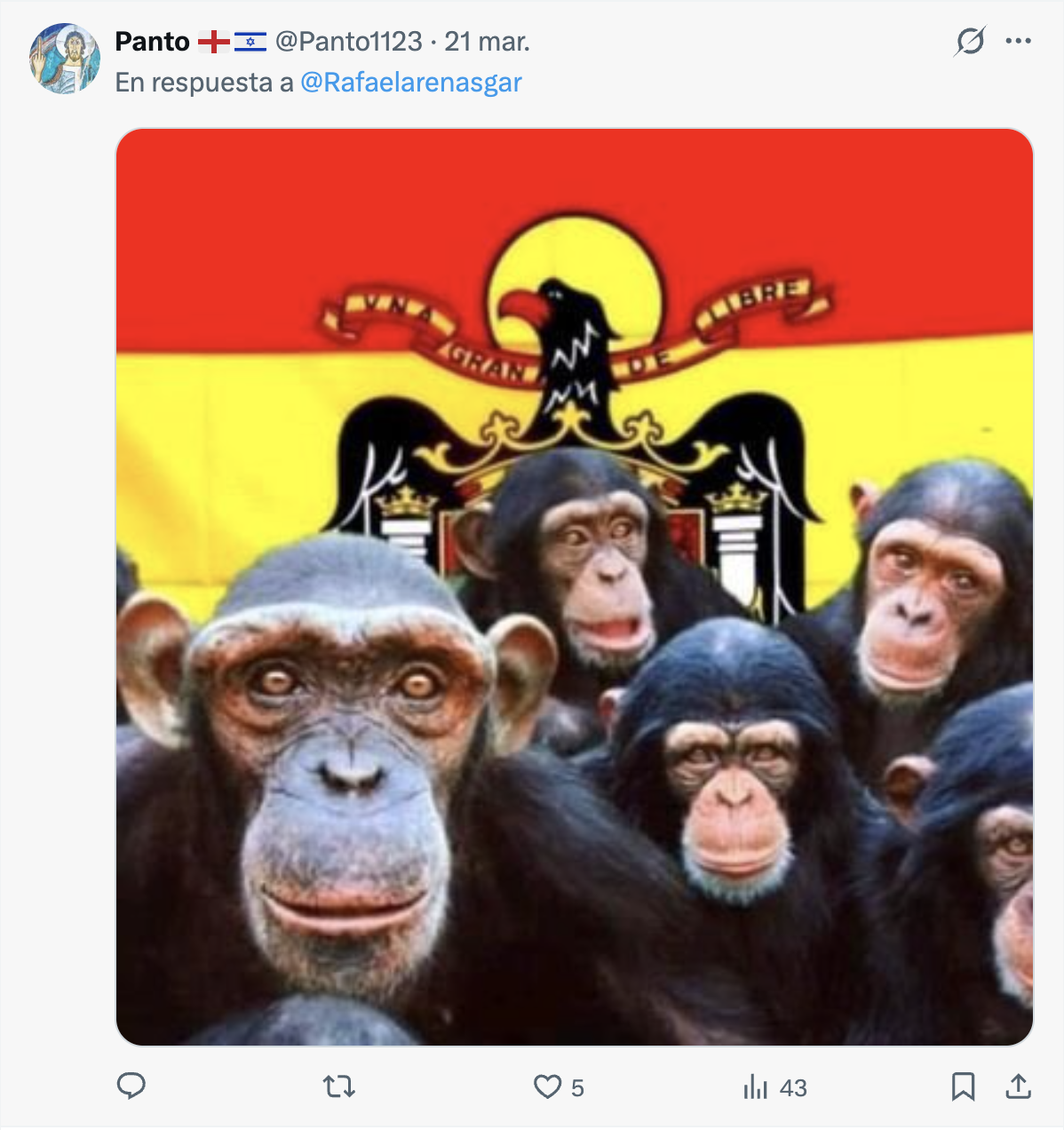
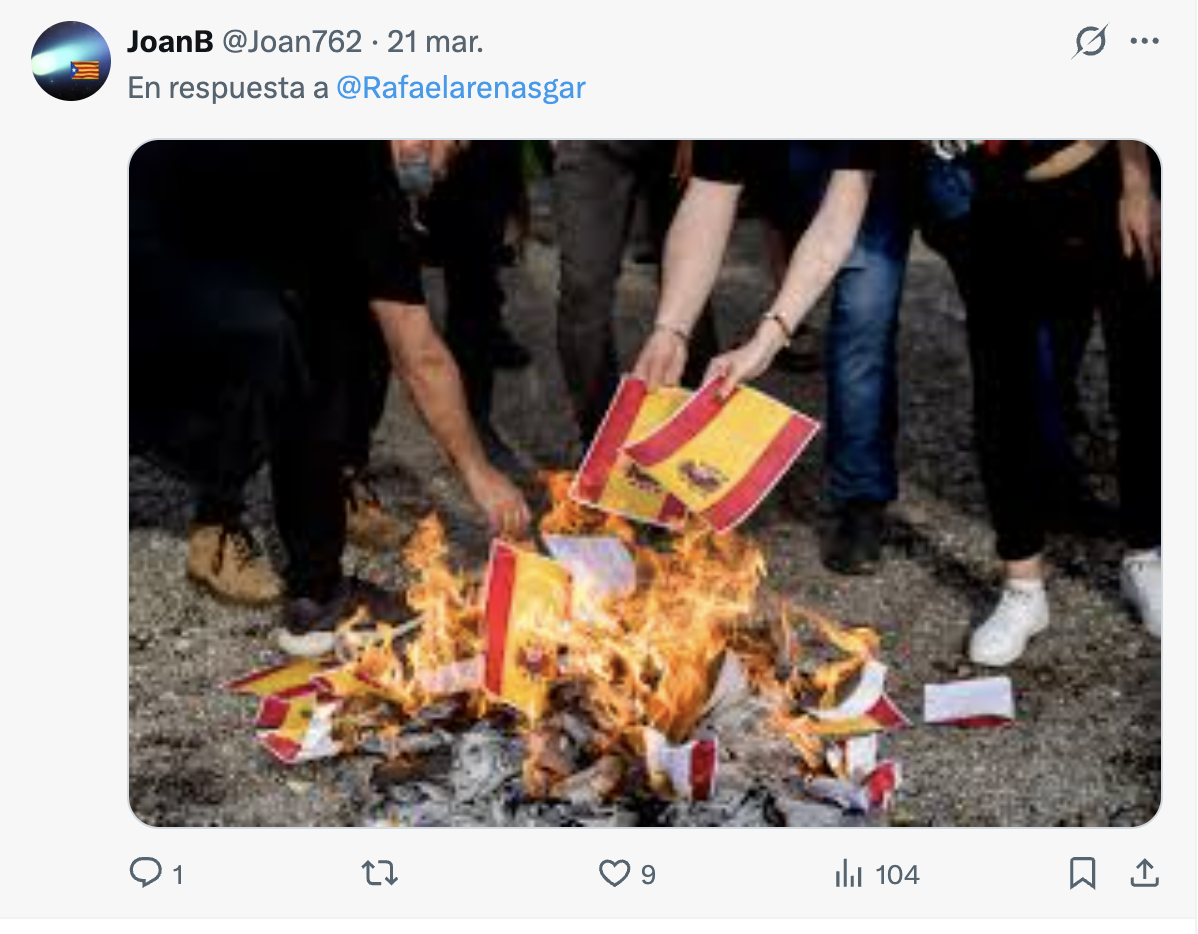
This connects with a discourse that insists on the “colonization” of Catalonia and on labeling as “colonists” those who do not share nationalist positions.
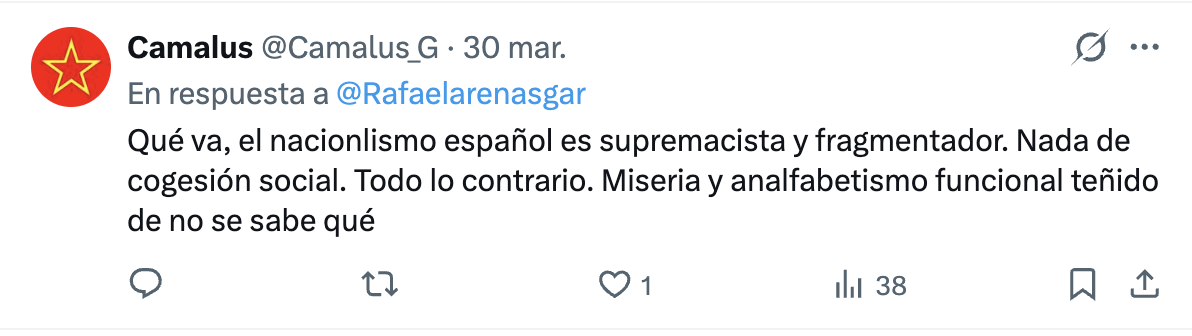
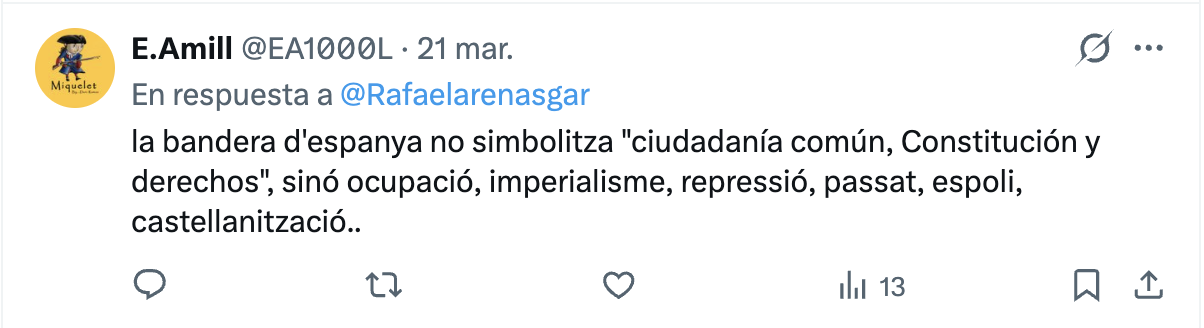

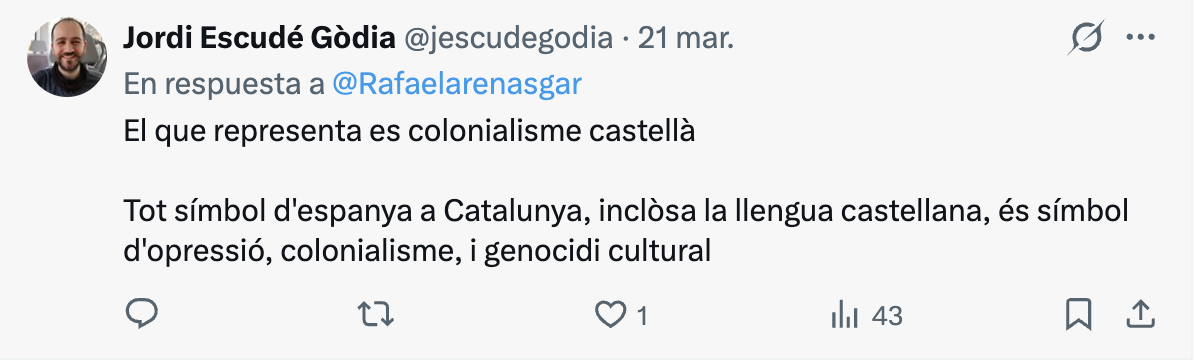
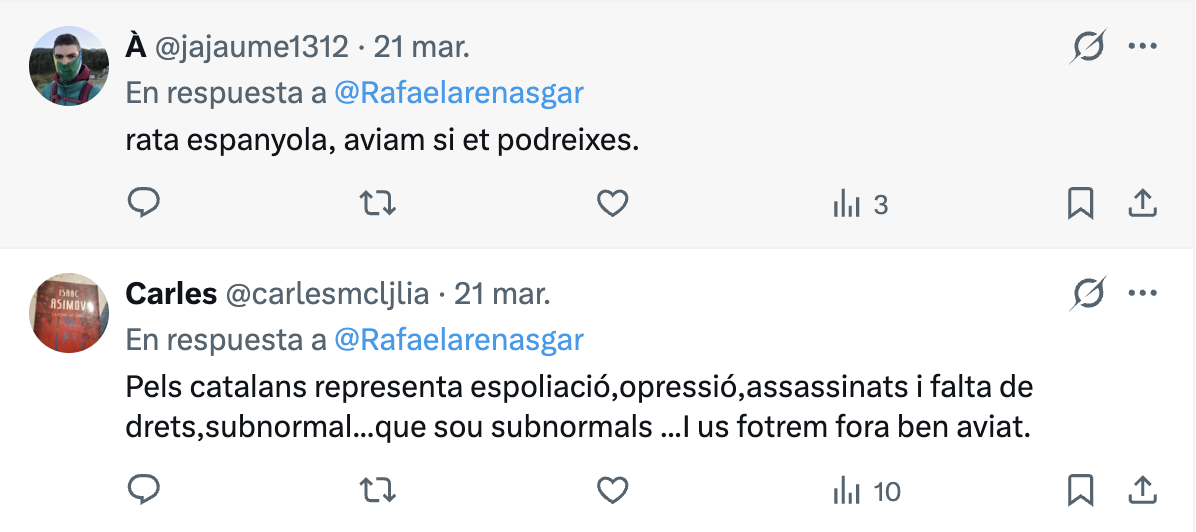
As can be seen, this is nothing more than a crude translation of the basic premise of Catalan nationalism: nation-building through opposition to an external power that constrains its development. An external power that is also associated with individuals whose values and abilities are portrayed as inferior to those attributed to “Catalans.” I use quotation marks because the concept of “Catalan” employed by nationalism excludes many citizens of Catalonia—either because they do not share the Catalan language as a defining identity marker or because they support Catalonia’s continued integration within Spain.
IV. Hate Speech and Hispanophobia
1. Hate Speech and the Limitation of Rights
Can the foregoing be considered a manifestation of hate speech? From my perspective, the answer is already yes; but in order to justify it, we must first pause to consider what hate speech entails and why it must be addressed—a task I undertook a few months ago in another post.
There, I argued that any intervention against hate speech—that is, its criminal or administrative prosecution, or the restriction by other means of speech deemed hostile toward a given group—affects freedom of expression and must therefore be properly justified. Such justification exists when words (speech) can lead to an effective limitation of the rights of the members of that group, who are harmed precisely because of their belonging to it. Without such an effective limitation of rights, there would be no grounds for restricting freedom of expression, however unpleasant or misguided the speech might be. This is because freedom of expression is the cornerstone upon which public debate in a democratic society rests—the debate that is a necessary precondition for the decisions that determine the course of that society.
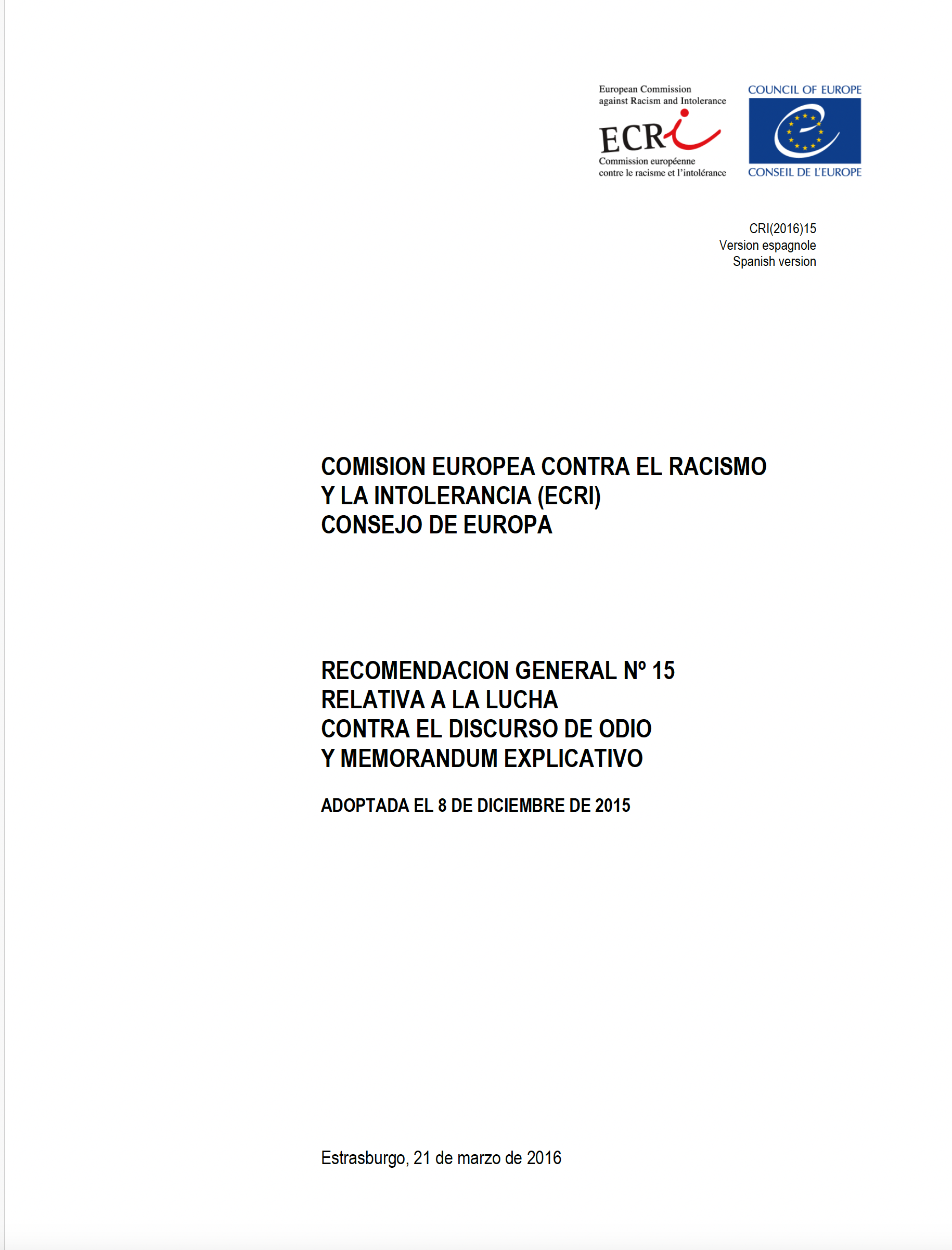
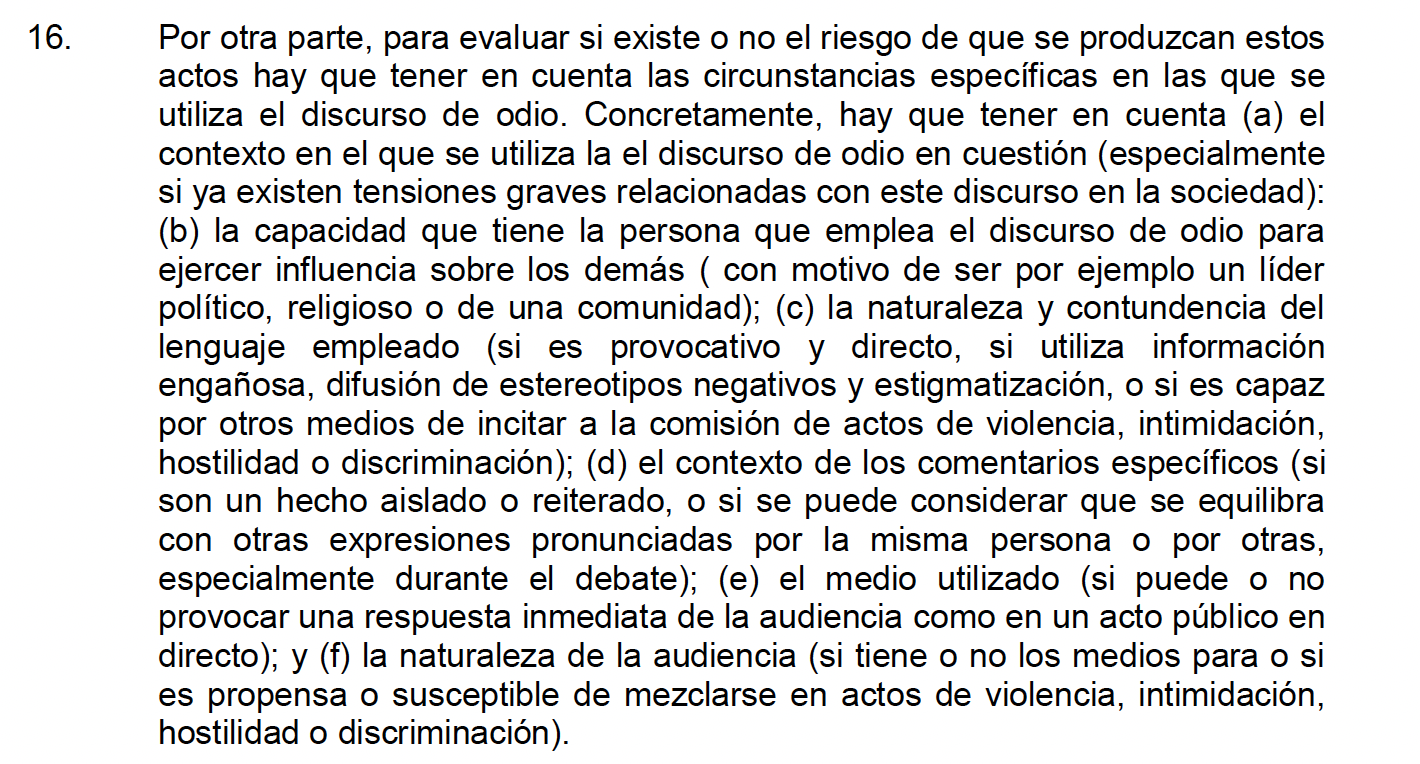
This limitation of rights is what, in each historical and geographical context, allows us to identify what constitutes a vulnerable group in the sense required by the hate speech framework. It is important, in my view, to anchor the identification of a group as susceptible to hate speech in the effective limitation of rights, because a priori categorizations can easily turn hate speech regulation into a tool of asymmetric censorship. It is more meaningful to start from the actual limitations of rights suffered by the members of a given group by virtue of belonging to it, and from there to assess how the denigration, stigmatization, or caricaturing of that group may contribute to such limitations of rights—thus justifying their classification as hate speech. This approach is consistent with General Policy Recommendation No. 15 on combating hate speech adopted by the European Commission against Racism and Intolerance.
2. Limitation of Rights and Nationalism in Catalonia
In the case at hand, such limitations of rights—affecting those who belong to groups that dissent from nationalist positions—do exist. Recently, it has been judicially established that hostile messages directed at those who identify with the Spanish language and the Spanish nation may constitute hate speech. This ruling relates to the harassment suffered by the family in Canet de Mar who obtained a court decision guaranteeing their daughter an education in which both Catalan (75%) and Spanish (25%) would be present; this led to calls on social media to identify the family so that they would be forced to leave. In other words, their identification as Spanish speakers and their sense of Spanish identity were decisive factors in attempts to restrict their rights.
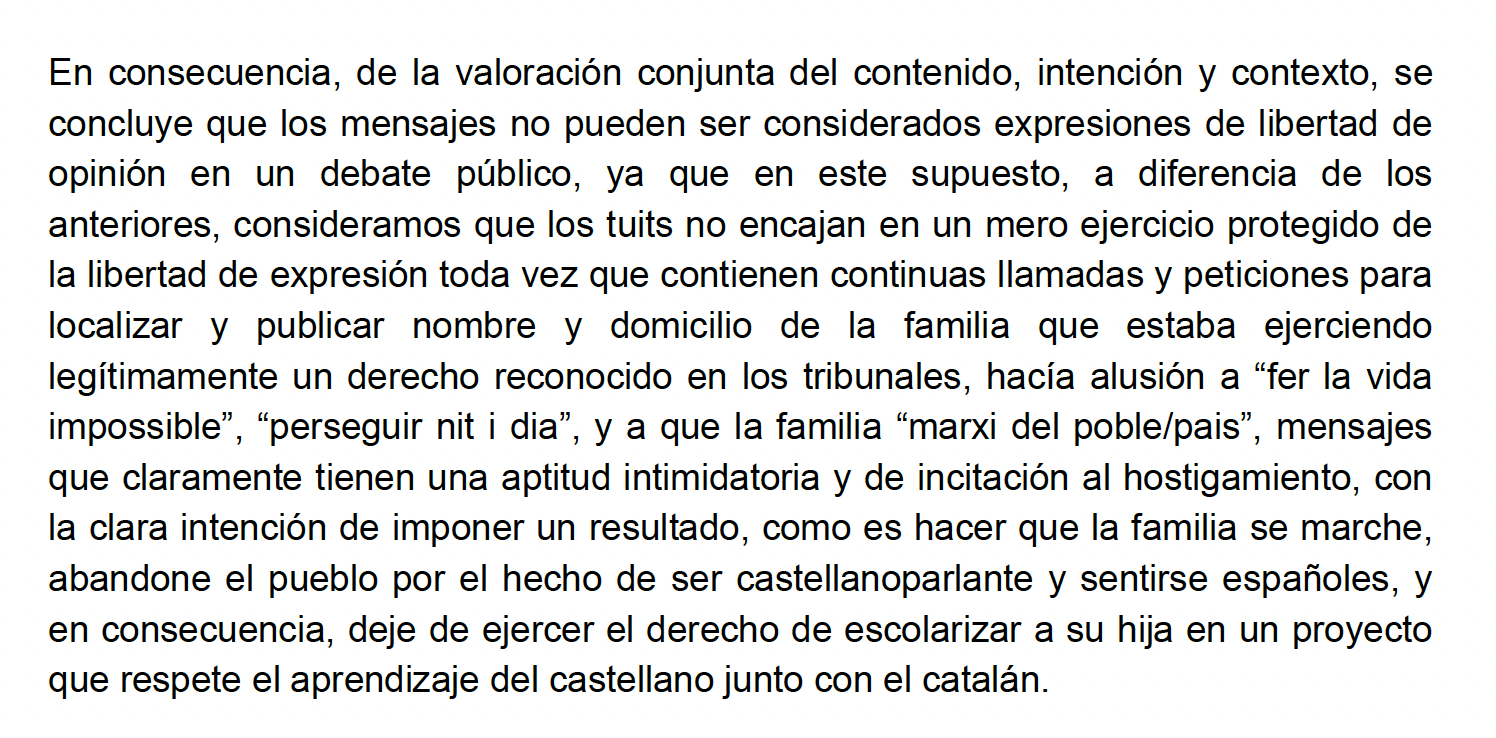
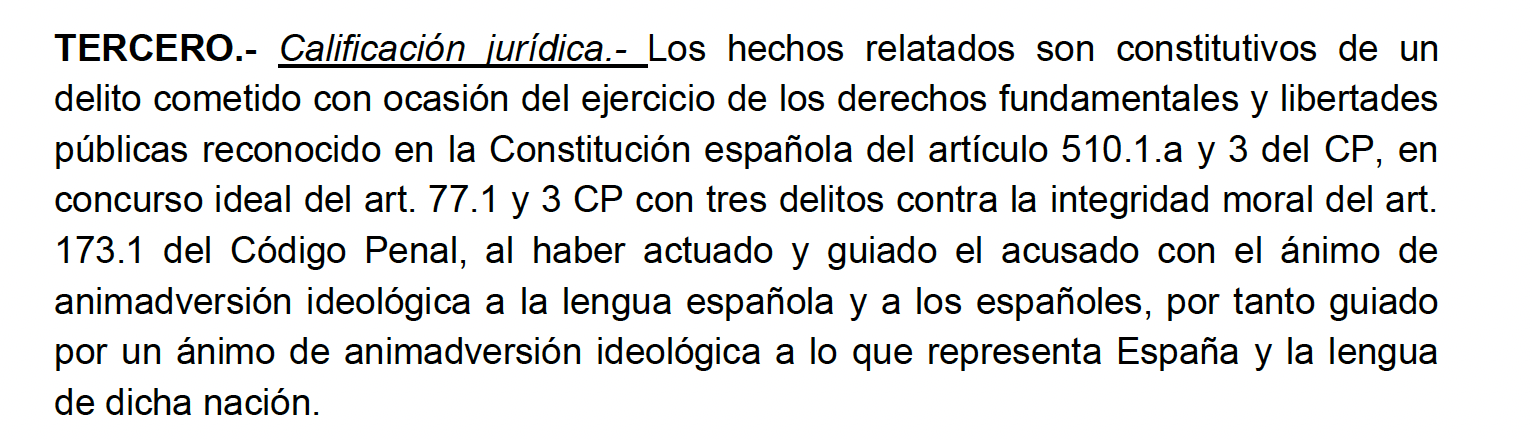
Limitations of rights affecting those who dissent from nationalism in Catalonia occur with some frequency. One example is the restriction on access to an education in which Spanish, alongside Catalan, serves as a language of instruction. Beyond the case referred to in the judgment mentioned above, there have been others in which families requesting bilingual education were harassed or had their businesses boycotted, with the clear intention of forcing them to abandon their demand for schooling in which Spanish is used as a language of instruction.
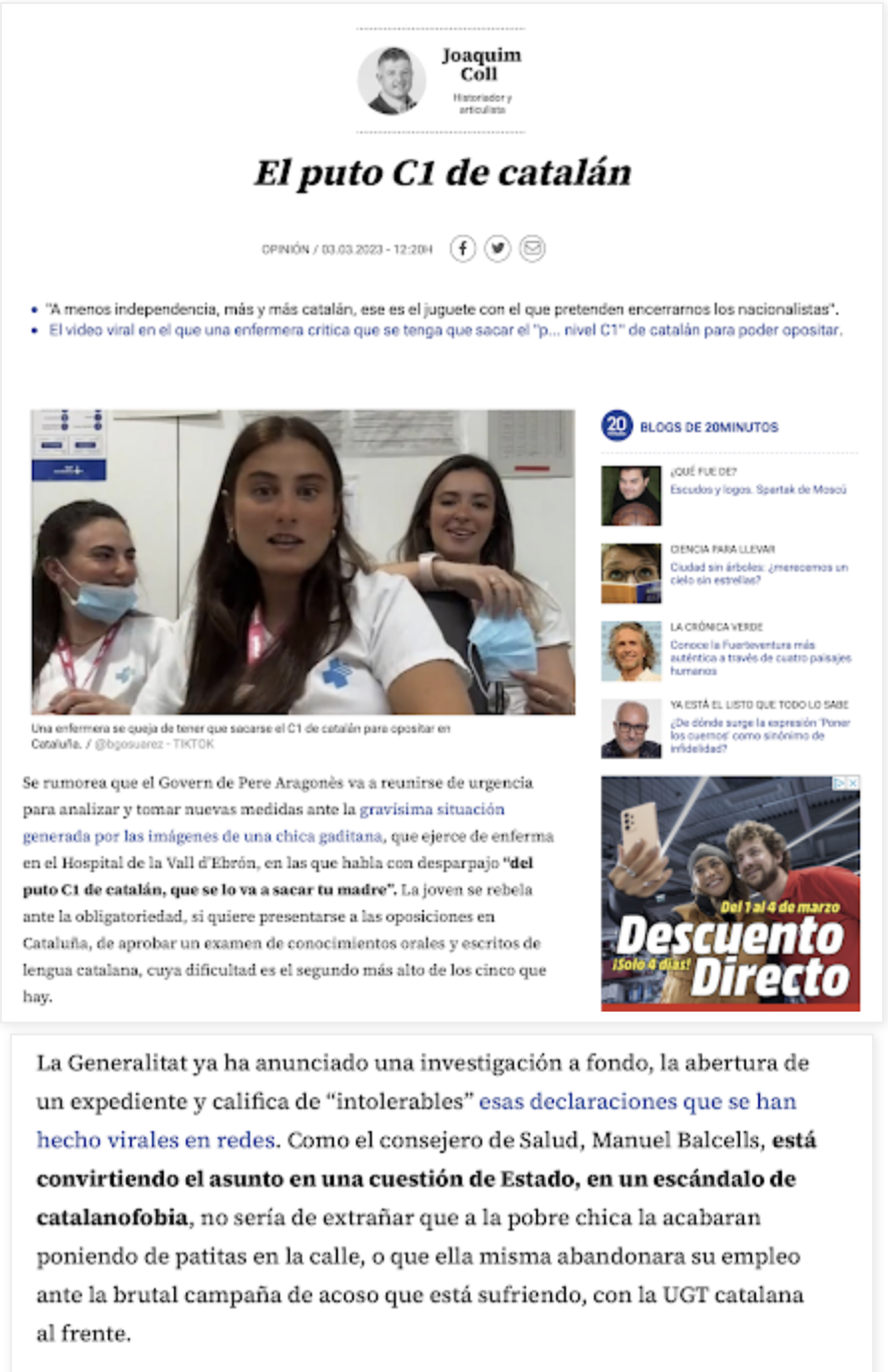
Without leaving the linguistic sphere, one may also recall the case of a nurse of Andalusian origin who lost her job in a public hospital after questioning the requirement of a certain level of Catalan in order to obtain a permanent position. Her criticism, which she shared on social media, triggered insults—also on social media—and prompted action by the Catalan authorities, leading to the adoption of disciplinary measures; measures that were explicitly taken because she had challenged those linguistic requirements.
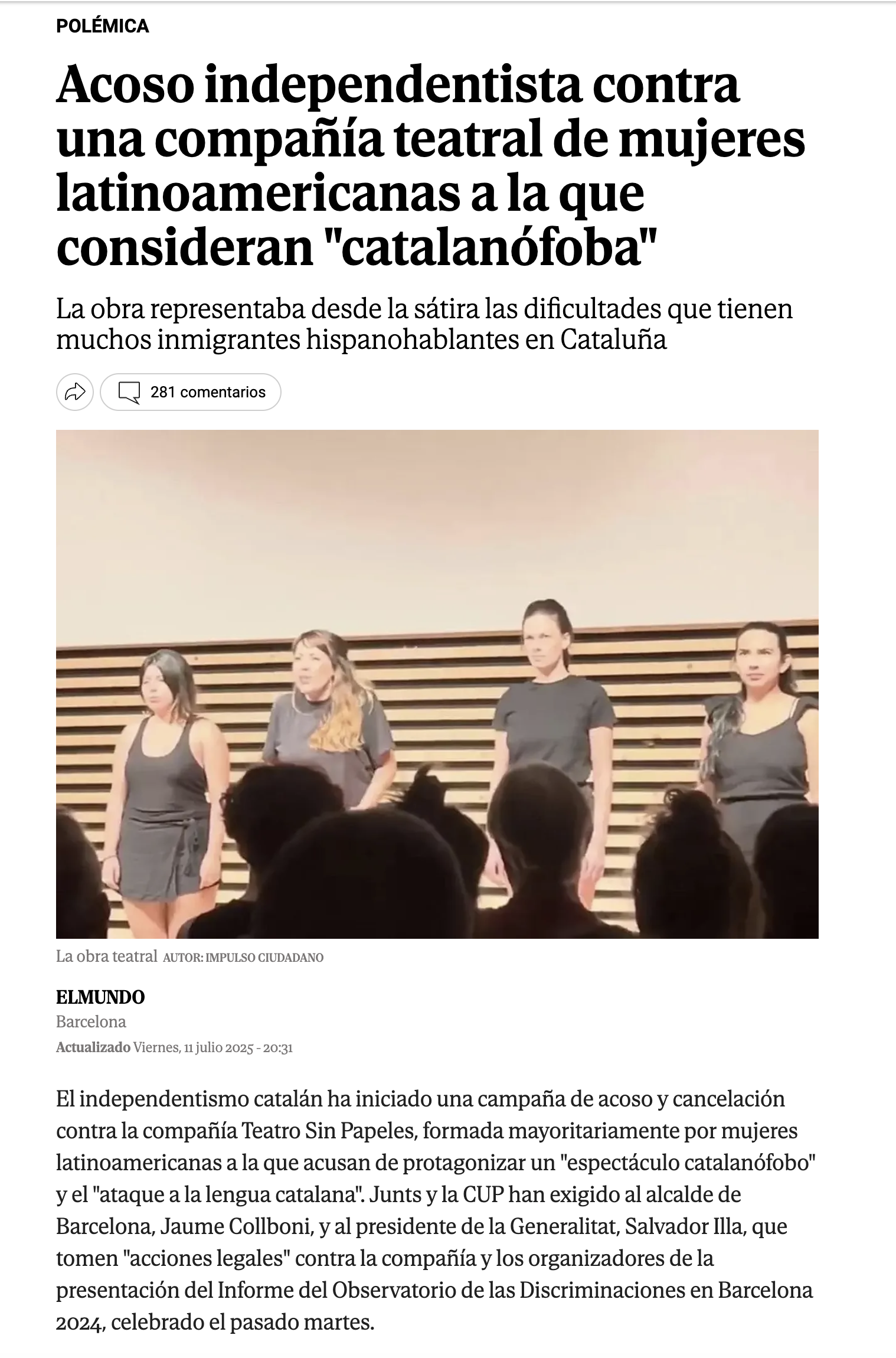
More recently, an amateur theatre group was also boycotted as a result of a play in which it questioned language policy in Catalonia.
Finally, limitations of rights can also be observed affecting non-nationalist students at Catalan public universities. In some cases, it has been judicially declared that academic authorities violated students’ fundamental rights by restricting their activities on campus for ideological reasons; in others, harassment suffered on university campuses at the hands of nationalist groups has led to criminal convictions. I have addressed these issues in some detail here.
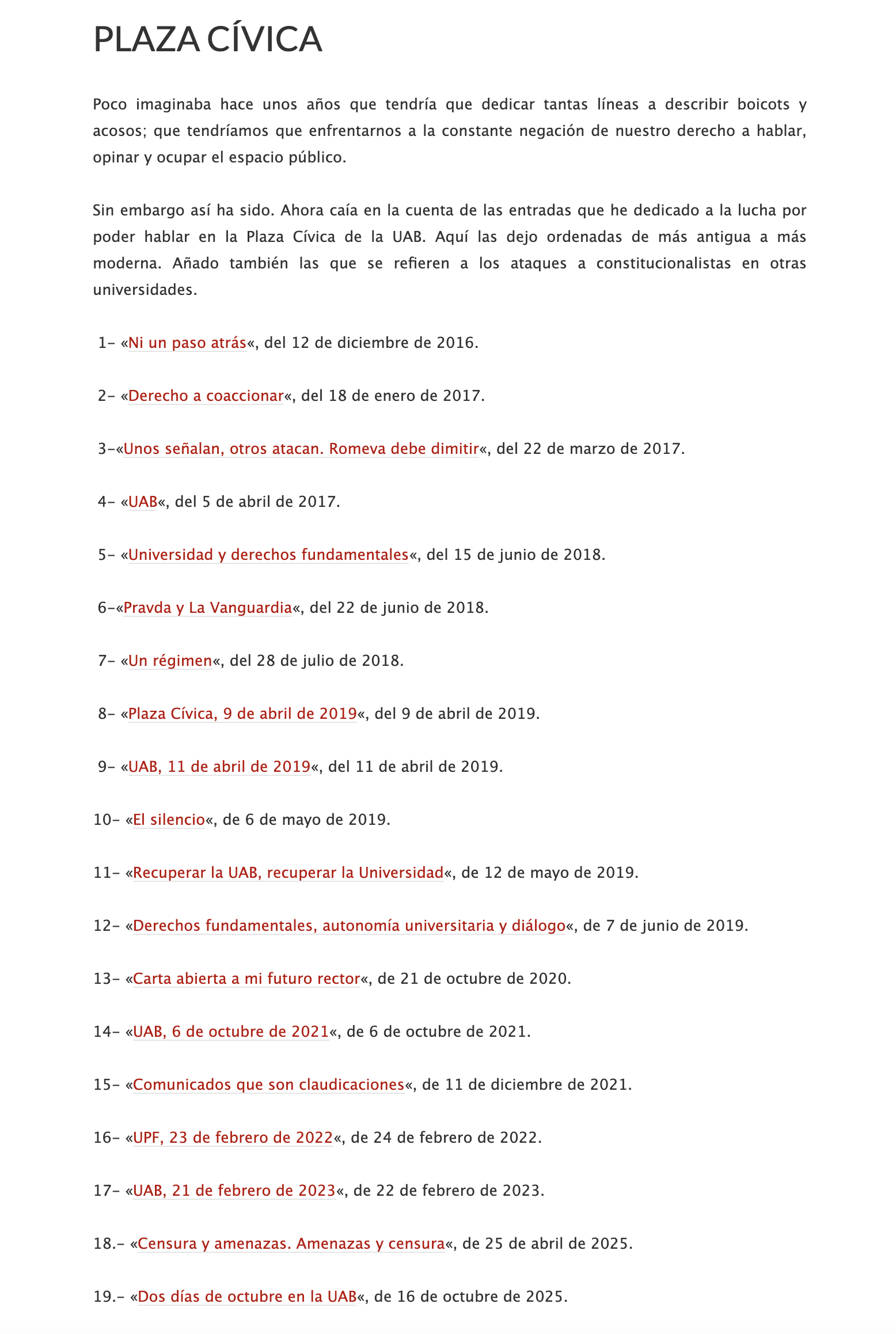
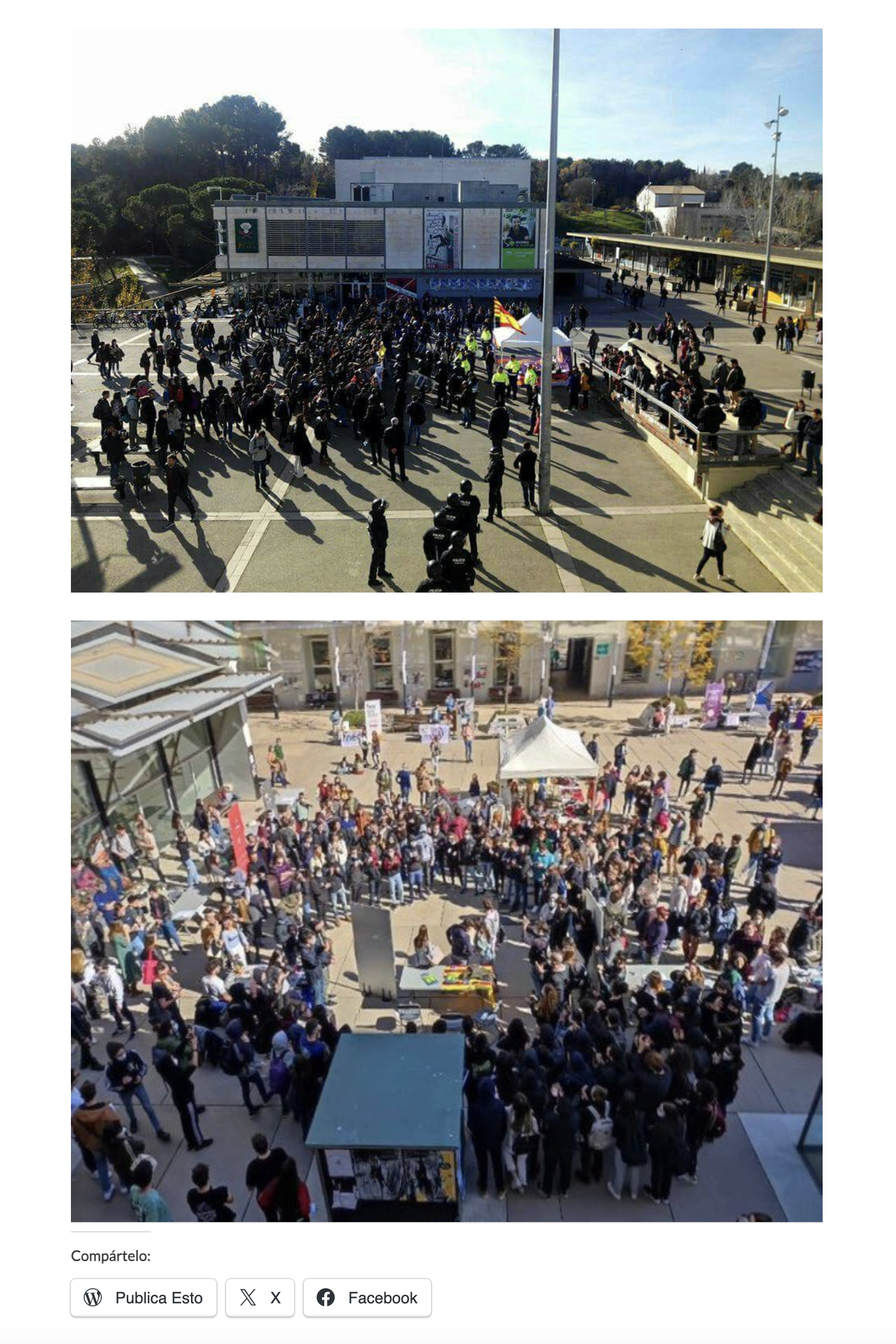
This limitation of rights affecting members of a particular group in Catalonia is quite clearly connected to what was noted at the outset: Catalan nationalist identity is, to a significant extent, constructed through opposition to Spanish identity, with Spain and Spaniards also being held responsible for having historically limited the possibilities of the Catalan nation. This narrative is projected onto those who, while living in Catalonia, have family origins in other parts of Spain and do not accept nationalist positions (which translates, for example, into advocating for bilingual education or questioning language requirements for access to employment). There is an additional nuance to consider: individuals of Catalan family origin and with Catalan as their mother tongue may also experience these same limitations of rights if they do not share the nationalist outlook. The label reserved for such individuals is botiflers—that is, traitors (although the term originally had a different meaning).

The necessary conditions are therefore present for the need to monitor, in Catalonia, discourse aimed at fostering hostility or contempt toward “Castilians,” Spain, Spanish identity, including its language. This is not arbitrary; rather, it responds to the real existence of limitations of rights connected to individuals’ belonging to a particular group—a group that is clearly defined by its opposition to Catalan nationalist positions, as explained above.
V. Hate Speech and Public Institutions
From what has been set out so far, it follows that there is a form of hate speech in Catalonia directed at Spain, Spaniards, and those Catalans who dissent from nationalist positions and identify as Spanish. This discourse is also linked to the limitation of certain rights affecting the members of this group—limitations that materialize, above all, in the areas of linguistic rights and freedom of expression.
In light of this reality, it is striking that not only anonymous individuals or those without public relevance take part in this discourse of hate, but that it is also reinforced from within public institutions. In this regard, it is noteworthy that, on the website of Catalonia’s public radio, the following message could be seen just a few days ago:
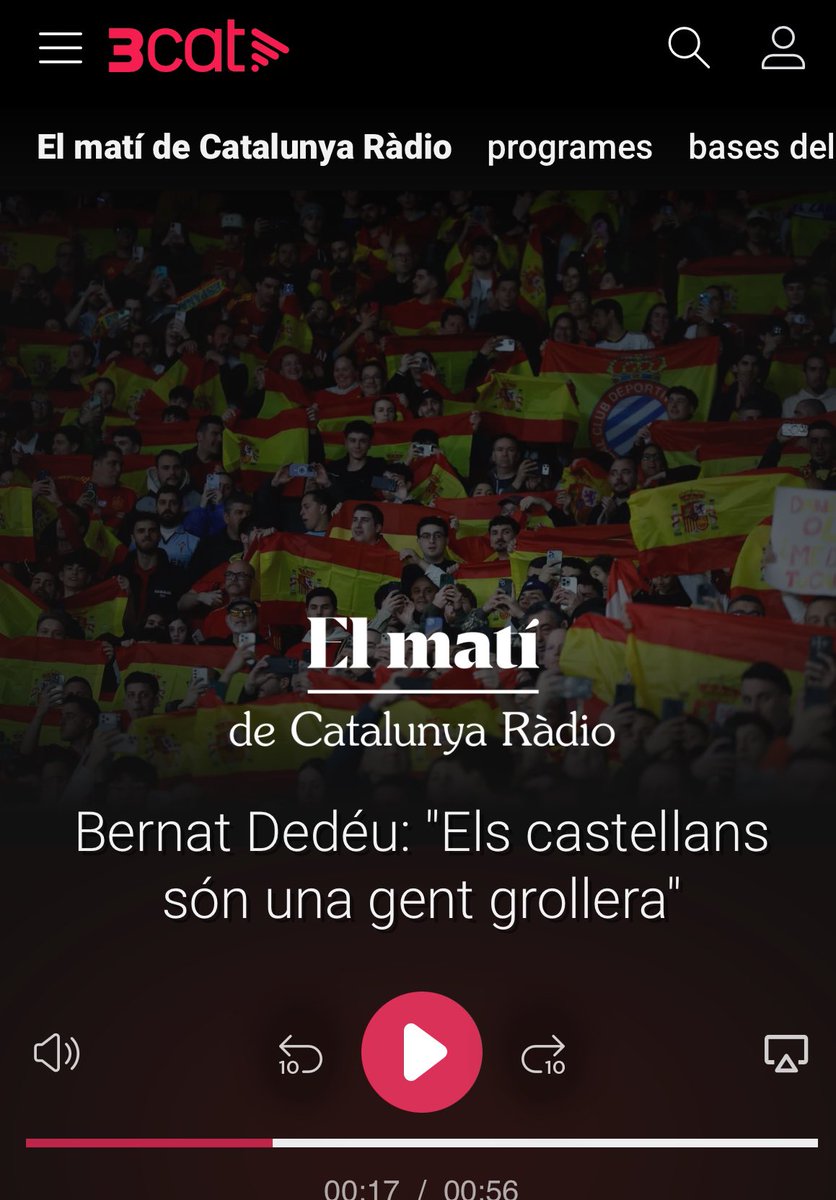
The issue is not that such a statement might be made by a commentator (although I would invite readers to replace “Castilians” with any other group and consider how it would be perceived); rather, it is that the website of a public radio broadcaster would feature, as a highlighted message, the claim that “Castilians are rude people.” This is, I believe, unacceptable.
Along the same lines, there is a clear disparity in how groups are treated: the group identified with Spain and Spanish identity is treated differently from others. Offensive messages about Spain on social media, or the burning of Spanish flags, are regarded as expressions of free speech; whereas equivalent actions directed at other groups are investigated as hate crimes.
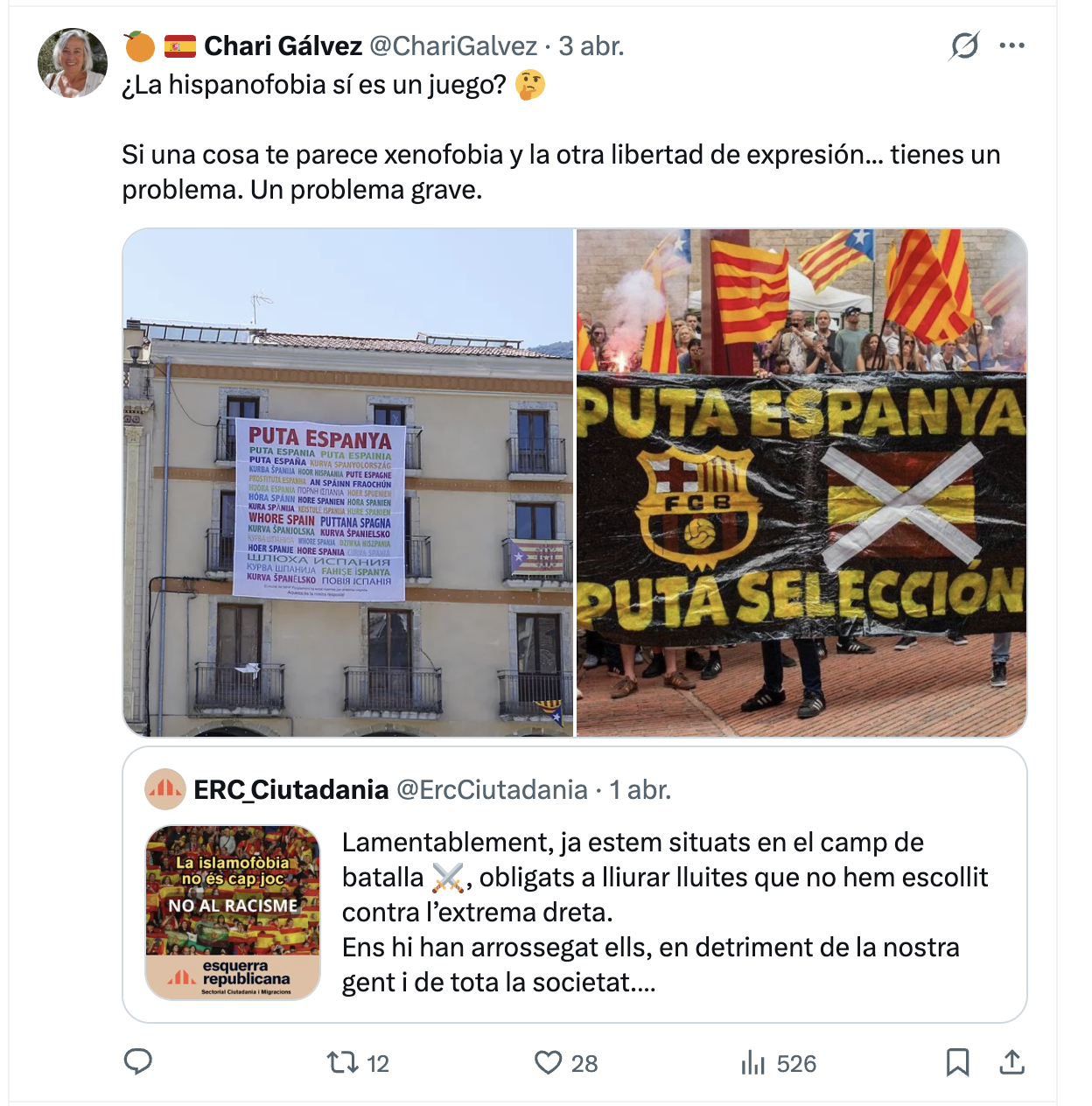
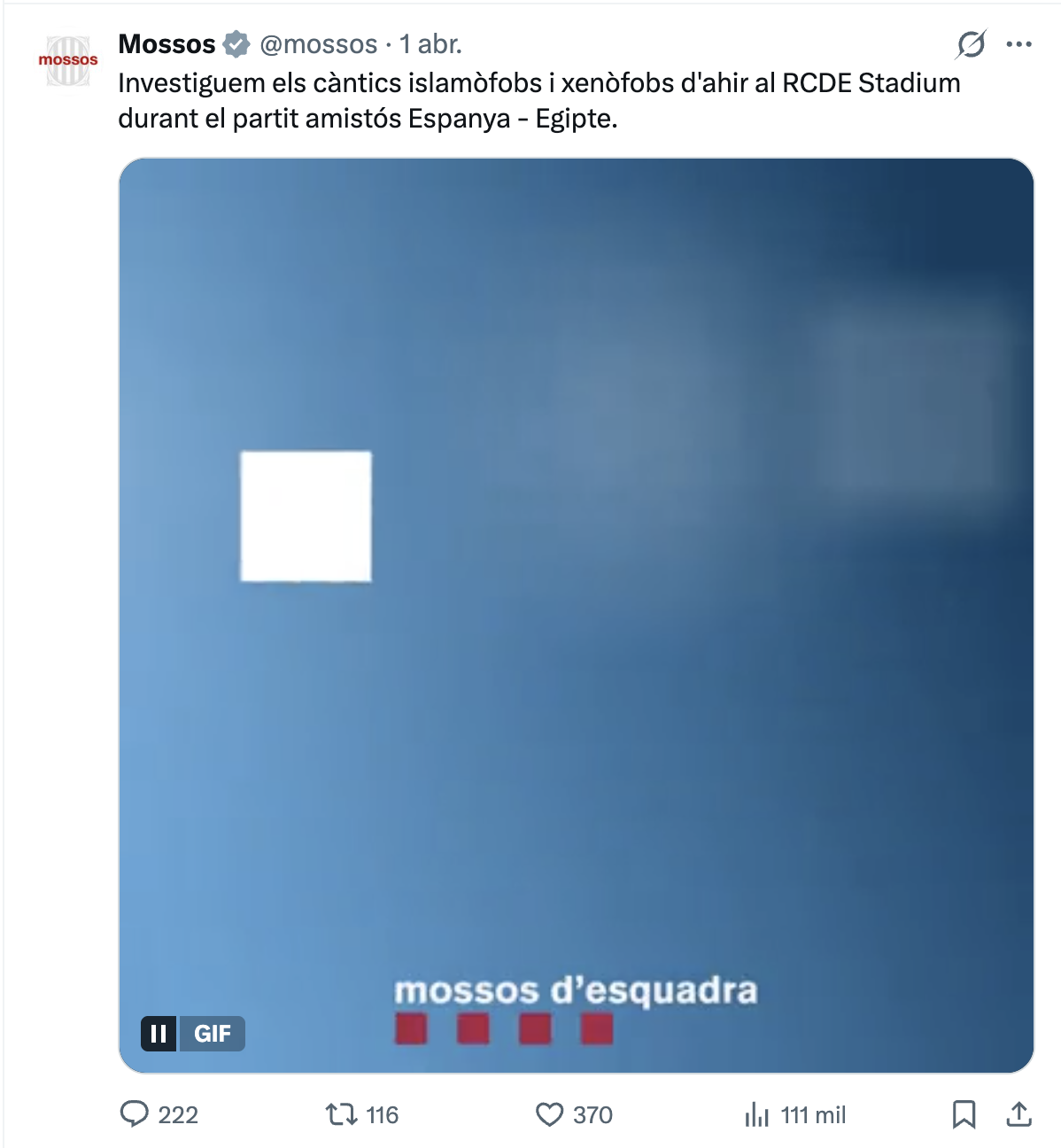
In other words, public authorities in Catalonia find it difficult to acknowledge that there exists a form of hate speech directed at Spain and Spaniards that also has an impact on the limitation of individual rights. However, in light of what has been discussed so far, this is not surprising; since public power in Catalonia is exercised by openly nationalist parties or by others (such as the PSC) which, despite not defining themselves as nationalist, have nevertheless adopted the nationalist narrative—both symbolically, in linguistic matters, and, to a significant extent, in their understanding of the relationship between Catalonia and the rest of Spain.
As we have seen, from a nationalist perspective there are clearly “good” actors (Catalans) and “bad” ones (Spaniards). The schematic and somewhat naïve framework of early twentieth-century Catalan nationalism has enjoyed institutional continuity and constitutes the foundation upon which the political positions of Catalanist parties are built—including, of course, the PSC and the various configurations of the parliamentary left in Catalonia.
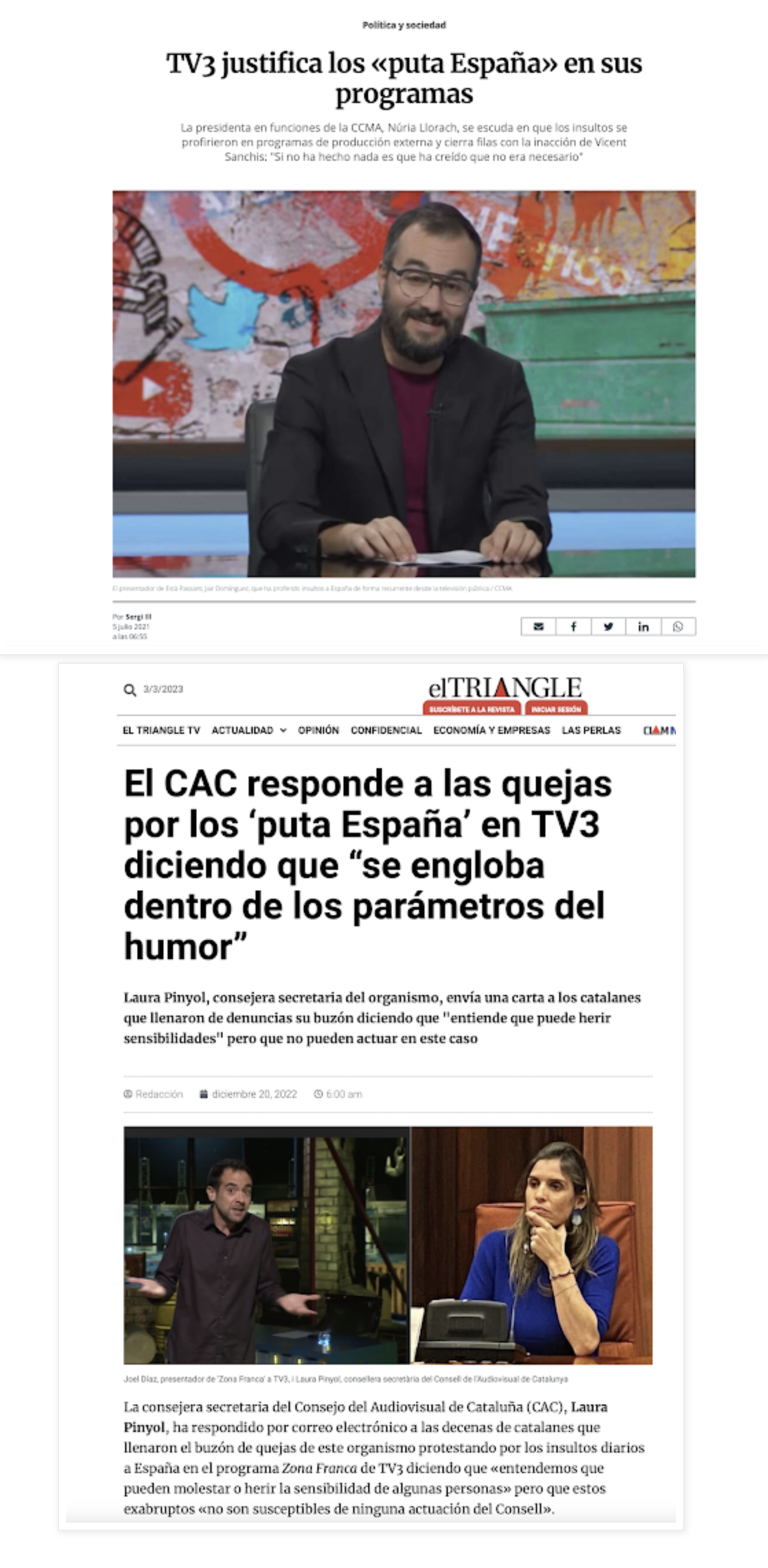
According to this nationalist framework, there is no symmetry between Catalanist positions and—not even “Spanish nationalist” ones—but simply those that defend equality of rights and the validity of constitutional principles. Meanwhile, slogans such as “Puta Espanya” may even receive a degree of institutional tolerance.
Criticism of the requirement of a C1 level in public healthcare recruitment examinations led to the initiation of disciplinary proceedings against a nurse of Andalusian origin.
From this perspective, it is inconceivable that insults directed at “Spaniards” or threats on social media would be prosecuted or investigated as hate speech. In such cases, they are regarded as legitimate exercises of freedom of expression, whereas any criticism of nationalism is liable to be portrayed as Catalanophobia—because here, it is considered necessary to ensure that freedom of expression does not become hate speech.
The result is that the narrative of hate speech is used by public authorities as a form of censorship, while at the same time preventing that same narrative from being used to challenge contempt or hostility emanating from those very authorities against those who dissent. This is, undoubtedly, a highly dangerous scenario.
VI. Conclusion
Hate speech is a complex concept that must be examined with particular care when it is the public authorities themselves who tolerate—or promote—the delegitimization of a group on identity-based grounds.
In such a context, the risk is twofold: on the one hand, a form of discourse is normalized that erodes social coexistence; on the other, the notion of “hate speech” is instrumentalized to disqualify or limit legitimate criticism of those in power. The result is a troubling inversion of terms: those who engage in hostility are protected, while those who dissent are singled out.
A plural society is grounded in freedom of expression. At the same time, it is legitimate to protect public debate from the disparagement of groups when such disparagement may lead to effective limitations of rights. What is unacceptable is for public authorities to tolerate such disparagement as a legitimate exercise of freedom of expression and, at the same time, invoke hate speech in order to restrict criticism of their own policies.
And that, unfortunately, is what is happening.

