I. The Proposition
One of the most counterintuitive findings in physics is that time does not pass at the same rate in all places and at all moments. A week ago, I wrote a post where I addressed this issue which, I repeat, is not a hypothesis or a speculation, but a well-proven physical reality.
If we synchronize two highly precise clocks, leave one on the surface of the Earth, and place the other at an altitude of 36,000 kilometers (in the orbit of geostationary satellites), after a certain amount of time, we will see that the clock on the satellite appears to have gained time—or, what is the same, the clock on the Earth’s surface has lost time. In cinema, this effect is explained very well in the movie Interstellar, which shows how a few hours on the surface of a world near the edge of a black hole equate to decades on the spaceship located a few thousand kilometers above that surface.
If we were to express the above using a metaphor, it would result in time having a different «density,» if we define density as the rate of the passage of time in a given place and moment compared to that same rate in another place or moment. In the case of Interstellar (or the clock on Earth’s surface compared to the clock in orbit), the variation is linked to space, but it can also be experienced as a change in the rhythm of time itself. Let me explain.
Imagine that from Earth, we measure the rate of time in the vicinity of a black hole. We will see that this rate is slower than what we experience on Earth. For example, we measure it through the changes in the luminosity of supernovas, which appear slower than what we would expect at a «normal» rate (there is no truly «normal» rate, all are equally valid; by «normal,» I mean the one we experience on Earth). After a few years, we measure that rate again and see that the supernova’s rhythm has «speeded up.» Why could that be? Perhaps because the black hole has disappeared (it is not impossible for this to happen).
In any case, before looking into the cause of that change, let’s focus on the fact that, from the perspective of an observation made on Earth, as time passes, the rate of time in that specific location in space has accelerated. In other words, the rate of time was slower before. Time has «speeded up.» And, returning to the density metaphor, time has become «less dense.»
What I have said so far, as I mentioned, is not speculation. The fact that time passes at different rates in different places and moments is a proven fact. However, this is where the «real» physics ends and, from here on out, what follows is speculation.
II. The Slowing of Time
1. Time is Becoming Denser
The speculation upon which the others will be built is that the rate of time has changed with the evolution of the universe. Specifically, for the reasons that will be provided, time would be slowing down (hence the title of the post), which implies that in the universe’s past, time passed «faster» or, in terms of our metaphor, time is becoming «denser.»
This could also be expressed in another way: the speed of light (c) has varied; specifically, in the past, it would have been faster than it is today. The variation of c at different points in time has been proposed as a «serious» theory by some scientists, although it has not been proven, so it remains in the realm of hypothesis.
The speculation to be developed here is that the density of time increases with the expansion of the universe, such that time currently passes more slowly than in the past, but, at the same time, faster than it will in the future.
Why propose such a hypothesis? Well, as crazy as it may seem, this speculation could help explain certain phenomena that currently do not fit perfectly within standard physics—the model which maintains that time is constant at a cosmic level, which could be expressed as g(t)=1. Let’s take a look.
2. What would the slowing of time explain?
A) The dimness of supernovas
Supernovas are stellar explosions that can light up the sky for several days (if they occur at a distance visible without telescopes). Astronomers track them both in our own galaxy and in others, even very distant ones. In principle, the brightness of a supernova allows us to measure its distance. However, that distance also depends on how much the universe has expanded since the supernova’s light was emitted. Let’s explain this.
If a galaxy is at a certain distance from Earth and a supernova occurs within it, the light from that supernova will reach us after millions of years (the time it takes for light to cover the distance between the supernova and Earth). The brightness of the supernova will be dimmer the farther away it is, just like a lighthouse or a flashlight on our planet’s surface.
Now, when distant galaxies are studied, we notice that the light reaching us is shifted toward the red (redshift). This redshift is an indication that space is growing and pushing galaxies apart. This is the phenomenon of the expansion of the universe. Without this expansion, there would be no redshift—or it would be much weaker and would have to be combined with «blueshift» for galaxies moving toward us instead of away; but this is not observed. All galaxies show redshift, implying they are all moving apart due to the expansion of the universe. Furthermore, this shift is measured and provides a gauge of the speed at which galaxies are receding and their distance from us. Up to this point, we are still within standard physics.
The problem we encounter is that the brightness of supernovas in distant galaxies does not match their redshift. That is, they appear to be farther away than their redshift would suggest. The explanation provided by standard physics is that about 5 billion years ago, the expansion of the universe accelerated, resulting in galaxies being farther away than their redshift implies. To explain this acceleration, scientists rely on something called dark energy, which would have an effect opposite to that of gravity and is introduced in just the right amount to make the observations fit. To be fair, this isn’t just for supernova observations, but also for other cosmic phenomena that would remain unexplained without dark energy.
The speculation that time is slowing down offers an alternative explanation for the mismatch in supernova brightness. If time passes more slowly today than in the past, we are in the same situation—regarding distant galaxies—as an observer near a gravitational field relative to light emitted from outside that field. That light will have a blueshift as a result of the increasing density of time (and this, again, is standard physics).
In the framework of temporal slowing, this would imply that the redshift of galaxies deriving from spatial expansion is partially offset by this temporal blueshift. The result is that the observed redshift does not measure the full displacement of the galaxy, as it loses part of its effect due to this temporal shift. Consequently, distant galaxies are actually farther away than the redshift indicates; meaning the brightness of supernovas matches their true distance if we account for both spatial expansion and the slowing of time.
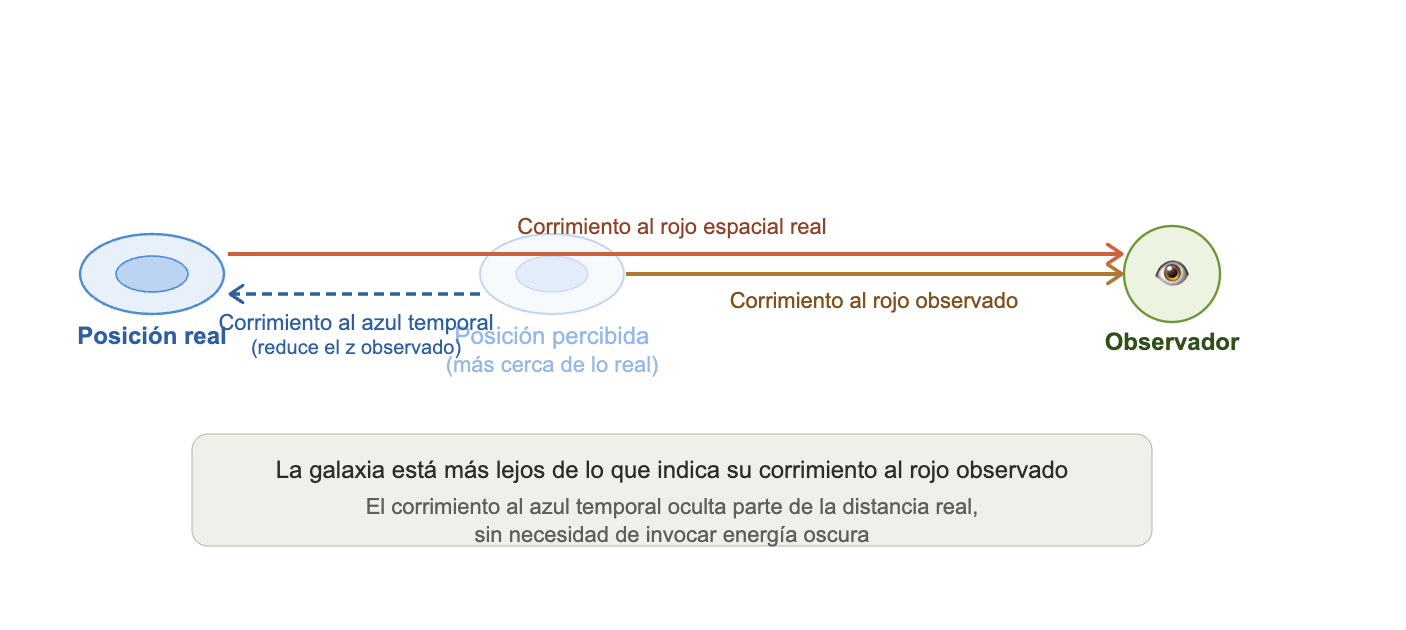
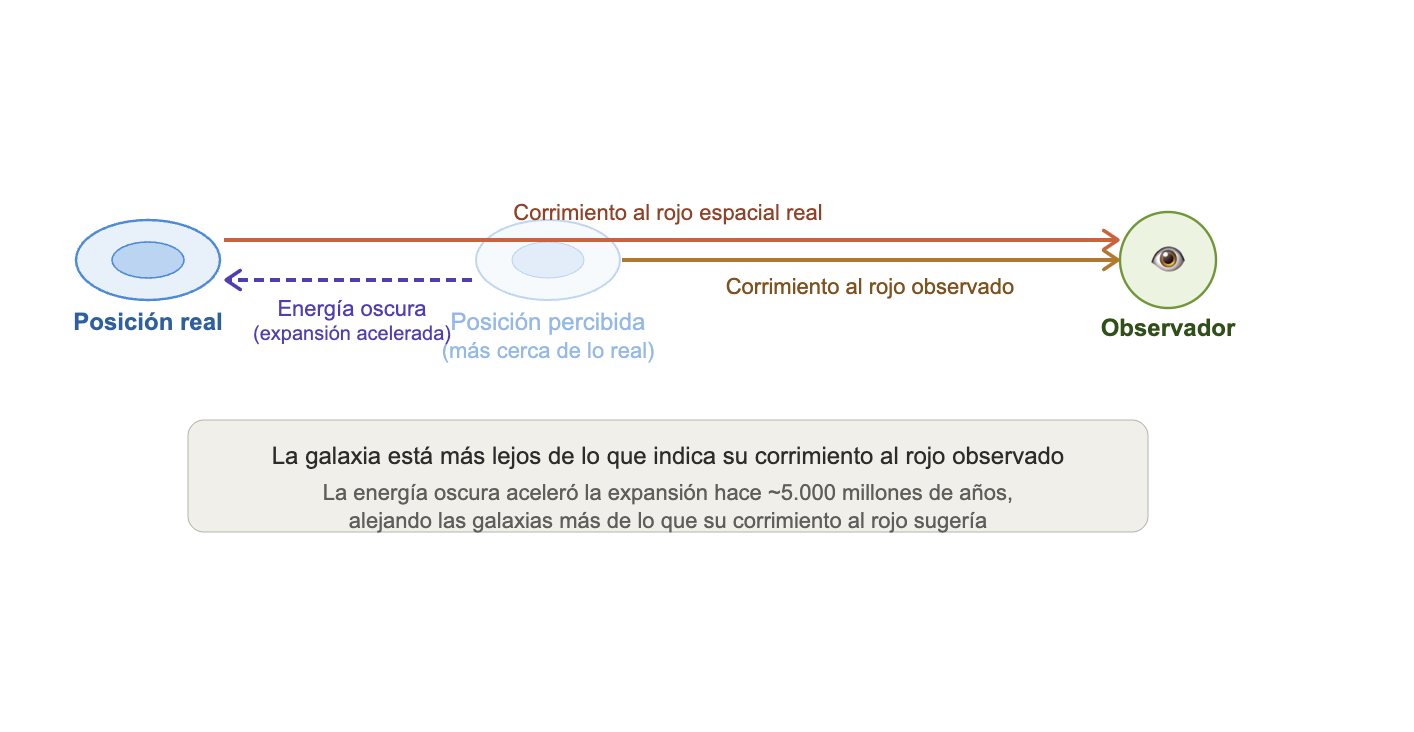
The slowing of time and the blueshift it would imply is a speculation that has not been formalized; that is, there is no equation to determine the exact rate of this slowing or to explain observable phenomena. However, it has one advantage over dark energy: we know that temporal slowing occurs in nature; it is a proven physical reality. Dark energy, on the other hand, remains a mystery and requires the incorporation of properties such as negative pressure and negative gravity, which do not correspond to any known physical phenomenon. Perhaps with the right mathematics, an equation could be found that uses this slowing to explain the phenomena currently solved by dark energy. If that were the case, the preference for temporal slowing over dark energy should be clear because, as I have said, the slowing of time has been experienced; dark energy has not.
Aside from the above—and although I cannot delve into it here—the hypothesis of temporal slowing would also affect the measurement of galactic distances. The distance of galaxies determined by the brightness of their supernovas would not match the results from other measurement mechanisms. Perhaps that is a topic for another post.
B) The Methuselah Stars
Based on a star’s composition, it is possible to measure its approximate age. The curious thing is that there are some stars that appear to be older than the universe itself. The most famous is known as the Methuselah star, located about 190 light-years from Earth. A few years ago, its age was estimated at 15 billion years—more than a billion years older than the age of the universe. While more recent measurements have reduced this estimate, it still sits right on the very edge of the moment the universe was created.
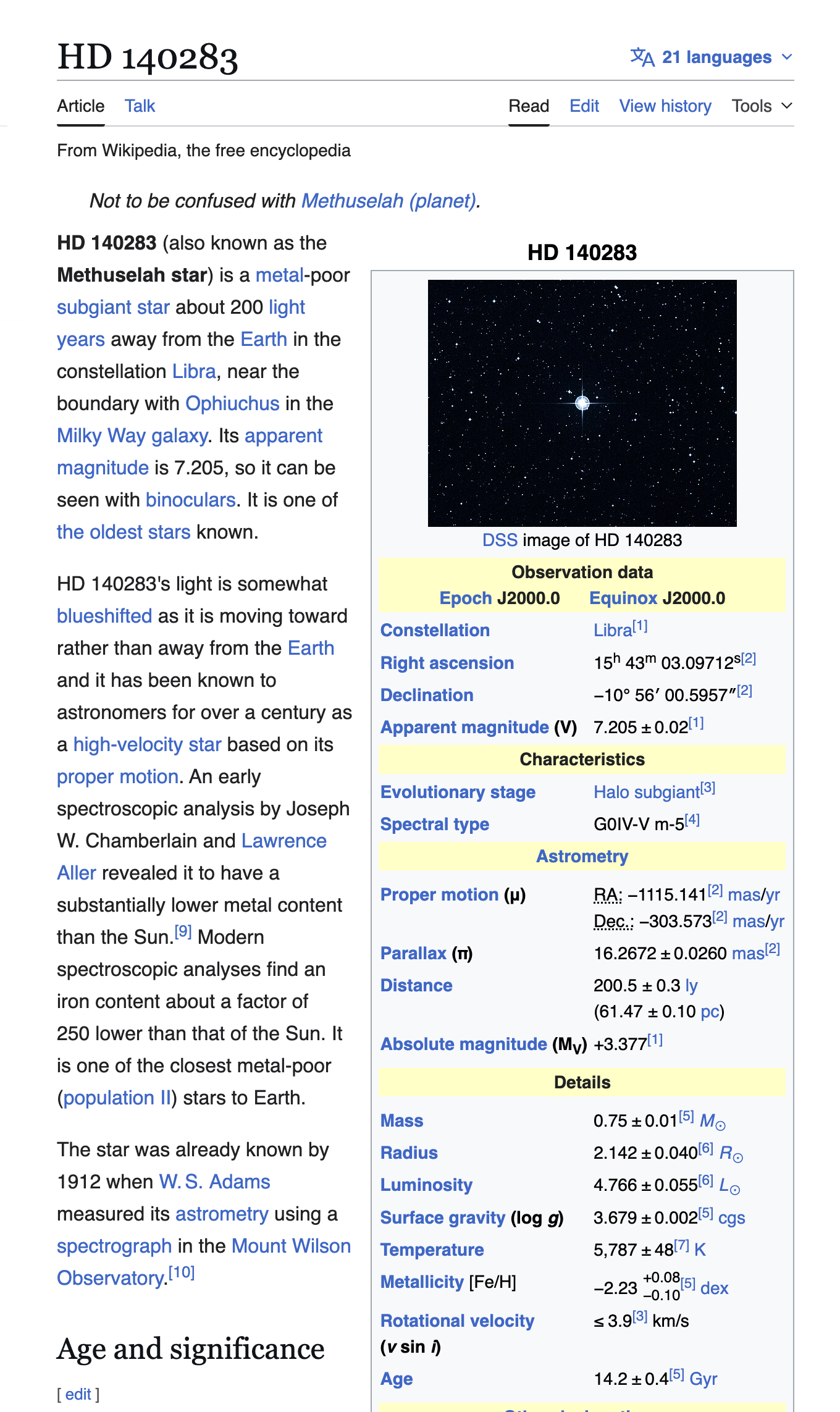
The temporal slowing hypothesis would imply that the universe has an «effective age» greater than what is currently estimated. If time passed faster during its early stages, physical phenomena would have unfolded at a higher speed from our current perspective. An additional 20% of time in the universe would represent several billion years, providing a natural explanation for phenomena such as the Methuselah star.
C) Galaxies that are too mature for their age
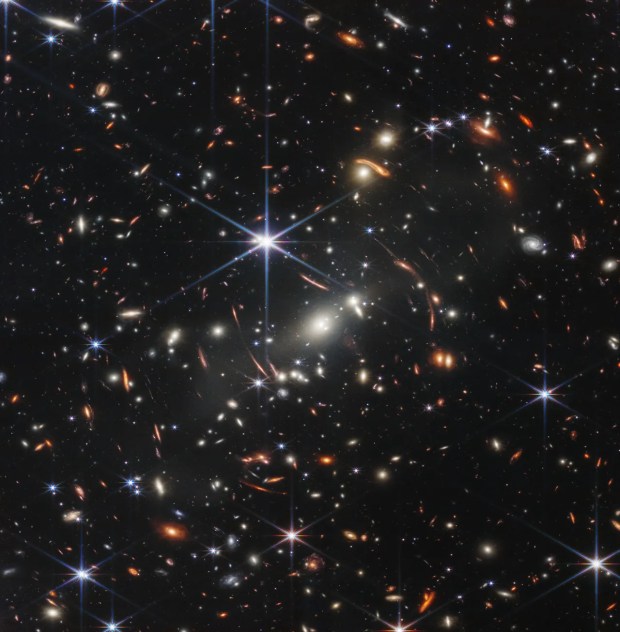
A few years ago (in 2022), it was observed that when looking far away and into the past—since looking far away is the same as looking into the past; if we see something 13 billion light-years away, it means it happened 13 billion years ago—galaxies appeared that were far too mature, far too soon. Barely 300 million years after the Big Bang, we were already finding massive galaxies. Current galaxy formation models could not perfectly account for how this was possible.
Since then, the initial surprise has been tempered, and it seems that some of those galaxies were not as «mature» as originally thought; nevertheless, they continue to pose difficulties for the standard model. In contrast, if time during the initial moments of the universe had passed at a faster rate than it does today, there would have been more time for these galaxies to develop. This would allow their evolution to fit easily within galaxy formation models.
3. Why is time slowing down?
Let us return to standard physics: near a gravitational field, time slows down; but this is not the only phenomenon that occurs. Space is also affected. If we measure something in the direction leading to the center of the gravitational field, we will see that it stretches. Using our metaphor of time density for cases where it slows down, this increase in density is accompanied, in the vicinity of a gravitational field, by a stretching of space.
That any effect on time also affects space seems natural in Relativity. After all, spacetime is one, and Einstein’s equations measure distances in spacetime. Not distances in space and distances in time separately, but distances in the combination of both. In the same way, any curvature of space also implies a modification of time. There is no one without the other.
Based on the above, what we should ask ourselves is: if the universe expands (stretches), why shouldn’t that stretching also produce a modification in time—in the rate of time? In principle, it would be the natural outcome, so the expansion of space should have some incidence on time as well. Of course, this is a speculation (not even a hypothesis yet), but a hypothesis that rests upon the relationship that General Relativity established between space and time. The difference here is that, instead of considering that connection locally, it is extended to the entire universe.
A different matter altogether is putting that relationship into an equation (and that is what transforms a speculation into a theory). It would be necessary to start from the equations of General Relativity to see what happens with a variable time. Perhaps then, a relationship could be established between the three components of everything in the universe: space, time, and «content»—that is, matter and energy, or, expressed in a more technical term, the energy-momentum tensor ((T_μν)).
Standard physics «plays» only with space and its content, while keeping time as an invariant. The challenge is to attempt to explain the functioning of the universe mathematically with a time that can vary. I suspect the equations would be more complex, but perhaps closer to the profound reality. In any case, as I have stated, what is being postulated—a difference in the temporal density of the universe linked to its expansion—would be nothing more than a particular case of the more general approaches of General Relativity. If near a gravitational field we observe that spatial stretching and the «densification» of time go hand in hand, why wouldn’t the expansion of the universe and the variation in the density of time go hand in hand as well?
4. The Arrow of Time
If this slowing of time were to exist, it could help us understand something else: why events move from the past to the future and not the other way around. This is the age-old issue of the arrow of time, which has traditionally been linked to the increase in entropy or the expansion of the universe. I believe that the slowing of time would allow for a simpler explanation based on a principle that frequently recurs in General Relativity: objects tend to move along the shortest path in spacetime—an idea that explains precisely why things fall toward the center of gravitational fields.
If we move from objects in motion to objects at rest and study their pure displacement in time, taking into account the higher density of time in the future compared to the past, we are presented with the following framework:
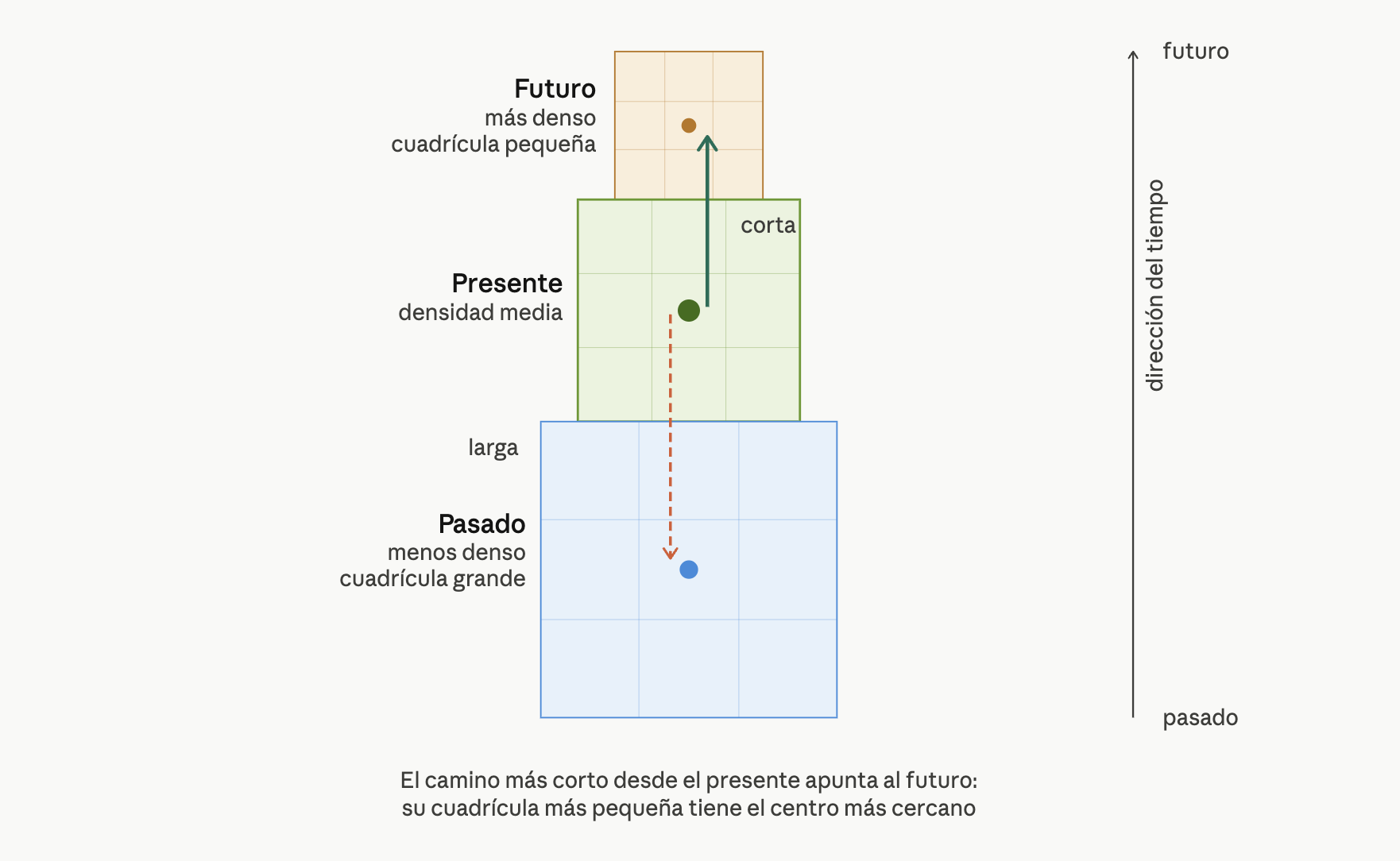
If we imagine time as a grid, the squares that compose it would be larger in the past (lower temporal density) than in the future (higher temporal density). If we now look at the red dot, which could represent a particle or an object, the question is whether it will move toward the past (blue dot) or toward the future (orange dot). Well, the answer is clear: it will move toward the future because, from the center of its own square, there is less distance to the center of the future square than to the one in the past. The law stating that it will follow the shortest path will push it toward the future, provided that future is denser than the past.
Of course, this is nothing more than speculation, but it could have significant consequences if it were formalized. One of the «mysteries» of physics is that equations work the same way toward the future as they do toward the past. It is as if the arrow of time were indifferent to physical equations, which does not align with our daily experience. The hypothesis is that this irrelevance of time stems from the assumption—erroneous, from the point of view of the speculation presented here—that the density of time is the same in the past, present, and future. If, instead of assuming an invariant time, we considered one that slows down in the future, perhaps the equations would lose the symmetry they currently hold between future and past. The catch is that they would also have to be reformulated so that time is not an invariant, but rather one more variable to be managed.
III. Conclusion
As I mentioned in another post, the variation in the rate of time has fascinated me since I was a child. However, I have never been able to explore it in such detail as I can now, thanks to AI tools. They allow you to ask questions, refine ideas, compare perspectives, confront doubts, and instantly obtain the information you need, explained at a level you can understand. A few days ago, I began speculating about the possibility of a variation in the rate of time throughout the history of the universe, testing it against Claude, ChatGPT, and Gemini. Now, I must confess that I see more and more clearly that this is a line of inquiry that should not be abandoned.
Claude is more «enthusiastic» about the approach, while ChatGPT tends to try to steer me back toward the boundaries of standard physics, and Gemini remains somewhere in the middle. Regardless, they have not only made it easier for me to continue this speculative game, but along the way, I have learned—or I believe I have learned—a few things about cosmology and physics that were completely foreign to me just a couple of weeks ago.
Therefore, this post is also a result of everything AI tools have to offer; though, of course, any nonsense is entirely my own responsibility.

