Ciencia

Is Time Slowing Down?

I. The Proposition

One of the most counterintuitive findings in physics is that time does not pass at the same rate in all places and at all moments. A week ago, I wrote a post where I addressed this issue which, I repeat, is not a hypothesis or a speculation, but a well-proven physical reality.

If we synchronize two highly precise clocks, leave one on the surface of the Earth, and place the other at an altitude of 36,000 kilometers (in the orbit of geostationary satellites), after a certain amount of time, we will see that the clock on the satellite appears to have gained time—or, what is the same, the clock on the Earth’s surface has lost time. In cinema, this effect is explained very well in the movie Interstellar, which shows how a few hours on the surface of a world near the edge of a black hole equate to decades on the spaceship located a few thousand kilometers above that surface.

If we were to express the above using a metaphor, it would result in time having a different «density,» if we define density as the rate of the passage of time in a given place and moment compared to that same rate in another place or moment. In the case of Interstellar (or the clock on Earth’s surface compared to the clock in orbit), the variation is linked to space, but it can also be experienced as a change in the rhythm of time itself. Let me explain.

Imagine that from Earth, we measure the rate of time in the vicinity of a black hole. We will see that this rate is slower than what we experience on Earth. For example, we measure it through the changes in the luminosity of supernovas, which appear slower than what we would expect at a «normal» rate (there is no truly «normal» rate, all are equally valid; by «normal,» I mean the one we experience on Earth). After a few years, we measure that rate again and see that the supernova’s rhythm has «speeded up.» Why could that be? Perhaps because the black hole has disappeared (it is not impossible for this to happen).

In any case, before looking into the cause of that change, let’s focus on the fact that, from the perspective of an observation made on Earth, as time passes, the rate of time in that specific location in space has accelerated. In other words, the rate of time was slower before. Time has «speeded up.» And, returning to the density metaphor, time has become «less dense.»

What I have said so far, as I mentioned, is not speculation. The fact that time passes at different rates in different places and moments is a proven fact. However, this is where the «real» physics ends and, from here on out, what follows is speculation.

II. The Slowing of Time

1. Time is Becoming Denser

The speculation upon which the others will be built is that the rate of time has changed with the evolution of the universe. Specifically, for the reasons that will be provided, time would be slowing down (hence the title of the post), which implies that in the universe’s past, time passed «faster» or, in terms of our metaphor, time is becoming «denser.»

This could also be expressed in another way: the speed of light (c) has varied; specifically, in the past, it would have been faster than it is today. The variation of c at different points in time has been proposed as a «serious» theory by some scientists, although it has not been proven, so it remains in the realm of hypothesis.
The speculation to be developed here is that the density of time increases with the expansion of the universe, such that time currently passes more slowly than in the past, but, at the same time, faster than it will in the future.

Why propose such a hypothesis? Well, as crazy as it may seem, this speculation could help explain certain phenomena that currently do not fit perfectly within standard physics—the model which maintains that time is constant at a cosmic level, which could be expressed as g(t)=1. Let’s take a look.

2. What would the slowing of time explain?

A) The dimness of supernovas

Supernovas are stellar explosions that can light up the sky for several days (if they occur at a distance visible without telescopes). Astronomers track them both in our own galaxy and in others, even very distant ones. In principle, the brightness of a supernova allows us to measure its distance. However, that distance also depends on how much the universe has expanded since the supernova’s light was emitted. Let’s explain this.

If a galaxy is at a certain distance from Earth and a supernova occurs within it, the light from that supernova will reach us after millions of years (the time it takes for light to cover the distance between the supernova and Earth). The brightness of the supernova will be dimmer the farther away it is, just like a lighthouse or a flashlight on our planet’s surface.

Now, when distant galaxies are studied, we notice that the light reaching us is shifted toward the red (redshift). This redshift is an indication that space is growing and pushing galaxies apart. This is the phenomenon of the expansion of the universe. Without this expansion, there would be no redshift—or it would be much weaker and would have to be combined with «blueshift» for galaxies moving toward us instead of away; but this is not observed. All galaxies show redshift, implying they are all moving apart due to the expansion of the universe. Furthermore, this shift is measured and provides a gauge of the speed at which galaxies are receding and their distance from us. Up to this point, we are still within standard physics.

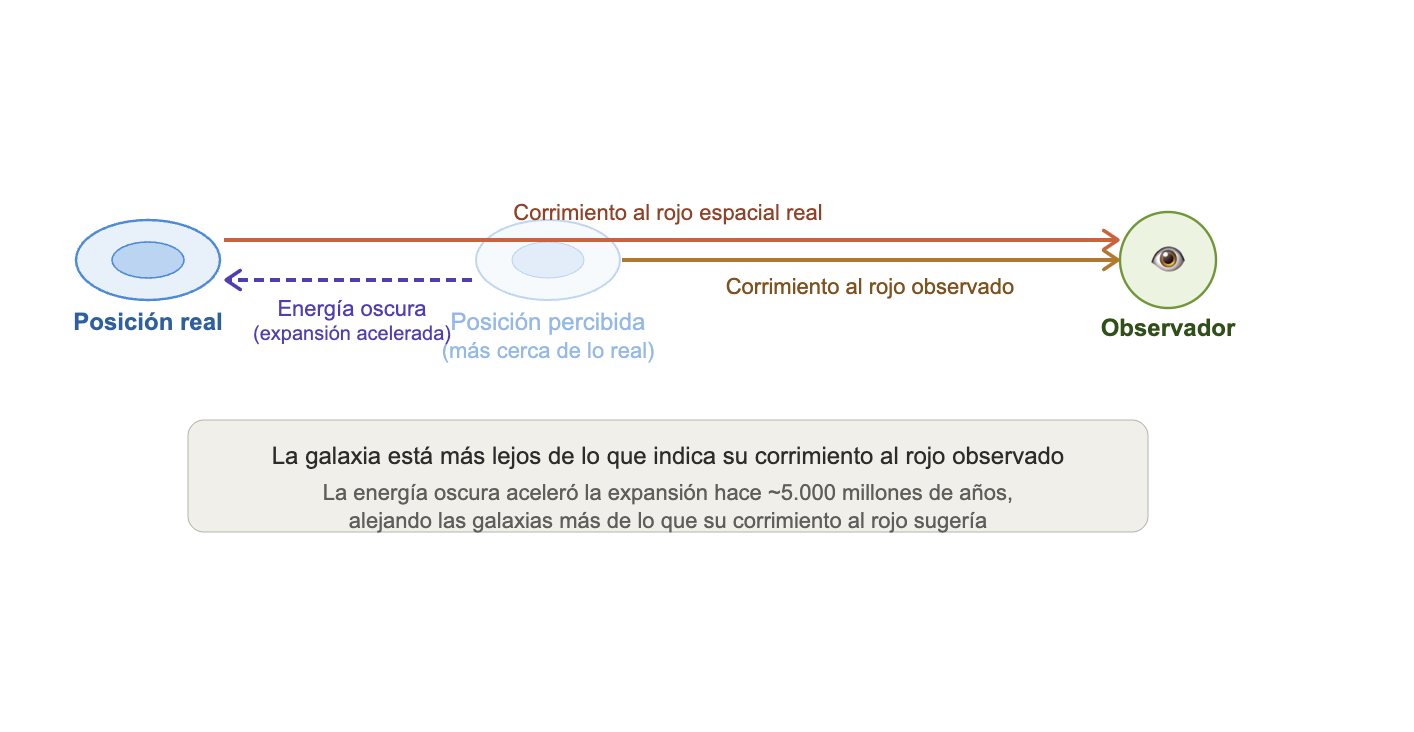
The problem we encounter is that the brightness of supernovas in distant galaxies does not match their redshift. That is, they appear to be farther away than their redshift would suggest. The explanation provided by standard physics is that about 5 billion years ago, the expansion of the universe accelerated, resulting in galaxies being farther away than their redshift implies. To explain this acceleration, scientists rely on something called dark energy, which would have an effect opposite to that of gravity and is introduced in just the right amount to make the observations fit. To be fair, this isn’t just for supernova observations, but also for other cosmic phenomena that would remain unexplained without dark energy.

The speculation that time is slowing down offers an alternative explanation for the mismatch in supernova brightness. If time passes more slowly today than in the past, we are in the same situation—regarding distant galaxies—as an observer near a gravitational field relative to light emitted from outside that field. That light will have a blueshift as a result of the increasing density of time (and this, again, is standard physics).

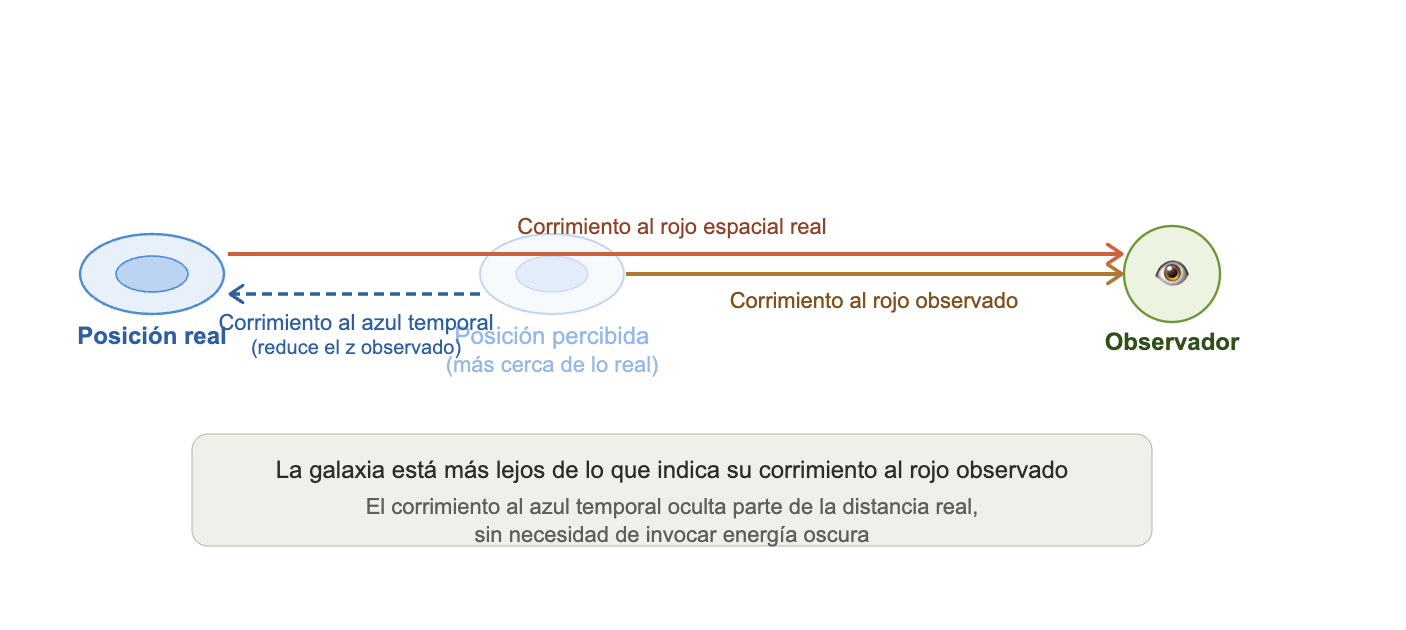
In the framework of temporal slowing, this would imply that the redshift of galaxies deriving from spatial expansion is partially offset by this temporal blueshift. The result is that the observed redshift does not measure the full displacement of the galaxy, as it loses part of its effect due to this temporal shift. Consequently, distant galaxies are actually farther away than the redshift indicates; meaning the brightness of supernovas matches their true distance if we account for both spatial expansion and the slowing of time.
The slowing of time and the blueshift it would imply is a speculation that has not been formalized; that is, there is no equation to determine the exact rate of this slowing or to explain observable phenomena. However, it has one advantage over dark energy: we know that temporal slowing occurs in nature; it is a proven physical reality. Dark energy, on the other hand, remains a mystery and requires the incorporation of properties such as negative pressure and negative gravity, which do not correspond to any known physical phenomenon. Perhaps with the right mathematics, an equation could be found that uses this slowing to explain the phenomena currently solved by dark energy. If that were the case, the preference for temporal slowing over dark energy should be clear because, as I have said, the slowing of time has been experienced; dark energy has not.

Aside from the above—and although I cannot delve into it here—the hypothesis of temporal slowing would also affect the measurement of galactic distances. The distance of galaxies determined by the brightness of their supernovas would not match the results from other measurement mechanisms. Perhaps that is a topic for another post.

B) The Methuselah Stars

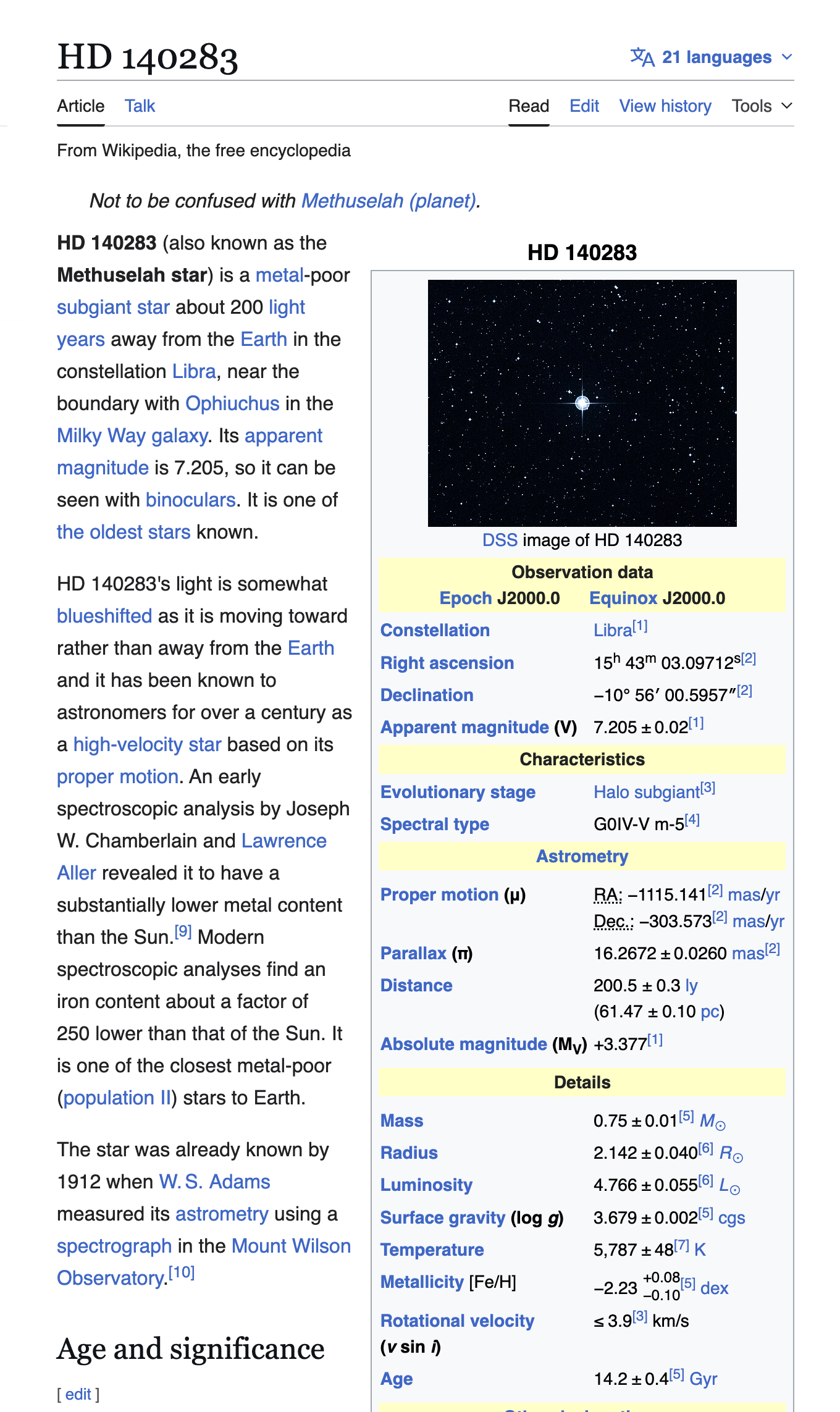
Based on a star’s composition, it is possible to measure its approximate age. The curious thing is that there are some stars that appear to be older than the universe itself. The most famous is known as the Methuselah star, located about 190 light-years from Earth. A few years ago, its age was estimated at 15 billion years—more than a billion years older than the age of the universe. While more recent measurements have reduced this estimate, it still sits right on the very edge of the moment the universe was created.
The temporal slowing hypothesis would imply that the universe has an «effective age» greater than what is currently estimated. If time passed faster during its early stages, physical phenomena would have unfolded at a higher speed from our current perspective. An additional 20% of time in the universe would represent several billion years, providing a natural explanation for phenomena such as the Methuselah star.

C) Galaxies that are too mature for their age

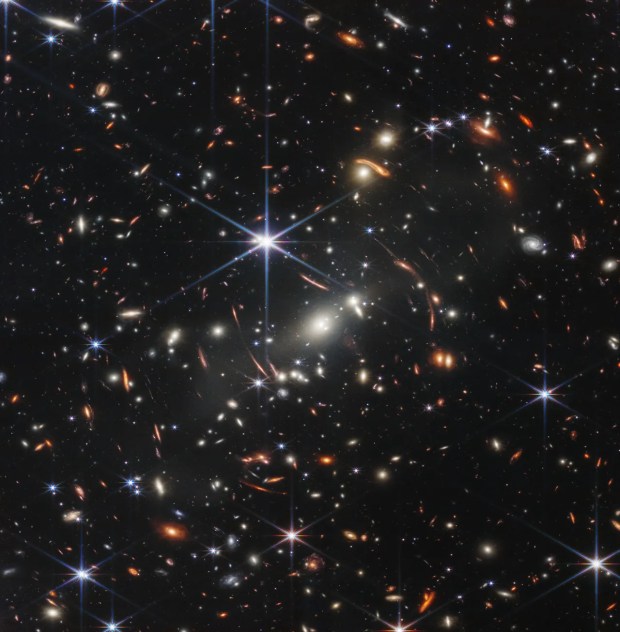
A few years ago (in 2022), it was observed that when looking far away and into the past—since looking far away is the same as looking into the past; if we see something 13 billion light-years away, it means it happened 13 billion years ago—galaxies appeared that were far too mature, far too soon. Barely 300 million years after the Big Bang, we were already finding massive galaxies. Current galaxy formation models could not perfectly account for how this was possible.

Since then, the initial surprise has been tempered, and it seems that some of those galaxies were not as «mature» as originally thought; nevertheless, they continue to pose difficulties for the standard model. In contrast, if time during the initial moments of the universe had passed at a faster rate than it does today, there would have been more time for these galaxies to develop. This would allow their evolution to fit easily within galaxy formation models.

3. Why is time slowing down?

Let us return to standard physics: near a gravitational field, time slows down; but this is not the only phenomenon that occurs. Space is also affected. If we measure something in the direction leading to the center of the gravitational field, we will see that it stretches. Using our metaphor of time density for cases where it slows down, this increase in density is accompanied, in the vicinity of a gravitational field, by a stretching of space.

That any effect on time also affects space seems natural in Relativity. After all, spacetime is one, and Einstein’s equations measure distances in spacetime. Not distances in space and distances in time separately, but distances in the combination of both. In the same way, any curvature of space also implies a modification of time. There is no one without the other.

Based on the above, what we should ask ourselves is: if the universe expands (stretches), why shouldn’t that stretching also produce a modification in time—in the rate of time? In principle, it would be the natural outcome, so the expansion of space should have some incidence on time as well. Of course, this is a speculation (not even a hypothesis yet), but a hypothesis that rests upon the relationship that General Relativity established between space and time. The difference here is that, instead of considering that connection locally, it is extended to the entire universe.

A different matter altogether is putting that relationship into an equation (and that is what transforms a speculation into a theory). It would be necessary to start from the equations of General Relativity to see what happens with a variable time. Perhaps then, a relationship could be established between the three components of everything in the universe: space, time, and «content»—that is, matter and energy, or, expressed in a more technical term, the energy-momentum tensor ((T_μν)).

Standard physics «plays» only with space and its content, while keeping time as an invariant. The challenge is to attempt to explain the functioning of the universe mathematically with a time that can vary. I suspect the equations would be more complex, but perhaps closer to the profound reality. In any case, as I have stated, what is being postulated—a difference in the temporal density of the universe linked to its expansion—would be nothing more than a particular case of the more general approaches of General Relativity. If near a gravitational field we observe that spatial stretching and the «densification» of time go hand in hand, why wouldn’t the expansion of the universe and the variation in the density of time go hand in hand as well?

4. The Arrow of Time

If this slowing of time were to exist, it could help us understand something else: why events move from the past to the future and not the other way around. This is the age-old issue of the arrow of time, which has traditionally been linked to the increase in entropy or the expansion of the universe. I believe that the slowing of time would allow for a simpler explanation based on a principle that frequently recurs in General Relativity: objects tend to move along the shortest path in spacetime—an idea that explains precisely why things fall toward the center of gravitational fields.

If we move from objects in motion to objects at rest and study their pure displacement in time, taking into account the higher density of time in the future compared to the past, we are presented with the following framework:
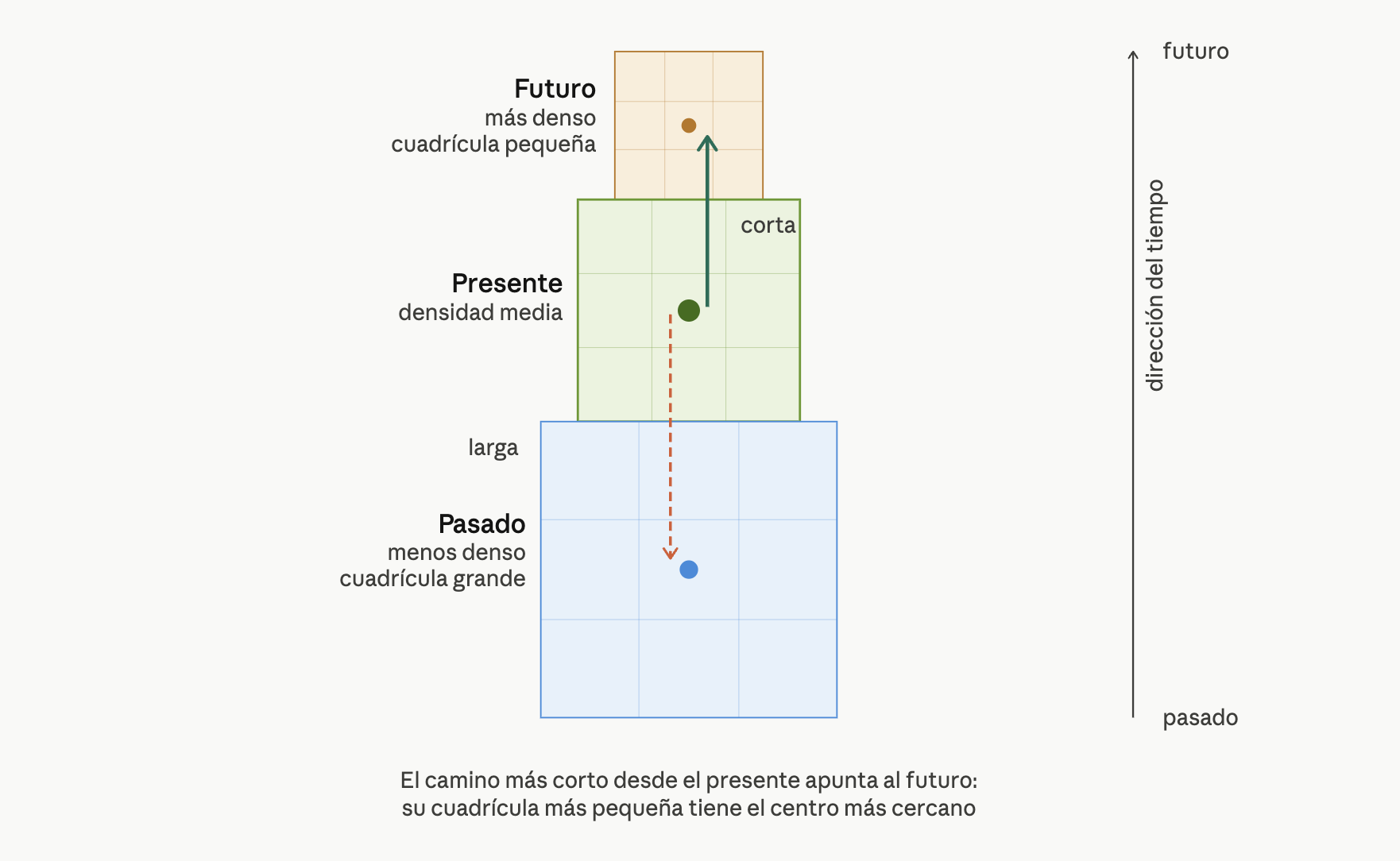
If we imagine time as a grid, the squares that compose it would be larger in the past (lower temporal density) than in the future (higher temporal density). If we now look at the red dot, which could represent a particle or an object, the question is whether it will move toward the past (blue dot) or toward the future (orange dot). Well, the answer is clear: it will move toward the future because, from the center of its own square, there is less distance to the center of the future square than to the one in the past. The law stating that it will follow the shortest path will push it toward the future, provided that future is denser than the past.

Of course, this is nothing more than speculation, but it could have significant consequences if it were formalized. One of the «mysteries» of physics is that equations work the same way toward the future as they do toward the past. It is as if the arrow of time were indifferent to physical equations, which does not align with our daily experience. The hypothesis is that this irrelevance of time stems from the assumption—erroneous, from the point of view of the speculation presented here—that the density of time is the same in the past, present, and future. If, instead of assuming an invariant time, we considered one that slows down in the future, perhaps the equations would lose the symmetry they currently hold between future and past. The catch is that they would also have to be reformulated so that time is not an invariant, but rather one more variable to be managed.

III. Conclusion

As I mentioned in another post, the variation in the rate of time has fascinated me since I was a child. However, I have never been able to explore it in such detail as I can now, thanks to AI tools. They allow you to ask questions, refine ideas, compare perspectives, confront doubts, and instantly obtain the information you need, explained at a level you can understand. A few days ago, I began speculating about the possibility of a variation in the rate of time throughout the history of the universe, testing it against Claude, ChatGPT, and Gemini. Now, I must confess that I see more and more clearly that this is a line of inquiry that should not be abandoned.

Claude is more «enthusiastic» about the approach, while ChatGPT tends to try to steer me back toward the boundaries of standard physics, and Gemini remains somewhere in the middle. Regardless, they have not only made it easier for me to continue this speculative game, but along the way, I have learned—or I believe I have learned—a few things about cosmology and physics that were completely foreign to me just a couple of weeks ago.

Therefore, this post is also a result of everything AI tools have to offer; though, of course, any nonsense is entirely my own responsibility.
¿Se está ralentizando el tiempo?

I. Planteamiento

Una de las constataciones físicas más contraintuitivas es la de que el tiempo no transcurre al mismo ritmo en todos los lugares y en todos los momentos. Hace una semana escribía una entrada donde abordaba esa cuestión que, repito, no es una hipótesis o una especulación, sino una realidad física bien contrastada. Si sincronizamos dos relojes muy precisos, dejamos uno en la superficie de la Tierra y colocamos el otro a 36.000 kilómetros de altura (en la órbita de los satélites geoestacionarios), al cabo de un tiempo veremos que el reloj colocado en el satélite parece haber adelantado o -lo que es lo mismo- el reloj situado en la superficie de la Tierra se ha retrasado. En el cine, este efecto se explica muy bien en la película Interestelar, donde se ve como unas horas en la superficie de un mundo cerca del borde de un agujero negro, son decenas de años en la nave que está situada unos miles de kilómetros por encima de dicha superficie

Si se quiere expresar lo anterior con una metáfora, resultaría que el tiempo tiene diferente «densidad», si entendemos densidad como el ritmo del paso del tiempo en un lugar y momento dado comparado con ese mismo ritmo en otro lugar o momento. En el caso de Interestelar (o del reloj en la superficie de la Tierra comparado con el reloj situado en un satélite en órbita) la variación se vincula al espacio, pero también puede experimentarse como un cambio del ritmo en el tiempo. Me explico.

Imaginemos que desde la Tierra medimos el ritmo del tiempo en la cercanía de un agujero negro. Veremos que ese ritmo es más lento que el que experimentamos en la Tierra. Por ejemplo, lo medimos a partir de los cambios de luminosidad de las supernovas, que son más lentos que los que esperaríamos a un ritmo «normal» (no hay ningún ritmo «normal», todos son igualmente válidos, con «normal» quiero decir el que experimentaríamos en la Tierra). Al cabo de unos años volvemos a medir ese ritmo y vemos que el ritmo de la supernova se ha «acelerado». ¿Por qué puede ser eso? Pues porque el agujero negro haya desaparecido (no es imposible que pase). En cualquier caso, antes de entrar en la causa de ese cambio de ritmo qudémonos con que, desde la perspectiva de la observación que se realiza en la Tierra, con el transcurso del tiempo el tiempo, en ese lugar concreto del espacio que estamos examinando, se ha acelerado. Dicho de otra manera, el ritmo del tiempo era más lento antes. El tiempo se ha «acelerado». Y, si volvemos a la metáfora de la densidad, el tiempo se ha vuelto «menos denso».

Lo anterior, como digo, no es especulación. El hecho de que el tiempo transcurre a ritmos diferentes en distintos lugares y momentos es una constatación. Ahora bien, aquí acaba la física de verdad y, de ahora en adelante, lo que habrá es especulación.

II. La ralentización del tiempo

1. El tiempo se vuelve más denso

La especulación sobre la que se construirán las demás es la de que el ritmo del tiempo ha cambiado con la evolución del universo. En concreto, por las razones que se darán, el tiempo se estaría ralentizando (y de ahí el título de la entrada), lo que implica que en el pasado del universo el tiempo transcurría «más rápido» o, lo que es lo mismo (en nuestra metáfora), el tiempo se va volviendo «más denso». También se podría expresar de otra forma: la velocidad de la luz (c) ha variado; en concreto, en el pasado sería más rápida que en la actualidad. La variación de c en distintos momentos se ha planteado como una propuesta «seria» por parte de algunos científicos, aunque no ha sido probada, por lo que se mueve en el plano de la hipótesis.

La especulación que aquí se desarrollará es la de que la densidad del tiempo aumenta con la expansión del universo, de tal forma que en la actualidad el tiempo transcurre más lento que en el pasado, pero, a la vez, más rápido que lo que transcurrirá en el futuro.

¿Por qué plantear esta hipótesis? Bueno, aunque parezca una locura, esta especulación podría ayudar a explicar algunos fenómenos que en la actualidad no encajan perfectamente con la física estándar, la que sostiene que el tiempo es constante a nivel cósmico, lo que se podría expresar como g(t)=1. Vamos a verlo a continuación.

2. ¿Qué explicaría la ralentización del tiempo?

A) El débil brillo de las supernovas

Las supernovas son explosiones estelares que durante varios días pueden iluminar el cielo (si se produce a una distancia que permita verla sin telescopios) y que los astrónomos siguen tanto en nuestra propia galaxia como en otras, incluso muy lejanas. En principio, el brillo de la supernova nos permite medir la distancia a la que se encuentra. Ahora bien, esa distancia depende también de cuánto se ha expandido el universo desde que se emitió la luz de la supernova. Vamos a explicar esto.
Si una galaxia está a una determinada distancia de la Tierra y una supernova se forma en la galaxia, la luz de la supernova nos llegará al cabo de millones de años (el tiempo que tarda la luz en cubrir la distancia entre la supernova y la Tierra). El brillo de la supernova será más débil cuanto más lejos esté, igual que sucede con un faro o una linterna en la superficie de nuestros planeta.

Ahora bien, cuando se estudian las galaxias lejanas se aprecia que la luz que nos llega está corrida hacia el rojo (redshift). Este corrimiento hacia el rojo de la luz es indicio de que el espacio está creciendo y separando las galaxias entre sí. Es el fenómeno de la expansión del universo. Sin esa expansión no habría corrimiento al rojo, o, en su caso, sería más débil y debería combinarse con «corrimiento al azul» para las galaxias que en vez de alejarse se acercaran; pero esto no se observa. Todas las galaxias tienen corrimiento al rojo, lo que implica que todas se están separando como consecuencia de la expansión del universo. Ese corrimiento, además, se observa y nos da una medida de la velocidad a la que se alejan las galaxias y de la distancia a la que se encuentran. Hasta aquí todo física estándar, de nuevo.

El problema con el que nos encontramos es que el brillo de las supernovas en las galaxias lejanas no se corresponde con su corrimiento al rojo. Esto es, parecen estar más lejos de lo que correspondería a su corrimiento al rojo. La explicación que da la física estándar es que hace unos 5000 millones de años la expansión del universo se aceleró, con la consecuencia de que las galaxias están más lejos de lo que resulta de su corrimiento al rojo. Para explicar esa aceleración se recurre a una cosas que se ha denominado energía oscura, que tendría un efecto contrario al de la gravedad y que se introduce en la justa medida que se necesita para que las observaciones cuadren. Para ser justos, no solamente las observaciones sobre las supernovas, sino también otros fenómenos cósmicos que sin esa energía oscura no tendrían explicación.

La especulación de que el tiempo se ralentiza ofrece una explicación alternativa al desajuste de brillo de las supernovas. Si el tiempo transcurre de manera más lenta en la actualidad que en el pasado estamos en la misma situación, respecto a las galaxias lejanas, en la que se encuentra el observador situado cerca de un campo gravitacional respecto a una emisión de luz que viene de fuera del campo gravitacional. Esa luz tendrá un corrimiento hacia al azul como consecuencia del aumento de la densidad del tiempo (y esto, de nuevo, es física estándar); lo que en el planteamiento de la ralentización temporal implicaría que el corrimiento al rojo de las galaxias que deriva de la expansión del universo se ve en parte compensado por el corrimiento al azul temporal. El resultado es que el corrimiento al rojo observado no mide todo el desplazamiento de la galaxia, pues pierde parte de su efecto como consecuencia de ese corrimiento temporal hacia el azul. La consecuencia es que realmente las galaxias lejanas están más lejos de lo que indica el corrimiento al rojo; lo que implica que el brillo de las supernovas se ajusta a su distancia real si tenemos en cuenta tanto la expansión espacial como la ralentización del tiempo.

La ralentización del tiempo y el corrimiento al azul que implicaría es una especulación que no está formalizada; esto es, no hay una ecuación que permita determinar cuál es esa ralentización y que permita explicar los fenómenos observables. Ahora bien, tiene una ventaja sobre la energía oscura: la ralentización temporal sabemos que sucede en la naturaleza, es una realidad física contrastada. La energía oscura, sin embargo, no se sabe qué es y ha de incorporar propiedades como una presión negativa y una gravedad negativa que no se corresponden con ningún fenómeno físico conocido. Quizás con las matemáticas adecuadas pueda encontrarse una ecuación que haciendo uso de la ralentización permita explicar los fenómenos que ahora se resuelven por la energía oscura. Si llegara a ser así, la preferencia por la ralentización sobre la energía oscura debería ser clara porque, como digo, la ralentización se ha experimentado; la energía oscura, no.

Aparte de lo anterior, y aunque aquí no pueda entrar en ello, la hipótesis de la ralentizacion temporal afectaría también a la medición de la distancia de las galaxias. La distancia de las galaxias determinada por el brillo de sus supernovas no coincidiría con el que resulta de otros mecanismos de medición. Quizás para otra entrada.

B) Las estrellas Matusalén

A partir de la composición de las estrellas es posible medir su edad aproximada. Lo curioso es que hay alguna que parece tener una edad mayor que el propio universo. Se la conoce como estrella Matusalén y está a 190 años luz de la Tierra. Hace unos años se consideraba que podría tener 15.000 millones de años, lo que es más de 1.000 millones de años por encima de la edad del universo. Mediciones más recientes han reducido la estimación de su edad, pero sigue situándose en el borde mismo del momento de creación del universo.

La hipótesis de la ralentización temporal supondría que el universo tiene una edad «efectiva» mayor de la que ahora se estima. Si en sus primeras etapas el tiempo transcurría más rápido, los fenómenos físicos se desarrollaban, desde nuestra perspectiva actual, a más velocidad. Un 20% más de tiempo en el universo serían varios miles de millones de años que permitirían que fenómenos como la estrella Matusalén tuvieran una explicación natural.

C) Galaxias demasiado maduras para su edad

Hace unos años (en 2022) se observó que cuando se miraba lejos y al pasado (es lo mismo mirar lejos que al pasado, si vemos algo que se encuentra a 13.000 millones de años luz es que sucedió hace 13.000 millones de años) aparecían galaxias demasiado maduras demasiado pronto. Apenas 300 millones de años después del Big Bang ya nos encontrábamos con galaxias masivas. Los modelos de formación de galaxias no daben perfecta cuenta de cómo podía ser eso.

Desde entonces se han matizado la sorpresa inicial y parece ser que algunas de esas galaxias no eran tan «madura» como se pensó inicialmente; pero aún así no dejan de plantear dificultades para el modelo estándar. En cambio, si el tiempo en los momentos iniciales del universo hubiera transcurrido a un ritmo mayor que el actual, habría habido más tiempo para el desarrollo de esas galaxias, lo que haría encajar con facilidad su desarrollo con los modelos de fomación de galaxias.

3. ¿Por qué se ralentiza el tiempo?

Volvamos a la física estándar: cerca de un campo gravitatorio el tiempo se vuelve más lento; pero este no es el único fenómeno que sucede. El espacio también se ve afectado. Si medimos algo en la dirección que lleva al centro del campo gravitatorio veremos que se alarga. Recuperando la metáfora de la densidad del tiempo para los casos en que se ralentiza, ese aumento de la densidad va acompañado, en las cercanías de un campo gravitatorio, de un estiramiento del espacio.

Que cualquier afectación en el tiempo afecte al espacio parece natural en la relatividad. Al fin y al cabo, el espaciotiempo es uno, y lo que miden las ecuaciones de Einstein son distancias en el espacio tiempo. No distancias en el espacio y distancias en el tiempo, sino distancias en la combinación de ambos. De la misma forma, cualquier curvatura del espacio implica también una modificación del tiempo. No hay una sin otra.

A partir de lo anterior, lo que deberíamos preguntarnos es: si el universo se expande (estira), ¿por qué ese estiramiento no habría de producir también una modificación en el tiempo, en el ritmo del tiempo? Sería, en principio, lo natural, de manera que la expansión del espacio debería tener alguna incidencia también en el tiempo. Por supuesto, esto es una especulación (ni siquiera una hipótesis), pero una hipótesis que descansa sobre la relación que la relatividad general estableció entre espacio y tiempo. Lo que cambia es que en vez de considerar esa conexión de manera local se extiende a todo el universo.

Cuestión distinta es poner esa relación en una ecuación (y eso es lo que transforma una especulación en una teoría). Sería necesario partir de las ecuaciones de la relatividad general para, a partir de ellas, ver qué pasa con un tiempo variable. Quizás entonces pueda establecerse una relación entre los tres componentes de todo lo que hay en el universo: espacio, tiempo y «contenido»; esto es materia y energía, o, expresado con un término algo más técnico, el tensor energía momento (T_μν).

La física estandar «juega» solo con el espacio y su contenido, pero manteniendo el tiempo como invariable. El desafío es intentar explicar matemáticamente el funcionamiento del universo con un tiempo que puede variar. Supongo que las ecuaciones serán más complejas, pero, quizás, más cercanas a la realidad profunda. En cualquier caso, como digo, lo que se postula (una diferencia en la densidad temporal del universo vinculada a su expansión, no pasaría de ser un caso particular de los planteamientos más generales de la relatividad general. Si cerca de un campo gravitatorio constatamos que estiramiento espacial y «densificación» del tiempo van unidos; ¿por qué no iban a ir unidos expansión del universo y variación en la densidad del tiempo?

4. La flecha del tiempo

Si esa ralentización del tiempo existiera podría servirnos para entender otra cosa: por qué los eventos van del pasado al futuro y no al revés. El viejo tema de la flecha del tiempo, que se ha vinculado al aumento de la entropía o a la expansión del universo. Creo que la ralentización del tiempo permitiría una explicación más sencilla a partir de un principio que se repite con frecuencia en la relatividad general: los objetos tienden a moverse por el recorrido más corto en el espacio tiempo, una idea que explica, precisamente, por qué las cosas caen hacia el centro de los campos gravitatorios.

Si de objetos en movimiento pasamos a objetos en reposo y estudiamos su puro desplazamiento en el tiempo, teniendo en cuenta la mayor densidad del tiempo en el futuro respecto al pasado nos encontramos con el siguiente esquema.

Si imaginamos el tiempo como una cuadrícula, los cuadrados que la integran serán más grandes en el pasado (menor densidad temporal que en el futuro (mayor densidad temporal). Si ahora nos fijamos en el punto rojo, que puede representar una partícula o un objeto, la duda que se plantea es si se moverá hacia el pasado (punto azul) o hacia el futuro (punto naranja). Bien, la respuesta es clara: se moverá hacia el futuro porque desde el centro de su propia cuadrícula hay menos distancia al centro de la cuadrícula del futuro que a la del pasado. La ley de que seguirá el camino más corto la empujará al futuro, siempre que ese futuro sea más denso que el pasado.

Por supuesto, no es más que una especulación, pero que podría tener consecuencias si pudiera formalizarse. Así, uno de los «misterios» de la física es que las ecuaciones funcionan igual hacia el futuro que hacia el pasado. Es como si la flecha del tiempo fuera indiferente para las ecuaciones físicas, lo que no se compadece con nuestra experiencia cotidiana. La hipótesis es que esa irrelevancia del tiempo deriva de considerar -erróneamente, desde el punto de vista de la especulación que aquí se presenta- que la densidad del tiempo es la misma en el pasado, en el presente y en el futuro. Si en vez de asumir ese tiempo invariable consideraramos otro que se ralentiza en el futuro quizás las ecuaciones dejaran de tener la simetría que ahora tienen entre futuro y pasado; lo que pasa es que habría también que reformularlas para que el tiempo no fuera invariante, sino una variante más que habría que gestionar.

III. Conclusión

Como decía en otra entrada, la variación en el ritmo del tiempo me fascina desde niño; pero nunca había podido explorarla con tanto detalle como ahora, gracias a las herramientas de IA, que te permiten preguntar, matizar, contrastar perspectivas, enfrentarte a dudas y obtener al instante la información que precisas explicada al nivel que tú puedes entender. Hace unos días comencé a especular con la posibilidad de una variación en el ritmo del tiempo a lo largo de la historia del universo, contrastándolo tanto con Claude como con ChatGPT y Gemini y ahora he de confesar que cada vez veo con más claridad que esta es una línea de investigación que no debería abandonarse. Claude es más «entusiasta» con el planteamiento, mientras que ChatGPT tiende a intentar reconducirme a los límites de la física estándar y Gemini se sitúa en una posición intermedia; pero, en cualquier caso, no solamente me han facilitado seguir con este juego especulativo, sino que en el camino he aprendido -o creo haber aprendido- unas cuantas cosas sobre cosmología y física que hace un par de semanas me eran completamente ajenas.
Así que esta entrada es también resultado de todo lo que ofrecen las herramientas de inteligencia artificial; aunque, por supuesto, los disparates son de mi única responsabilidad.

Time, Elementary Particles, Black Holes…

1. Time is slower near gravitational fields

Since I was a child, I have been fascinated by the fact that time does not pass at the same rate everywhere. If we take two perfectly synchronized clocks, leave one on Earth’s surface, and place the other in a spacecraft traveling at a significant fraction of the speed of light, upon the ship’s return, we would find that the clock on board has ticked away fewer seconds than the one on Earth. Actually, this would happen whether the ship travels at thousands of kilometers per second or if it were a plane at a thousand kilometers per hour, or a train at a hundred. In all cases, the moving clock will have run slower than the one at rest; it is just that at speeds of a few kilometers per second or less, the difference is barely perceptible.

The above is curious, and we will return to it; but there is another scenario where a clock runs slower: when it is near a gravitational field. A clock on the surface of the Earth runs slower than one on a satellite a few hundred kilometers above us. This difference, though small, is vital. It must be accounted for to adjust the functioning of GPS, for example.

I want to dwell on this last point because I find it especially fascinating—particularly if we consider a causal inversion that might be surprising but has, I believe, significant consequences.

What do I mean by causal inversion? Well, we take for granted that gravity «pulls» things and that is why Newton’s apple moves from the tree to the ground. It feels natural, as if it requires no further explanation. The fact that time passes slower near a gravitational field seems like a curious trivia point that most people ignore.

And yet, what makes things fall is precisely that time dilation near gravitational fields. If things go «down,» it is because time passes slower near a body with mass. Why?

To understand this, we must think that every object not only moves through space but also moves through time. The movement of an object must be described by taking into account both its displacement in space and its displacement in time.

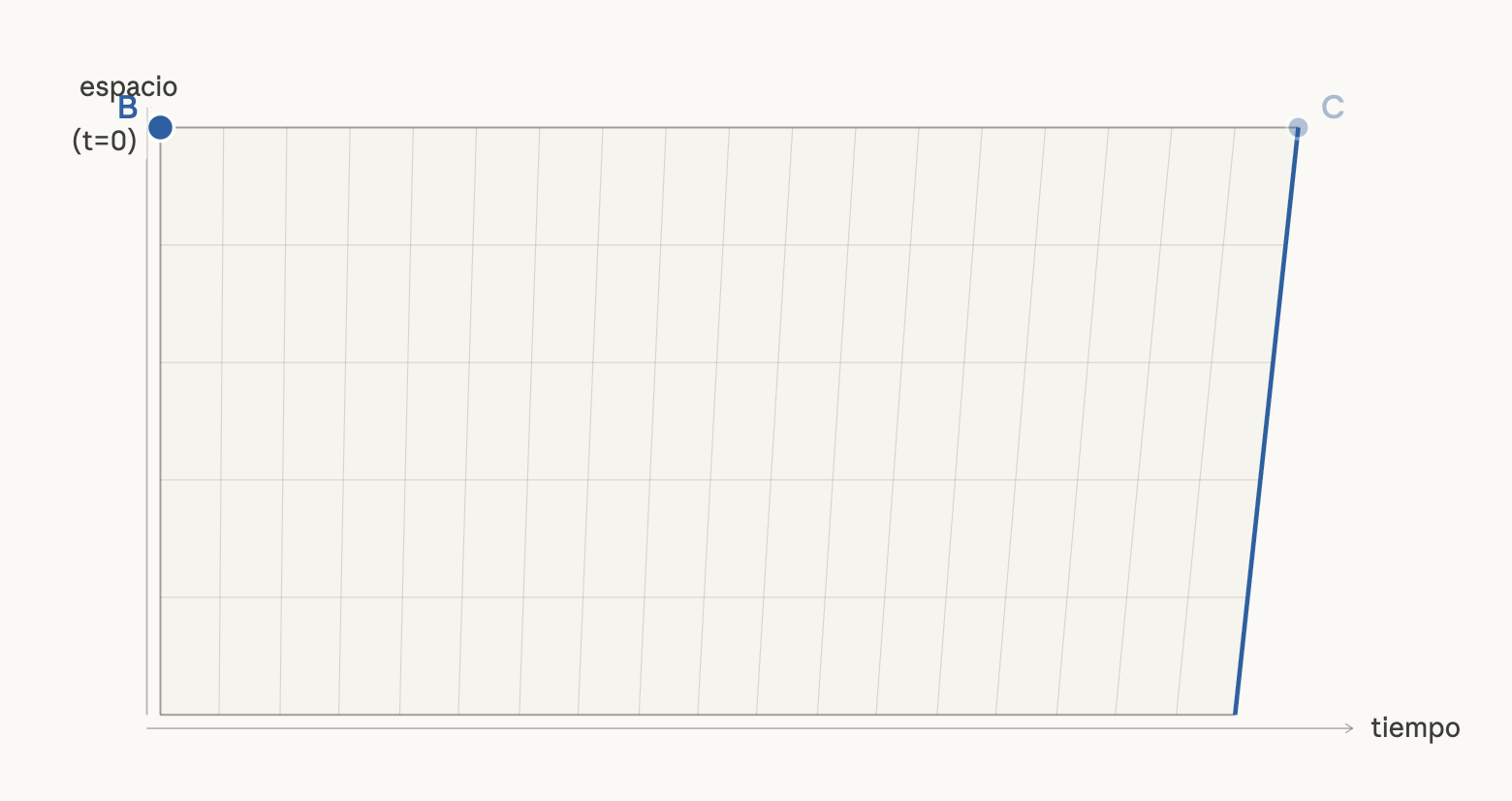
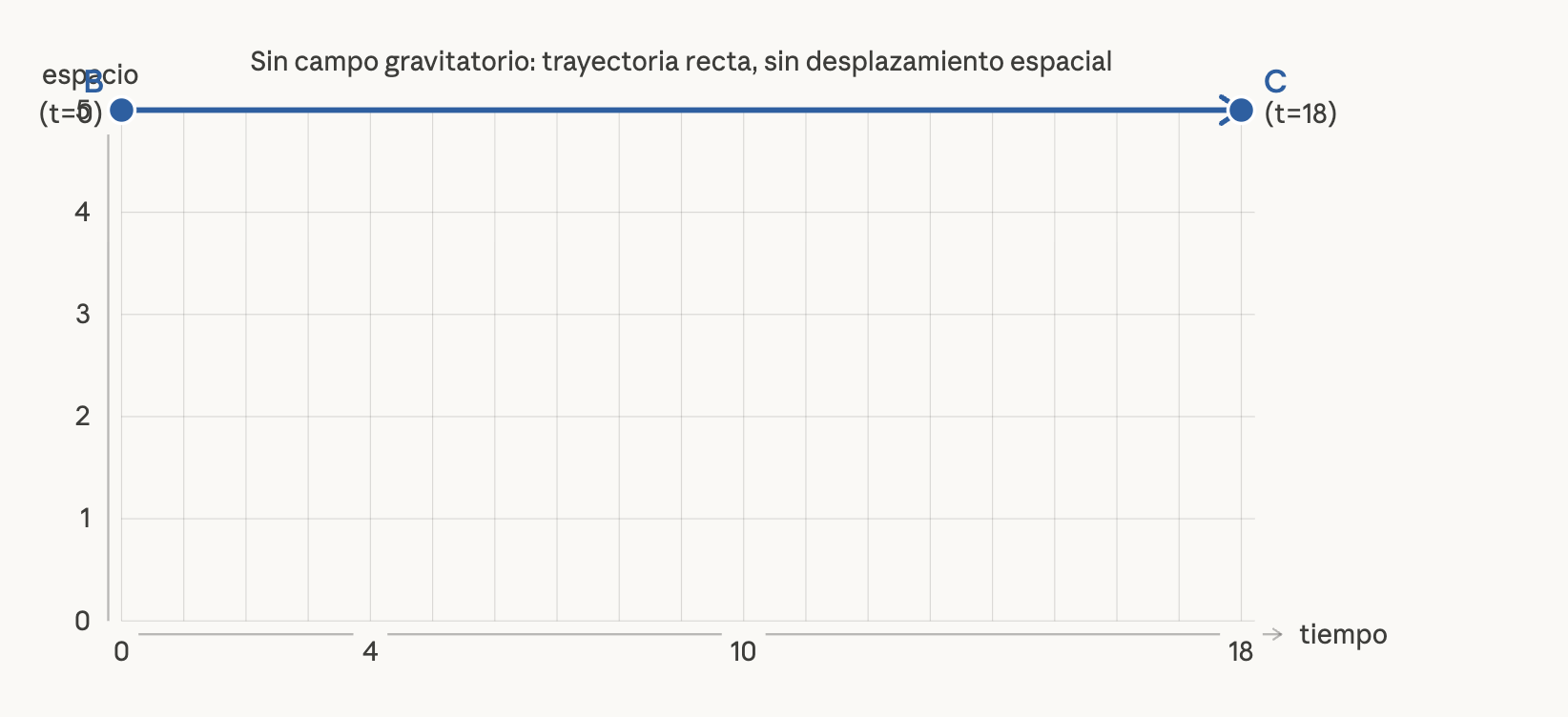
The y-axis represents displacement in space, and the x-axis represents displacement in time. The blue line represents the path through spacetime of an object at rest. At instant 0, it is at point (0,5). At instant 18, it is at point (18,5). It has moved 18 units (seconds, if you will) in time, but it has not moved in space. Simple, right?

Another thing we must keep in mind is that an object always follows the shortest path in spacetime. In the previous image, the object is initially in the grid square defined by points (0,5), (1,5), (1,4), and (0,4) and must move to the grid square defined by points (1,5), (2,5), (2,4), and (1,4). The shortest line to reach that square is the one drawn by the blue line. As we have seen, this is a line that translates into movement in time, not in space.

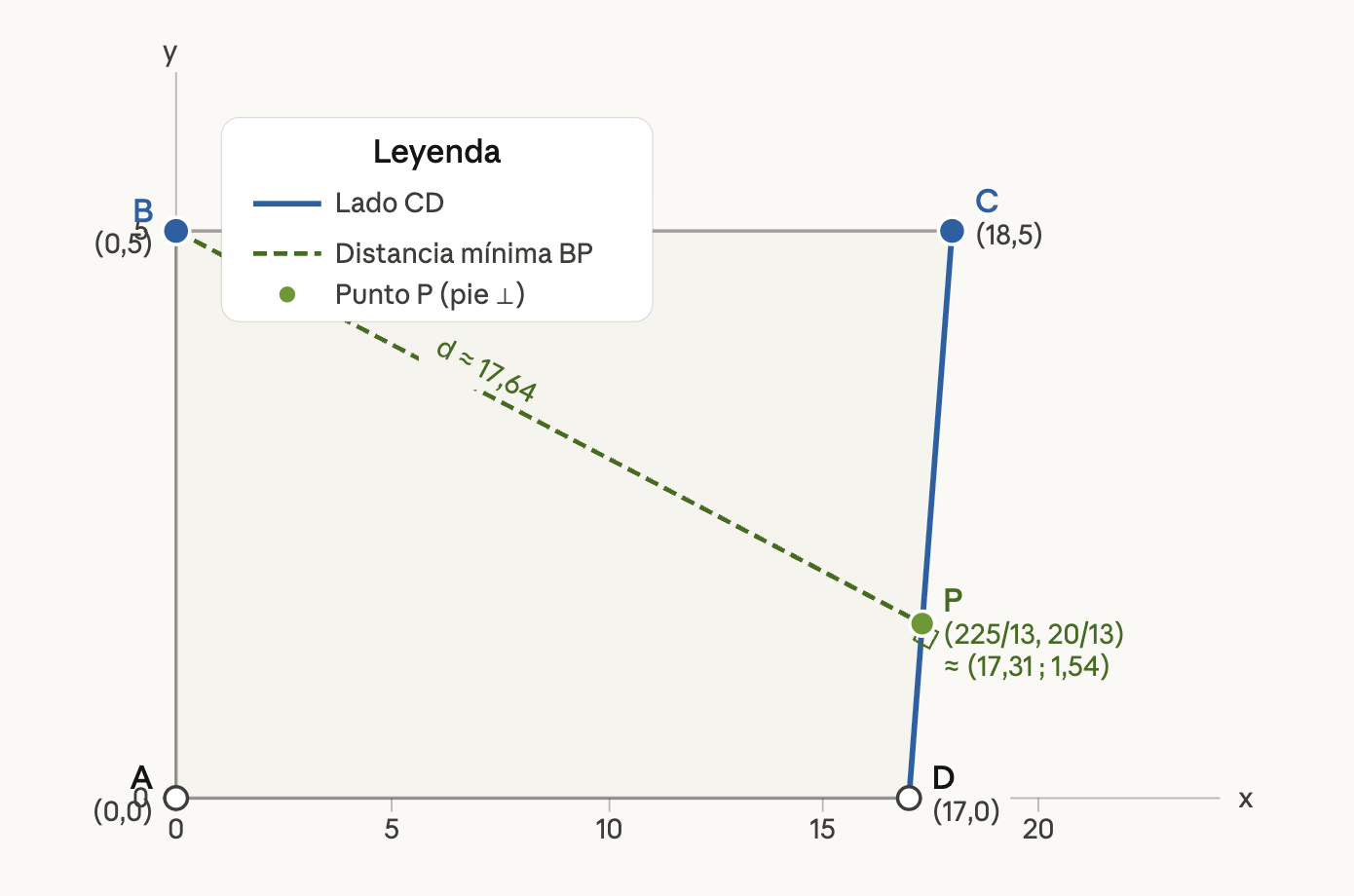
Now, let’s see what happens if we introduce a gravitational field, assuming the field is located along the x-axis. If so, time passes more slowly the «lower» we are on the y-axis. When one second passes at point (0,1), two seconds might have passed at point (0,5). This causes the squares of the previous graph to transform into trapezoids.

The object at point (0,5), which we have called B, will continue to tend toward the shortest path through spacetime. It will attempt to move from the grid square it currently occupies—[(0,5), (1,5), (1,4), and (0,4)]—to the next one—[(1,5), (2,5), (2,4), and (1,4)]—via the shortest possible route. However, what happens is that the shortest line between these two grid squares is no longer a perpendicular to the y-axis, but rather this other one:

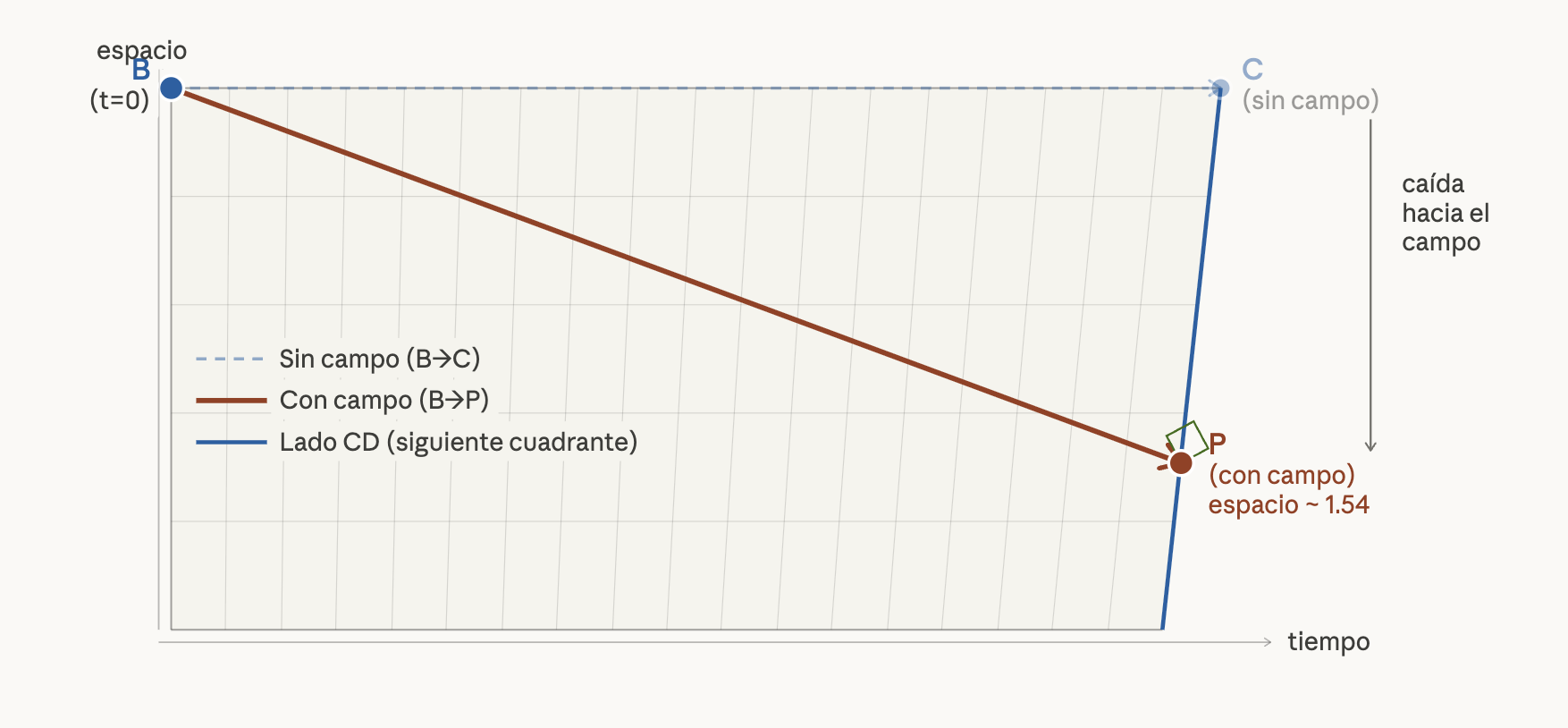
Since it is no longer a square but a trapezoid, the shortest line between one grid square and the next is no longer perpendicular to the y-axis; instead, it «descends» in the direction where time passes more slowly.

In other words, the object naturally tends to fall. I would like to point out that the fall is not oblique, but perpendicular, because the graph shows displacement in spacetime. What the graph indicates is that at second 1, the object is at point 4.8 (approx.); at second 2, it is at point 4.6… and at second 17, it is at point 1.7 (approx.). That is, the graph represents a fall from a height of 5 meters (for example) to 1.7 meters in 17 seconds. Of course, these figures do not correspond to any real fall on Earth; they are intended to show that the «downward» movement of objects—that is, toward gravitational masses—is an inevitable consequence of two things: first, that objects tend to follow the shortest path in spacetime; and second, that time passes more slowly near gravitational fields.

This concept is also featured in this video starting at minute 4, which served as the source for this idea

To put it another way: it is time that makes things fall. Time dilation is not a consequence of gravity; rather, gravity is an inevitable effect of time dilation.

We will leave it here for now (we will return to this) to examine time dilation as a consequence of velocity.

2. Time, Velocity, and Mass

As I mentioned at the beginning: if we move at high speed (actually, at any speed), time will pass more slowly. Why?

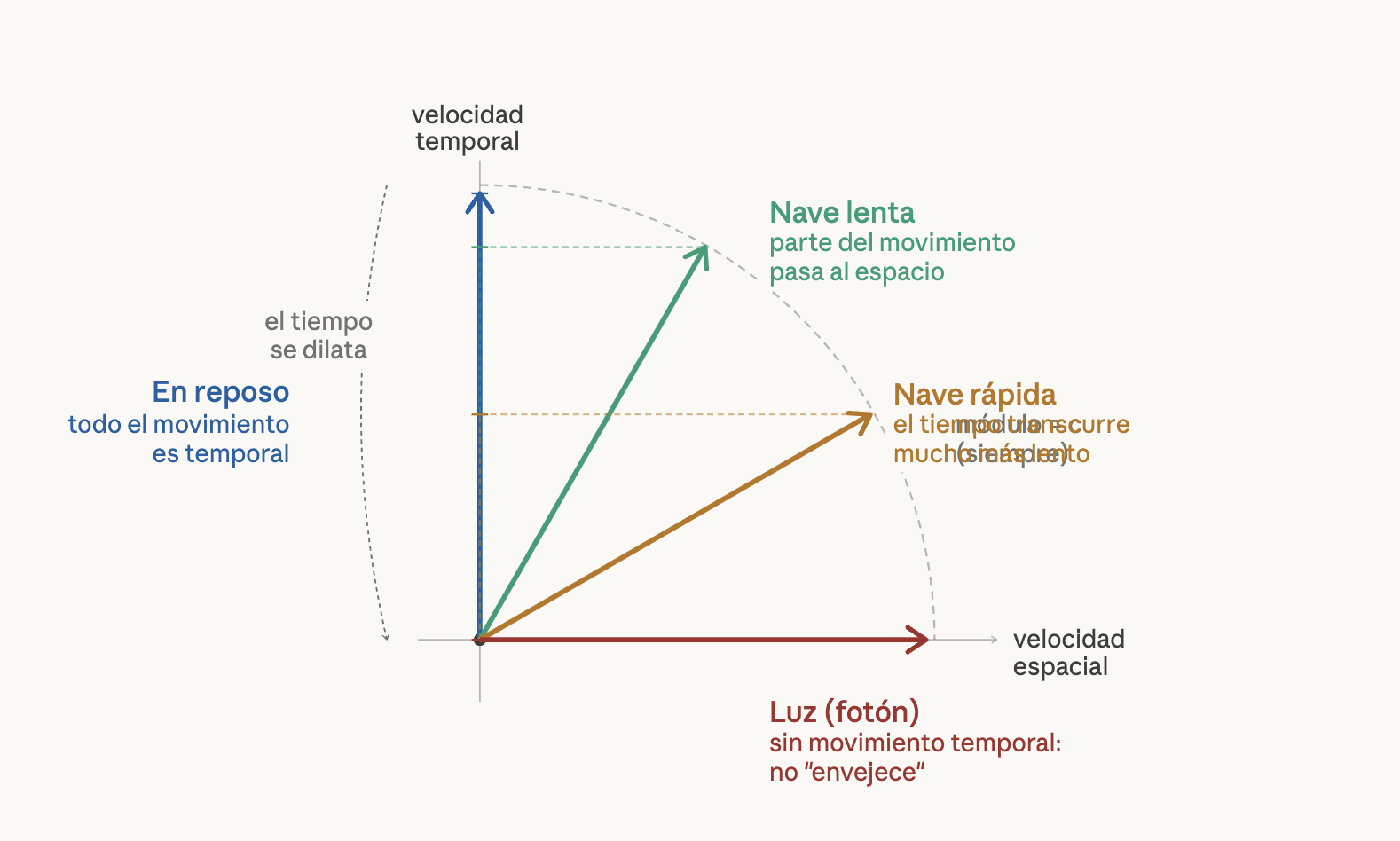
It has to do with the fact that all objects move through spacetime with a constant «velocity.» If the object (or particle) has no temporal displacement (it does not «age»), all its movement is transferred to space, and it moves at the maximum possible speed: the speed of light, hereafter referred to as c If the object is completely still in space, all its displacement occurs in time. This is what happens to us, as we are practically at rest (although the Earth moves through space at a speed of several hundred kilometers per second relative to the cosmic background, that speed is irrelevant compared to c).

However, if we go from being seated on Earth to moving through space in a spacecraft, part of the movement that was previously temporal becomes spatial, which necessarily causes time to pass more slowly for us.

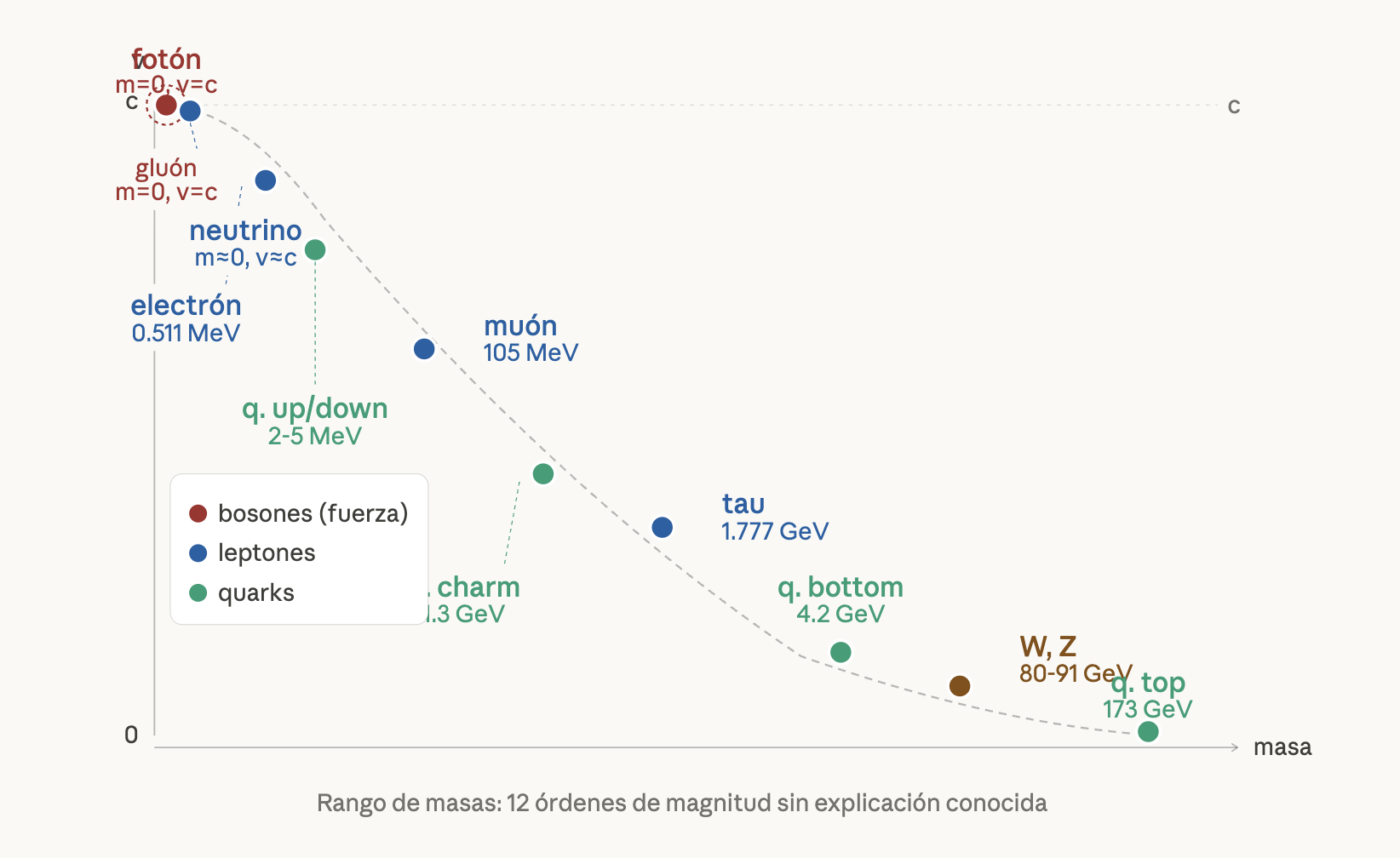
And here we come to something curious: as can be seen, the photon has no temporal movement; and this is related to the fact that it lacks mass. That is, there is a relationship between mass and the orientation of the movement vector. Bodies (or particles) with mass move through time, whereas massless particles only move through space. In a way, mass is the measure of a particle’s anchorage in time; the greater the mass, the greater the displacement in time and the smaller the displacement in space. It could be said that mass is the vibration in time of particles or objects. Since the total displacement must be constant (nothing can be simultaneously still in both time and space), the mass of elementary particles and their natural velocity are related, as can be seen in the following graph:

The same can be said of massive objects [components of atoms (protons, neutrons—electrons are already elementary particles—), atoms, molecules, stones, people, planets, or stars…]; they have a displacement (or vibration, if you prefer) in both space and time. This temporal vibration is precisely a consequence of their mass. In a way, mass creates time.

3. Mass and Elementary Particles

Let us return to what we saw in Section 1: near gravitational fields, time runs slower. A second in the vicinity of a star with enormous mass can be a minute or a year compared to a second millions of kilometers away from that star. Mass causes time in its environment to slow down. At the same time, it is mass that causes particles to move through time. If I may use a metaphor: a particle with mass is like a ball that you submerge in a liquid. By Archimedes’ principle, the ball will tend to rise within the liquid; the massive particle will tend to move toward the future in time.

Now then, why does this thrust occur, and, at the same time, why does time pass more slowly in the vicinity of a gravitational field? It is tempting to speculate that it is for a reason similar to what explains the thrust in Archimedes’ principle. Let’s see.

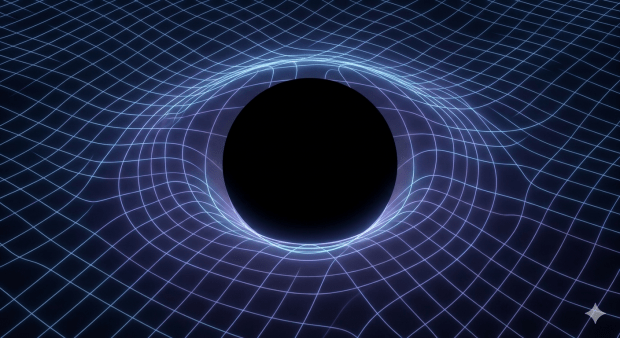
As has been reiterated, in the vicinity of a gravitational field, time passes more slowly. This is evident even in the path of light. Light always travels at speed c; but near a gravitational field, because time passes slower, from the perspective of an external observer, the light will appear to be going slower. This is what is known as the Shapiro delay. In a way, it is as if spacetime were «denser» in the vicinity of a gravitational field. But where does this higher density come from?

Obviously, this is purely speculative; but could it be that massive particles are «holes» in spacetime? A kind of bubble that travels as a vibration through space (photons) and through both space and time (massive particles). Seen from this perspective, it would explain why particles are «elementary.» It does not depend on them being very small, but on the fact that, being an anomaly in the structure of spacetime, their interior is, in a literal sense, nothingness. There is no possibility of division because it does not, and cannot, have any internal structure. From there, the higher density in the vicinity of a gravitational mass could be understood either as spacetime’s attempt to fill the hole or as a result of the spacetime that has been «displaced» from the particle; or perhaps a combination of both. In any case, this higher density—which manifests as the slowing of time—would be linked to the presence of massive particles and objects.

Current physics explains elementary particles as excitations of a field. What a field actually is remains unexplained by theoretical physics, but it is a necessity to account for how particles function. And each elementary particle has its own field; that is, we currently have to imagine seventeen different fields «inhabiting» spacetime, which is the framework in which they all reside. If we understand particles as holes moving through spacetime, these fields are no longer necessary. The difference between one particle and another would simply derive from the shape that the spacetime hole takes for each of them. In the case of the photon, for example, we would be looking at a purely spatial hole, without a temporal dimension, which would explain its behavior (displacement at c in space and no vibration in time).

4. Black Holes

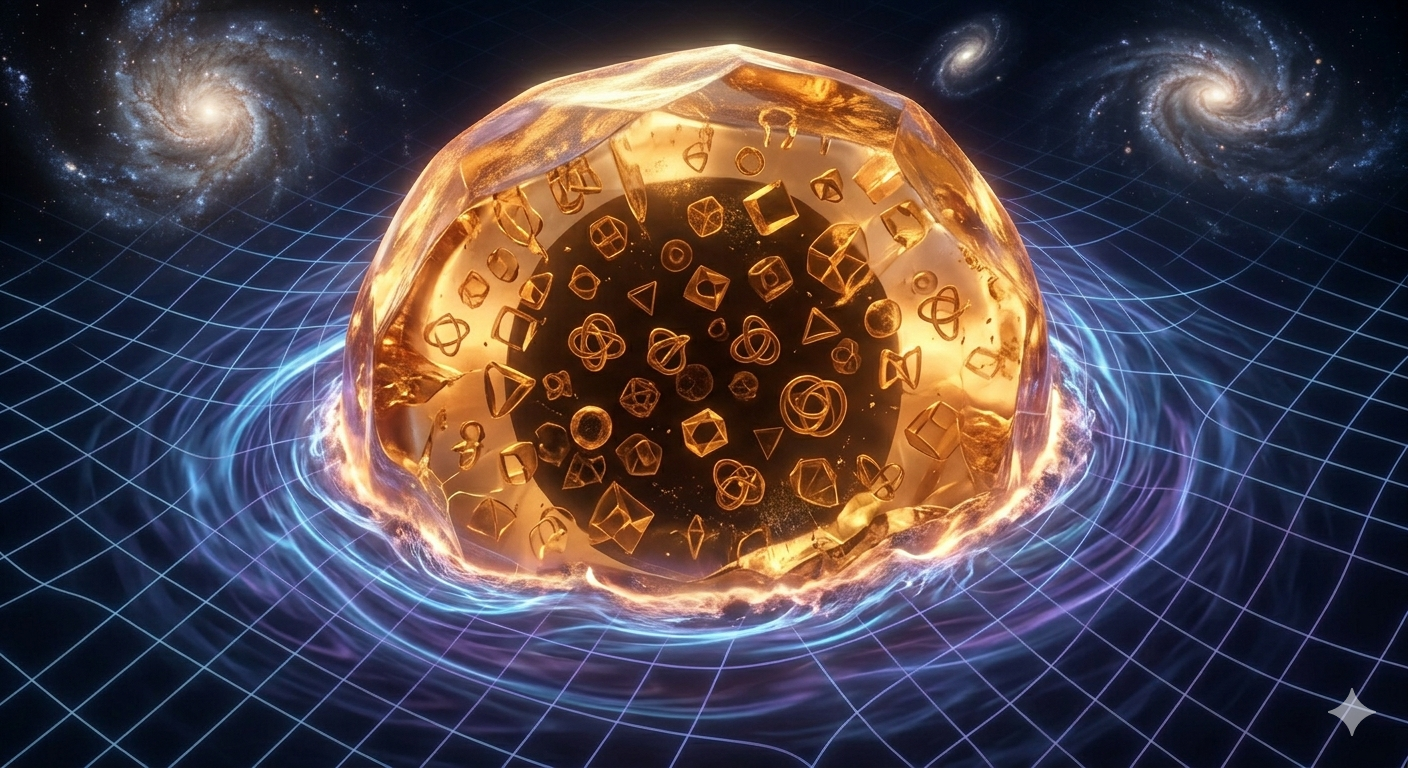
From the perspective of particles as holes in a spacetime with varying «densities» (identified by time dilation), black holes can be understood as regions where the density has become so high that it has somehow «crystallized.» Beyond the event horizon, there would be a spacetime so dense—that is, with such extreme time dilation—that movement would be impossible. The exterior of this «solid» part would rub against the fluid spacetime surrounding it, giving rise to phenomena such as Hawking radiation.

This would explain the relatively low density observed in known black holes. Curiously, these supermassive black holes have a density equivalent to that of water; but from this perspective, it is not surprising: density measures the distribution of mass in space, but what characterizes a black hole is the «density» of spacetime itself. If a point of rigidity is reached that prevents the movement of particles, they will be unable to move, even if they are separated from one another. They would be like mosquitos trapped in spacetime amber.

5. Conclusion

What I explained in Sections 1 and 2 is entirely orthodox and corresponds—as far as I know—to the postulates of General and Special Relativity; although I am fond of the simplification that allows us to understand gravity as an imperative requirement of the rule by which an object follows the shortest path in spacetime between two points—which, in the vicinity of a gravitational field, implies moving toward the center of said field. The need to compensate in time for the displacement of objects moving through space is a fundamental finding of Special Relativity. The «temporal vibration» of matter is also a postulate supported by standard physics, although, as far as I am aware, it has not yet been empirically directly proven.

It is, however, purely speculative to maintain that elementary particles are holes in spacetime. Nevertheless, I appreciate the simplicity with which this idea would explain the elementary nature of particles, the time dilation near gravitational fields, and the low density of black holes.

Tiempo, partículas elementales, agujeros negros…

1. El tiempo es más lento cerca de los campos gravitatorios

Desde niño me ha fascinado que el tiempo no transcurra igual en todos los lugares. Si tenemos dos relojes perfectamente sincronizados, uno lo dejamos en la superficie de la Tierra y otro lo metemos en una nave espacial que viaje a una velocidad que sea significativa respecto a la velocidad de la luz, a la vuelta de la nave veremos que el reloj en ella habrá marcado menos segundos que el reloj en Tierra. Bueno, en realidad, eso sucedería tanto si la nave va a varios miles de kilómetros por segundo como si es un avión a mil kilómetros por hora o un tren a cien kilómetros por hora. En todos los casos el reloj en movimiento habrá ido más lento que el reloj que ha permanecido en reposo; lo que sucede es que a velocidades de unos pocos kilómetros por segundo o menos la diferencia es muy difícilmente apreciable.

Lo anterior es curioso y volveremos a ello; pero hay otro supuesto en el que el reloj irá más lento: cuando esté cerca de un campo gravitatorio. Un reloj en la superficie de la Tierra va más lento que otro en un satélite a unos centenares de kilómetros sobre la superficie terrestre. Y la diferencia, aunque sea pequeña, es relevante. Tiene que tenerse en cuenta a la hora de ajustar el funcionamiento del GPS, por ejemplo.

Ahora quiero detenerme en esto último, porque me parece especialmente fascinante. Sobre todo si tenemos en cuenta una inversión causal que puede, quizás, sorprender, pero que tiene -me parece- consecuencias relevantes.

¿A qué me refiero con la inversión causal? Bueno, damos por sentado de que la gravedad «atrae» a las cosas y que por eso la manzana de Newton se desplaza del árbol al suelo. Es algo natural que nos parece que no merece mucha más explicación. Lo que acabo de comentar, lo de que el tiempo transcurre más lento en las cercanías de un campo gravitatorio parece un dato curioso que, además, muchas personas ignoran.

Y, sin embargo, lo que hace que las cosas caigan es, precisamente, esa dilatación temporal cerca de los campos gravitatorios. Si las cosas van «hacia abajo» es porque el tiempo transcurre más lento cerca de un cuerpo con masa. ¿Por qué?

Para entenderlo tenemos que pensar que todo objeto no solamente se desplaza (o puede desplazarse) en el espacio, sino que también se desplaza en el tiempo. El movimiento de un objeto ha de describirse teniendo en cuenta tanto su desplazamiento en el espacio como su desplazamiento en el tiempo. Veámoslo con la siguiente imagen.

El eje y representa el desplazamiento en el espacio y el eje x el desplazamiento en el tiempo. La línea azul representa el recorrido en el espacio tiempo de un objeto que está quieto. En el instante 0 está en el punto (0,5). En el instante 18 está en el punto (18,5). Se ha movido 18 instantes (segundos si se quiere) en el tiempo, pero no se ha movido en el espacio. Fácil, ¿no?

Otra cosa que tenemos que tener en cuenta es que un objeto recorre siempre el camino más corto en el espacio tiempo. En la imagen anterior, el objeto está iniciamente en la cuadrícula definida por los puntos (0,5), (1,5), (1,4) y (0,4) y tiene que desplazarse a la cuadrícula definida por los puntos (1,5), (2,5), (2,4) y (1,4). La línea más corta para llegar a esa cuadrícula es la que dibuja la línea azul. Como hemos visto, una línea que traduce movimiento en el tiempo, no en el espacio.

Veamos ahora lo que sucede si introducimos el campo gravitatorio, suponiendo que el campo gravitatorio se localiza en el eje de las x. Si es así, el tiempo transcurre más lento cuanto más abajo estemos en la línea de las y. Cuando transcurre un segundo en el punto (0,1) pueden haber transurrido dos segundos en el punto (0,5). Eso hace que los cuadrados del gráfico anterior se conviertan en trapecios.

El objeto que se encuentra en el punto (0,5), y al que hemos llamado B seguirá tendiendo a recorrer su camino en el espacio tiempo por el camino más corto. Intentará pasar de la cuadrícula en la que se encuentra [(0,5), (1,5), (1,4) y (0,4)] a la siguiente [(1,5), (2,5), (2,4) y (1,4)] por el camino más corto, lo que pasa es que la línea más corta entre las dos cuadrículas ya no es una perpendicular al eje y, sino esta otra:

Al no ser un cuadrado, sino un trapecio la línea más corta entre una y otra cuadrícula no es perpendicular al eje y, sino que «baja» en la dirección en la que el tiempo transcurre más lento.

Es decir, el objeto tiende naturalmente a caer. Llamo la atención sobre que la caída no es oblicua, sino en perpendicular, porque el gráfico muestra el desplazamiento en el espacio tiempo. El gráfico lo que indica es que en el segundo 1 el objeto está en el punto 4,8 (aprox.); en el segundo 2 en el punto 4,6… y en el segundo 17 en el punto 1,7 (aprox.). Esto es, el gráfico representa una caída desde una altura de 5 metros (por ejemplo) hasta 1,7 metros en 17 segundos. Por supuesto, las cifras no se corresponden a ninguna caída real en la Tierra, sino que lo que pretenden es que se aprecie que el movimiento de los objetos «hacia abajo»; esto es, hacia las masas gravitatorias es una consecuencia inevitable de dos cosas: la primera, que los objetos tienden a seguir el trayecto más corto en el espacio tiempo. La segunda, que el tiempo transcurre más lentamente cerca de los campos gravitatorios.

Esta idea se encuentra también en este vídeo a partir del minuto 4, que es de donde tomé la idea.

Dicho con otras palabras, es el tiempo el que hace que las cosas caigan. La dilatación temporal no es una consecuencia de la gravedad, sino que la gravedad es un efecto inevitable de la dilatación temporal.

Vamos a dejarlo aquí de momento (volveremos) para examinar ahora la dilatación temporal como consecuencia de la velocidad.

2. Tiempo, velocidad y masa

Lo comentaba al comienzo: si nos desplazamos a una alta velocidad (en realidad, a cualquier velocidad), el tiempo transcurrirá más lentamente. ¿Por qué?

Tiene que ver con que todos los objetos se mueven por el espacio tiempo con una «velocidad» constante. Si el objeto (o partícula) no tiene desplazamiento temporal (no «envejece») todo su movimiento se traslada al espacio y se mueve a la velocidad máxima posible, la velocidad de la luz, c a partir de ahora. Si el objeto está completamente quieto todo su desplazamiento se produce en el tiempo. Es lo que nos pasa a nosotros, que estamos prácticamente quietos (aunque la Tierra se desplaza por el espacio a una velocidad de varios centenares de kilómetros por segundo respecto al fondo cósmico esa velocidad es irrelevante respecto a c).

Ahora bien, si pasamos de estar sentados en la Tierra a movernos por el espacio en una nave espacial, parte del movimiento que antes era temporal pasa a ser espacial, lo que hace que, necesariamente, el tiempo transcurra más lentamente para nosotros.

Y aquí llegamos a algo curioso: como puede verse el fotón no tiene movimiento temporal; y esto se relaciona con que carece de masa. Es decir, hay una relación entre la masa y la orientación del vector del movimiento. Los cuerpos (o partículas) con masa se desplazan en el tiempo; mientras que las partículas sin masa solamente se desplazan en el espacio. De alguna forma, la masa es la medida de anclaje en el tiempo de las partículas; cuanto mayor es la masa, mayor es el desplazamiento en el tiempo y menor el desplazamiento en el espacio. Podría decirse que la masa es la vibración en el tiempo de las partículas o de los objetos. Como el desplazamiento total ha de ser constante (no hay nada que esté, simultáneamente, quieto en el tiempo y en el espacio), la masa de las partículas elementales y su velocidad natural están relacionadas, como puede verse en el siguiente gráfico:

Lo mismo puede predicarse de los objetos masivos [componentes de los átomos (protones, neutrones -los electrones ya son partículas elementales-), átomos, moléculas, piedras, personas, planetas o estrellas…] tienen un desplazamiento (vibración si se prefiere) tanto en el espacio como en el tiempo; y esa vibración temporal es precisamente, consecuencia de su masa. De alguna forma, la masa crea el tiempo.

3. Masa y partículas elementales

Volvamos ahora a lo que veíamos en el epígrafe 1: cerca de los campos gravitatorios el tiempo transcurre más lento. Un segundo en la cercanía de una estrella de una masa enorme puede ser un minuto o un año a unos millones de kilómetros de esa estrella. La masa hace que en su entorno el tiempo se vuelva más lento. Al mismo tiempo, la masa es la que hace que las partículas se desplacen en el tiempo. Si se me permite la metáfora, una partícula con masa es como un balón que introduces en un líquido. Por el principio de Arquímedes, el balón tenderá a subir dentro del líquido; la partícula masiva tenderá a moverse hacia el futuro en el tiempo.

Ahora bien, ¿por qué se produce ese empuje y, a la vez, por qué el tiempo transcurre más lento en la cercanía de un campo gravitatorio? Resulta tentador especular que por una razón parecida a la que explica el empuje del principio de Arquímedes. Veamoslo.

Como ya se ha reiterado, en las cercanías de un campo gravitatorio el tiempo transcurre más lentamente. Esto se aprecia, incluso, en el recorrido de la luz. La luz siempre viaja a velocidad c; pero en las cercanías de un campo gravitatorio, como el tiempo transcurre más lento, desde la perspectiva de un observador externo, la luz estará yendo más lenta. Es lo que se conoce como retraso de Shapiro. De alguna forma es como si el espacio tiempo fuera «más denso» en las cercanías de un campo gravitatorio. Ahora bien, ¿de dónde viene esa mayor densidad?

Obviamente, esto es puramente especulativo; pero, ¿podría ser que las partículas masivas fueran «huecos» en el espacio tiempo? Una especie de burbuja que se desplaza como una vibración a lo largo del espacio (fotones) y en el espacio y en el tiempo (las partículas con masa). Visto desde esta perspectiva, se explicaría por qué las partículas son «elementales». No depende de que sean muy pequeñas, sino de que al ser una anomalía en la estructura del espacio tiempo su interior es, en sentido literal, la nada; sin posibilidad alguna de división porque no tiene, ni puede tener, ninguna estructura. A partir de ahí, podría entenderse la mayor densidad en las cercanías de una masa gravitatoria como consecuencia o bien del intento del espacio tiempo de rellenar el hueco o bien como resultado de la presencia del espacio tiempo que ha sido «expulsado» de la partícula; o como una combinación de ambas cosas. En cualquier caso, esa mayor densidad, que se traduce en la ralentización del paso del tiempo, se conectaría con la presencia de las partículas y objetos masivos.

La física explica en la actualidad las partículas elementales como excitaciones de un campo. Lo que sea un campo no lo explica la física teórica, pero es una necesidad para dar cuenta de cómo funcionan las partículas. Y cada partícula elemental tiene su propio campo; o sea, que en la actualidad tenemos que imaginar diecisiete campos diferentes que «habitan» en el espacio tiempo, que es el marco en el que descansan todos ellos. Si entendemos las partículas como huecos que se desplazan por el espacio tiempo, no son necesarios los campos, la diferencia entre una y otra partícula deriva de la forma que adopta el hueco del espacio tiempo para cada una de ellas. En el caso del fotón, por ejemplo, estaríamos ante un hueco puramente espacial, sin dimensión temporal, lo que explicaría su comportamiento (desplazamiento a c en el espacio y sin vibración en el tiempo).

4. Agujeros negros

Desde la perspectiva de las partículas como huecos en un espacio tiempo que tiene diferentes «densidades» (identificadas por la dilatación temporal) los agujeros negros pueden ser entendidos como regiones en las que la densidad se ha vuelto tan alta que, de alguna forma, ha «cristalizado». Más allá del horizonte de eventos lo que habría sería un espacio tiempo tan denso; esto es, con una dilatación temporal tan extrema, que sería imposible el movimiento. El exterior de esa parte «sólida» entraría en fricción con el espacio tiempo fluido que la rodearía, lo que daría lugar fenómenos como la radiación de Hawking.

Esto explicaría la relativamente baja densidad que se observa en los agujeros negros conocidos. Curiosamente, estos agujeros negros supermasivos tienen una densidad equivalente a la del agua; pero desde esta perspectiva no es soprendente: la densidad mide el reparto de masa en el espacio, pero lo que convierte en característico a un agujero negro es la «densidad» del espacio tiempo. Si se alcanza el punto de rigidez que impide el movimiento de las partículas; estás, incluos aunque separadas entre sí no podrán desplazarse. Serían como mosquitos atrapados en ámbar de espacio tiempo.

5. Conclusión

Lo que explicaba en los apartados 1 y 2 es absolutamente ortodoxo y se corresponde -hasta donde yo sé- con lo que postulan la relatividad general y la relatividad especial; aunque me gusta la simplificación que permite entender la gravedad como una necesidad imperiosa de la regla por la que un objeto sigue en el espacio tiempo el camino más corto entre dos puntos; lo que, en las cercanías de un campo gravitatorio implica moverse hacia el centro de dicho campo. La necesidad de compensar en el tiempo el desplazamiento de los objetos que se mueven en el espacio es un hallazgo de la relatividad especial. La vibración en el tiempo de la materia también es un postulado que sostiene la física estándard, aunque, hasta donde sé, no ha sido comprobado empíricamente de forma directa.

Es, sin embargo, puramente especulativo sostener que las partículas elementales son huecos del espacio tiempo. Me gusta, sin embargo, la sencillez con la que explicaría el carácter elemental de las partículas, la dilatación temporal cerca de los campos gravitatorios y la baja densidad de los agujeros negros.