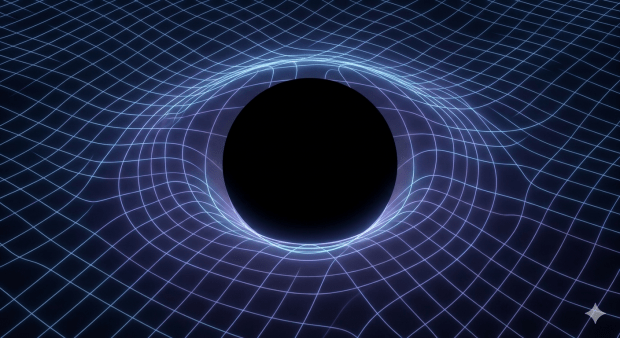
1. Time is slower near gravitational fields
Since I was a child, I have been fascinated by the fact that time does not pass at the same rate everywhere. If we take two perfectly synchronized clocks, leave one on Earth’s surface, and place the other in a spacecraft traveling at a significant fraction of the speed of light, upon the ship’s return, we would find that the clock on board has ticked away fewer seconds than the one on Earth. Actually, this would happen whether the ship travels at thousands of kilometers per second or if it were a plane at a thousand kilometers per hour, or a train at a hundred. In all cases, the moving clock will have run slower than the one at rest; it is just that at speeds of a few kilometers per second or less, the difference is barely perceptible.
The above is curious, and we will return to it; but there is another scenario where a clock runs slower: when it is near a gravitational field. A clock on the surface of the Earth runs slower than one on a satellite a few hundred kilometers above us. This difference, though small, is vital. It must be accounted for to adjust the functioning of GPS, for example.
I want to dwell on this last point because I find it especially fascinating—particularly if we consider a causal inversion that might be surprising but has, I believe, significant consequences.
What do I mean by causal inversion? Well, we take for granted that gravity «pulls» things and that is why Newton’s apple moves from the tree to the ground. It feels natural, as if it requires no further explanation. The fact that time passes slower near a gravitational field seems like a curious trivia point that most people ignore.
And yet, what makes things fall is precisely that time dilation near gravitational fields. If things go «down,» it is because time passes slower near a body with mass. Why?
To understand this, we must think that every object not only moves through space but also moves through time. The movement of an object must be described by taking into account both its displacement in space and its displacement in time.
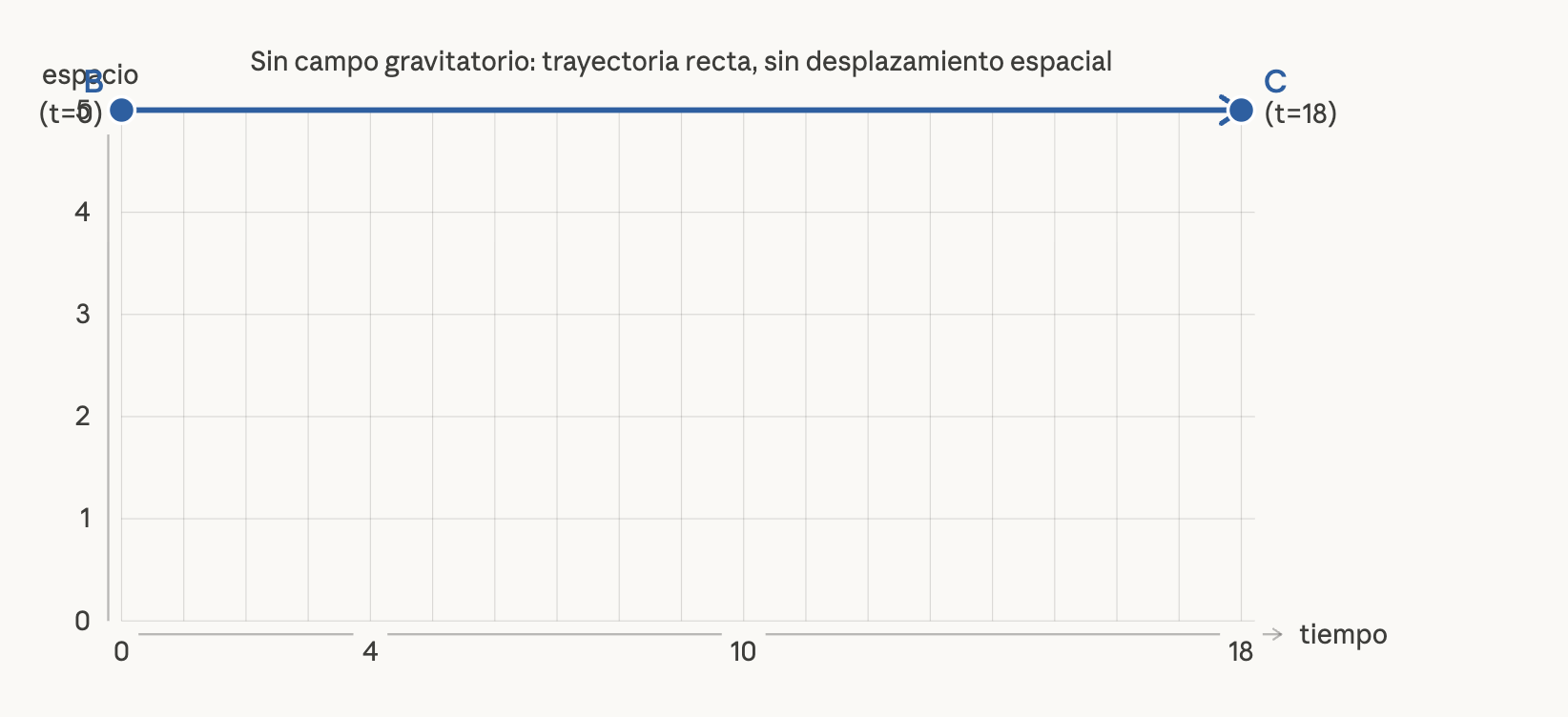
The y-axis represents displacement in space, and the x-axis represents displacement in time. The blue line represents the path through spacetime of an object at rest. At instant 0, it is at point (0,5). At instant 18, it is at point (18,5). It has moved 18 units (seconds, if you will) in time, but it has not moved in space. Simple, right?
Another thing we must keep in mind is that an object always follows the shortest path in spacetime. In the previous image, the object is initially in the grid square defined by points (0,5), (1,5), (1,4), and (0,4) and must move to the grid square defined by points (1,5), (2,5), (2,4), and (1,4). The shortest line to reach that square is the one drawn by the blue line. As we have seen, this is a line that translates into movement in time, not in space.
Now, let’s see what happens if we introduce a gravitational field, assuming the field is located along the x-axis. If so, time passes more slowly the «lower» we are on the y-axis. When one second passes at point (0,1), two seconds might have passed at point (0,5). This causes the squares of the previous graph to transform into trapezoids.
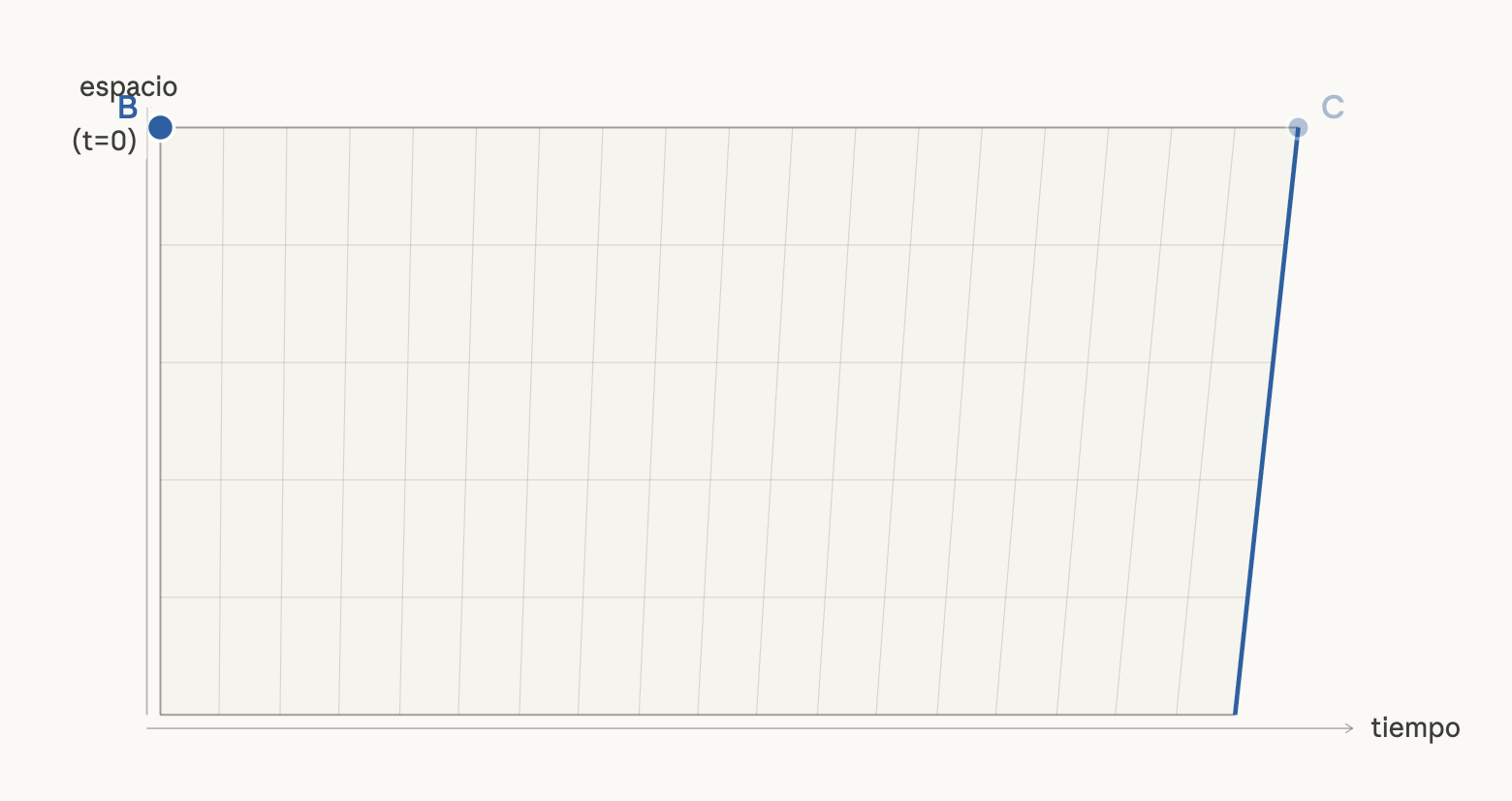
The object at point (0,5), which we have called B, will continue to tend toward the shortest path through spacetime. It will attempt to move from the grid square it currently occupies—[(0,5), (1,5), (1,4), and (0,4)]—to the next one—[(1,5), (2,5), (2,4), and (1,4)]—via the shortest possible route. However, what happens is that the shortest line between these two grid squares is no longer a perpendicular to the y-axis, but rather this other one:
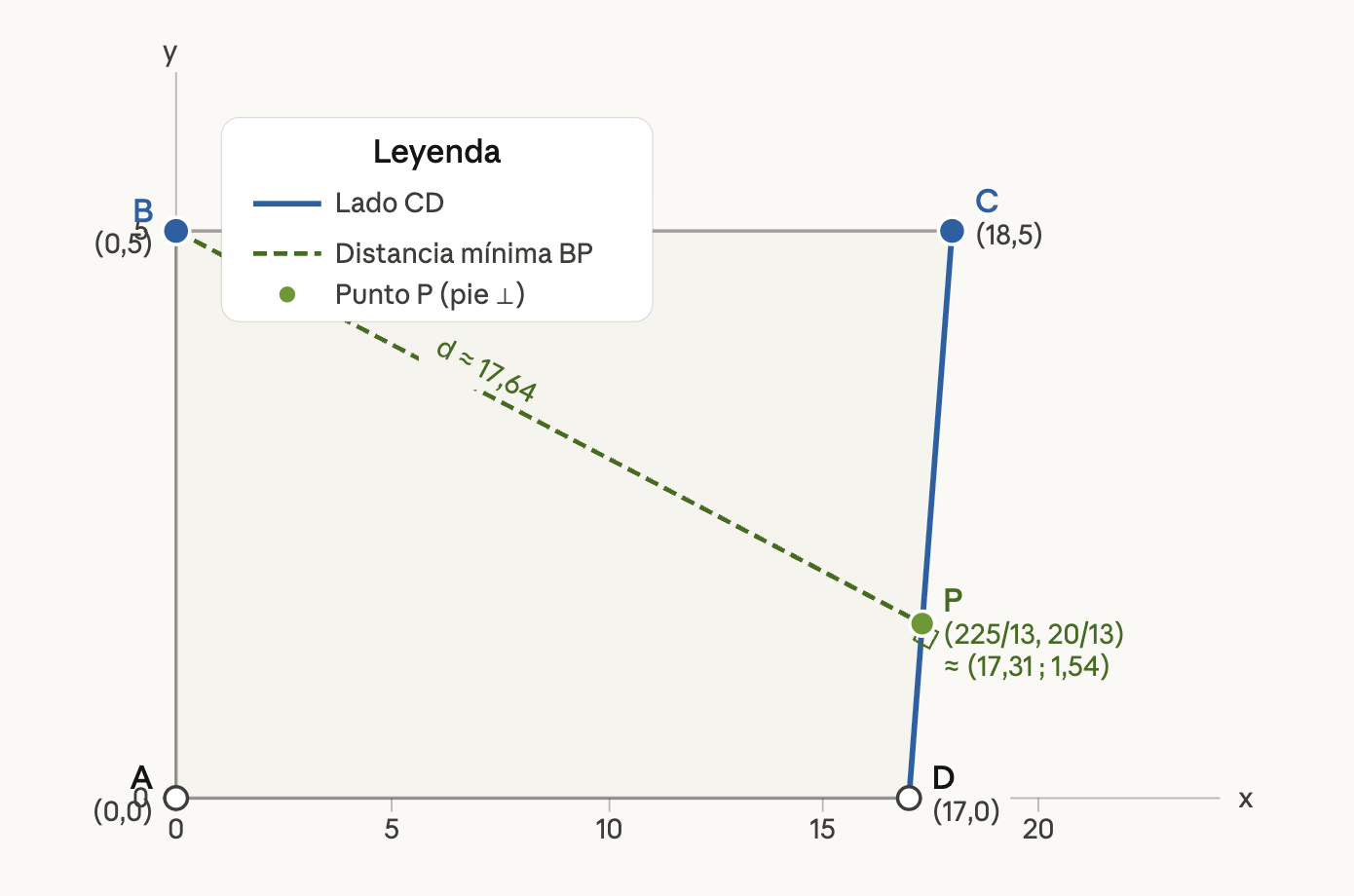
Since it is no longer a square but a trapezoid, the shortest line between one grid square and the next is no longer perpendicular to the y-axis; instead, it «descends» in the direction where time passes more slowly.
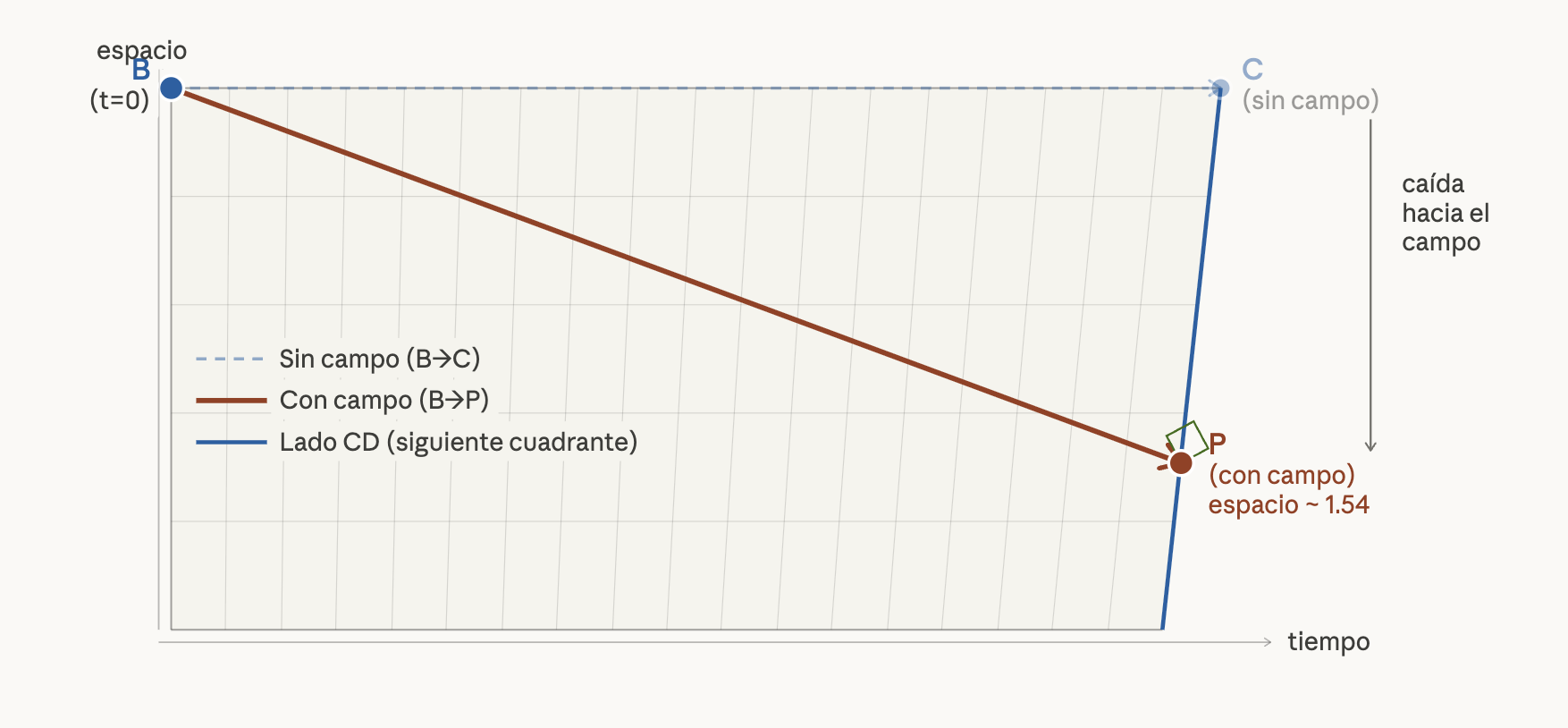
In other words, the object naturally tends to fall. I would like to point out that the fall is not oblique, but perpendicular, because the graph shows displacement in spacetime. What the graph indicates is that at second 1, the object is at point 4.8 (approx.); at second 2, it is at point 4.6… and at second 17, it is at point 1.7 (approx.). That is, the graph represents a fall from a height of 5 meters (for example) to 1.7 meters in 17 seconds. Of course, these figures do not correspond to any real fall on Earth; they are intended to show that the «downward» movement of objects—that is, toward gravitational masses—is an inevitable consequence of two things: first, that objects tend to follow the shortest path in spacetime; and second, that time passes more slowly near gravitational fields.
This concept is also featured in this video starting at minute 4, which served as the source for this idea
To put it another way: it is time that makes things fall. Time dilation is not a consequence of gravity; rather, gravity is an inevitable effect of time dilation.
We will leave it here for now (we will return to this) to examine time dilation as a consequence of velocity.
2. Time, Velocity, and Mass
As I mentioned at the beginning: if we move at high speed (actually, at any speed), time will pass more slowly. Why?
It has to do with the fact that all objects move through spacetime with a constant «velocity.» If the object (or particle) has no temporal displacement (it does not «age»), all its movement is transferred to space, and it moves at the maximum possible speed: the speed of light, hereafter referred to as c If the object is completely still in space, all its displacement occurs in time. This is what happens to us, as we are practically at rest (although the Earth moves through space at a speed of several hundred kilometers per second relative to the cosmic background, that speed is irrelevant compared to c).
However, if we go from being seated on Earth to moving through space in a spacecraft, part of the movement that was previously temporal becomes spatial, which necessarily causes time to pass more slowly for us.
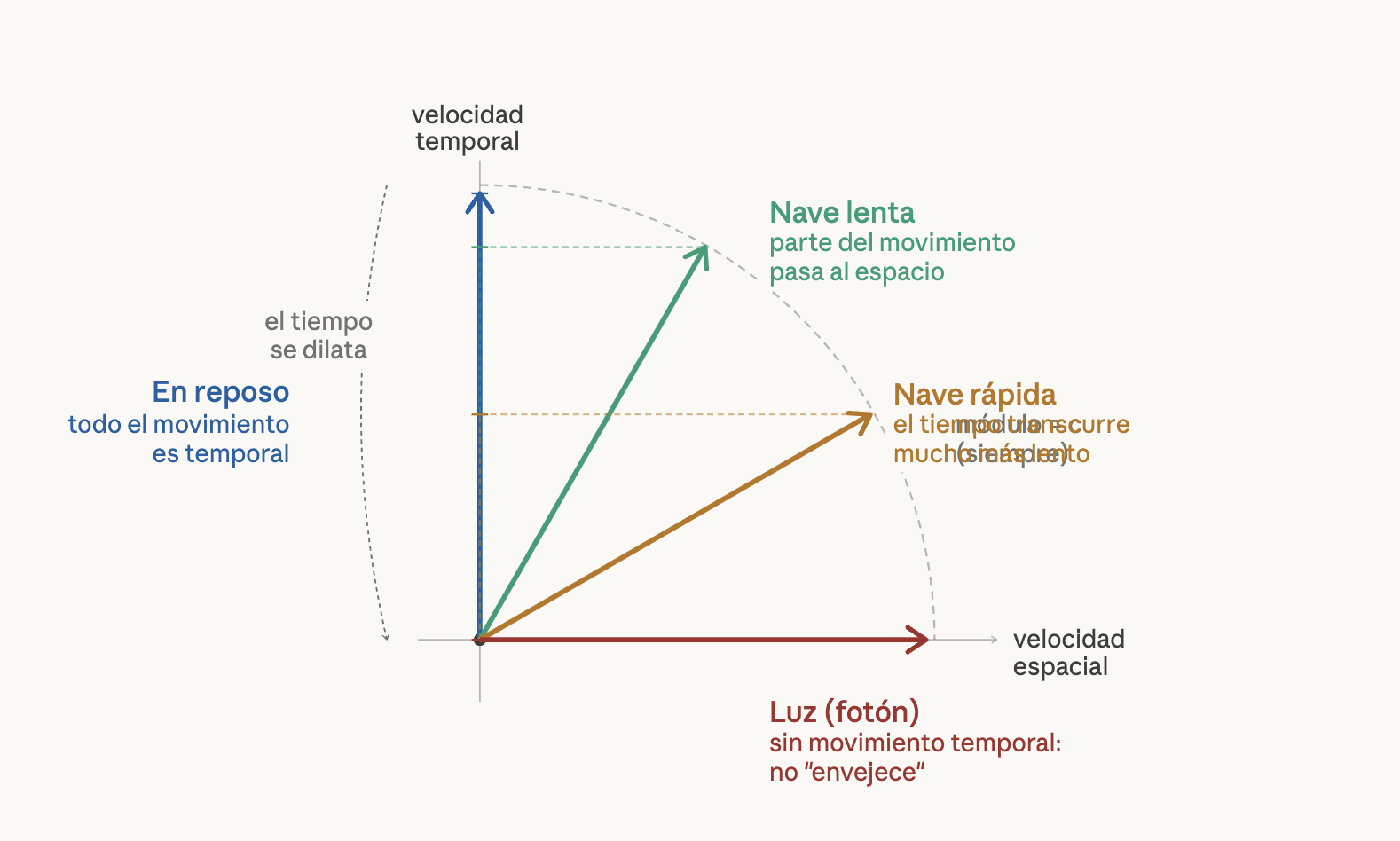
And here we come to something curious: as can be seen, the photon has no temporal movement; and this is related to the fact that it lacks mass. That is, there is a relationship between mass and the orientation of the movement vector. Bodies (or particles) with mass move through time, whereas massless particles only move through space. In a way, mass is the measure of a particle’s anchorage in time; the greater the mass, the greater the displacement in time and the smaller the displacement in space. It could be said that mass is the vibration in time of particles or objects. Since the total displacement must be constant (nothing can be simultaneously still in both time and space), the mass of elementary particles and their natural velocity are related, as can be seen in the following graph:
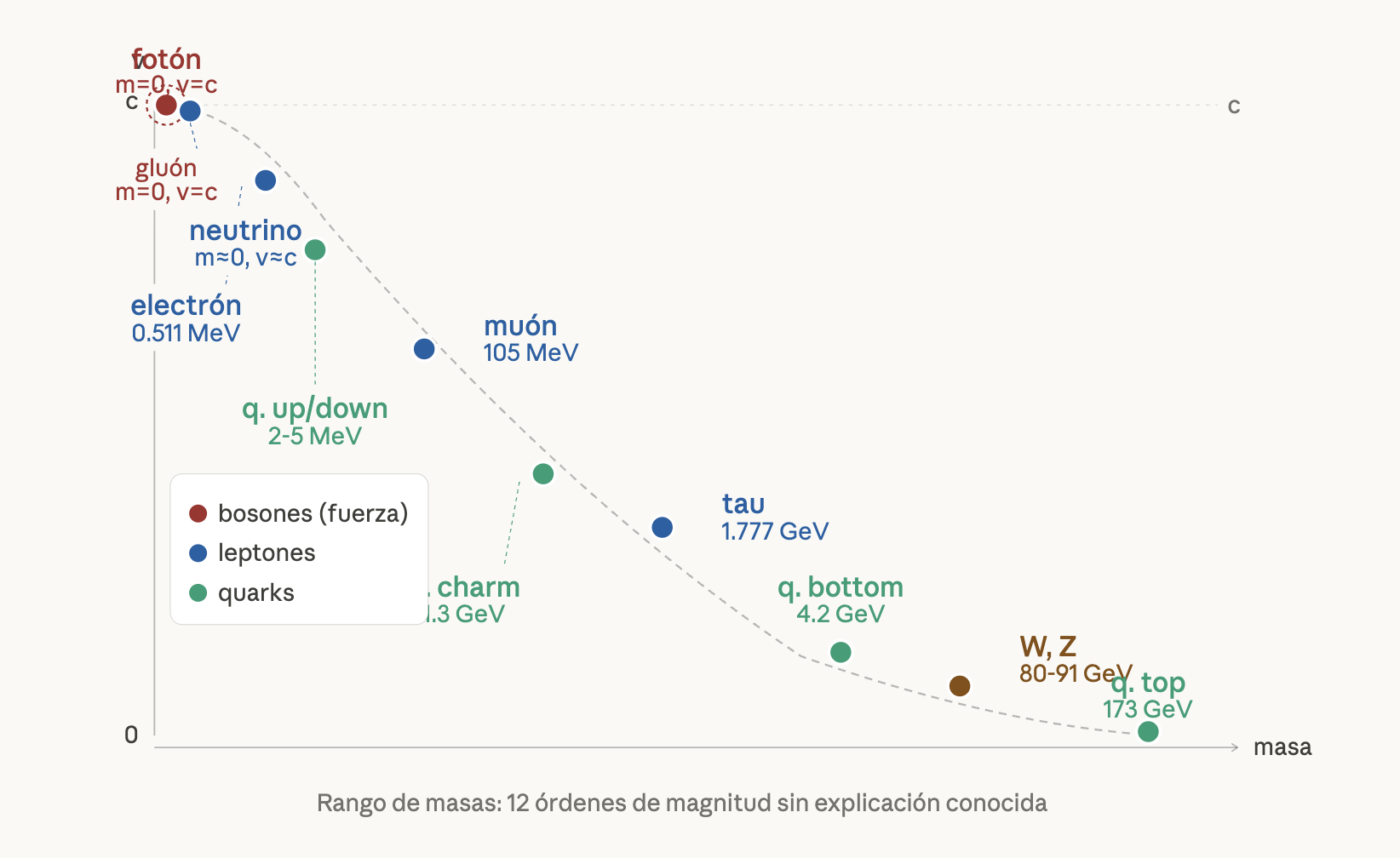
The same can be said of massive objects [components of atoms (protons, neutrons—electrons are already elementary particles—), atoms, molecules, stones, people, planets, or stars…]; they have a displacement (or vibration, if you prefer) in both space and time. This temporal vibration is precisely a consequence of their mass. In a way, mass creates time.
3. Mass and Elementary Particles
Let us return to what we saw in Section 1: near gravitational fields, time runs slower. A second in the vicinity of a star with enormous mass can be a minute or a year compared to a second millions of kilometers away from that star. Mass causes time in its environment to slow down. At the same time, it is mass that causes particles to move through time. If I may use a metaphor: a particle with mass is like a ball that you submerge in a liquid. By Archimedes’ principle, the ball will tend to rise within the liquid; the massive particle will tend to move toward the future in time.
Now then, why does this thrust occur, and, at the same time, why does time pass more slowly in the vicinity of a gravitational field? It is tempting to speculate that it is for a reason similar to what explains the thrust in Archimedes’ principle. Let’s see.
As has been reiterated, in the vicinity of a gravitational field, time passes more slowly. This is evident even in the path of light. Light always travels at speed c; but near a gravitational field, because time passes slower, from the perspective of an external observer, the light will appear to be going slower. This is what is known as the Shapiro delay. In a way, it is as if spacetime were «denser» in the vicinity of a gravitational field. But where does this higher density come from?
Obviously, this is purely speculative; but could it be that massive particles are «holes» in spacetime? A kind of bubble that travels as a vibration through space (photons) and through both space and time (massive particles). Seen from this perspective, it would explain why particles are «elementary.» It does not depend on them being very small, but on the fact that, being an anomaly in the structure of spacetime, their interior is, in a literal sense, nothingness. There is no possibility of division because it does not, and cannot, have any internal structure. From there, the higher density in the vicinity of a gravitational mass could be understood either as spacetime’s attempt to fill the hole or as a result of the spacetime that has been «displaced» from the particle; or perhaps a combination of both. In any case, this higher density—which manifests as the slowing of time—would be linked to the presence of massive particles and objects.
Current physics explains elementary particles as excitations of a field. What a field actually is remains unexplained by theoretical physics, but it is a necessity to account for how particles function. And each elementary particle has its own field; that is, we currently have to imagine seventeen different fields «inhabiting» spacetime, which is the framework in which they all reside. If we understand particles as holes moving through spacetime, these fields are no longer necessary. The difference between one particle and another would simply derive from the shape that the spacetime hole takes for each of them. In the case of the photon, for example, we would be looking at a purely spatial hole, without a temporal dimension, which would explain its behavior (displacement at c in space and no vibration in time).
4. Black Holes
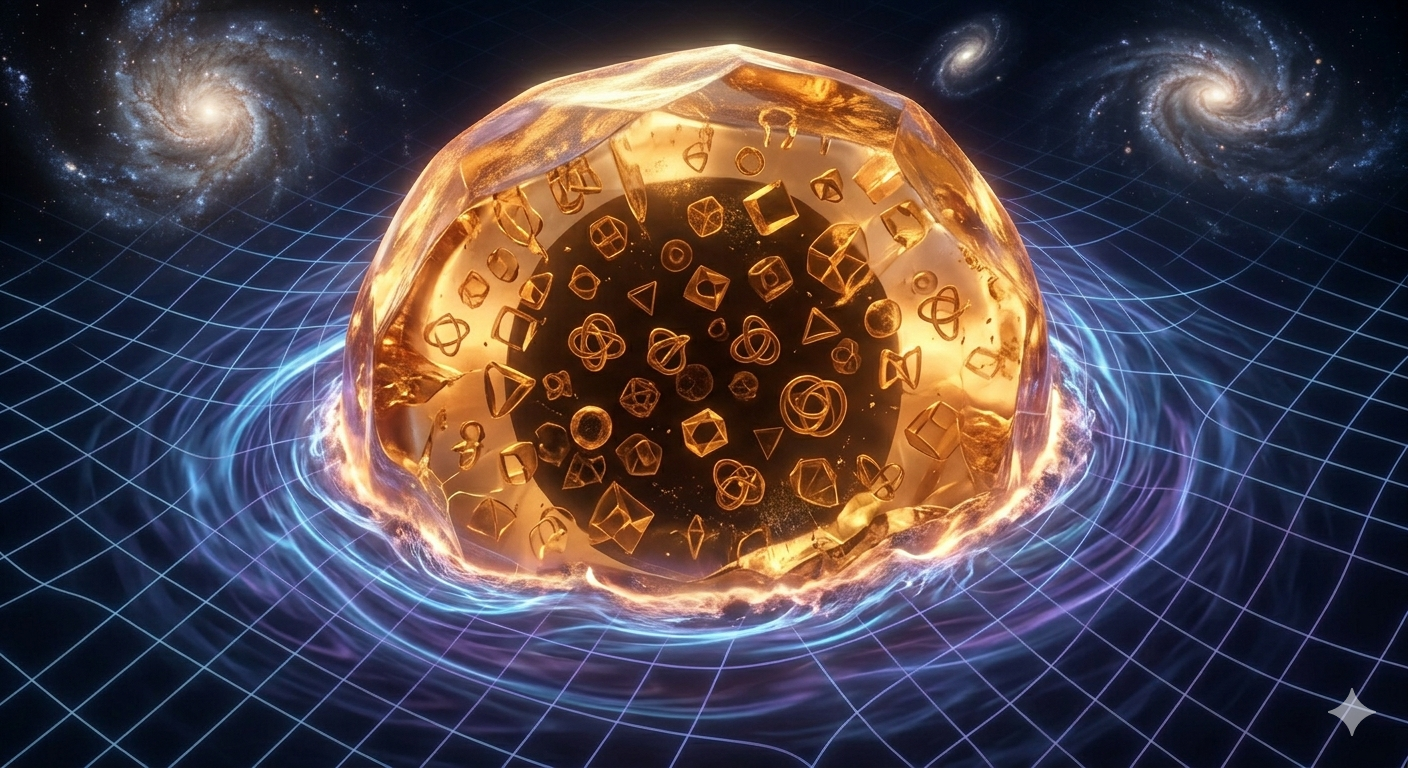
From the perspective of particles as holes in a spacetime with varying «densities» (identified by time dilation), black holes can be understood as regions where the density has become so high that it has somehow «crystallized.» Beyond the event horizon, there would be a spacetime so dense—that is, with such extreme time dilation—that movement would be impossible. The exterior of this «solid» part would rub against the fluid spacetime surrounding it, giving rise to phenomena such as Hawking radiation.
This would explain the relatively low density observed in known black holes. Curiously, these supermassive black holes have a density equivalent to that of water; but from this perspective, it is not surprising: density measures the distribution of mass in space, but what characterizes a black hole is the «density» of spacetime itself. If a point of rigidity is reached that prevents the movement of particles, they will be unable to move, even if they are separated from one another. They would be like mosquitos trapped in spacetime amber.
5. Conclusion
What I explained in Sections 1 and 2 is entirely orthodox and corresponds—as far as I know—to the postulates of General and Special Relativity; although I am fond of the simplification that allows us to understand gravity as an imperative requirement of the rule by which an object follows the shortest path in spacetime between two points—which, in the vicinity of a gravitational field, implies moving toward the center of said field. The need to compensate in time for the displacement of objects moving through space is a fundamental finding of Special Relativity. The «temporal vibration» of matter is also a postulate supported by standard physics, although, as far as I am aware, it has not yet been empirically directly proven.
It is, however, purely speculative to maintain that elementary particles are holes in spacetime. Nevertheless, I appreciate the simplicity with which this idea would explain the elementary nature of particles, the time dilation near gravitational fields, and the low density of black holes.
 Rafael Arenas Garcia